

334
W. Pfleging et al.
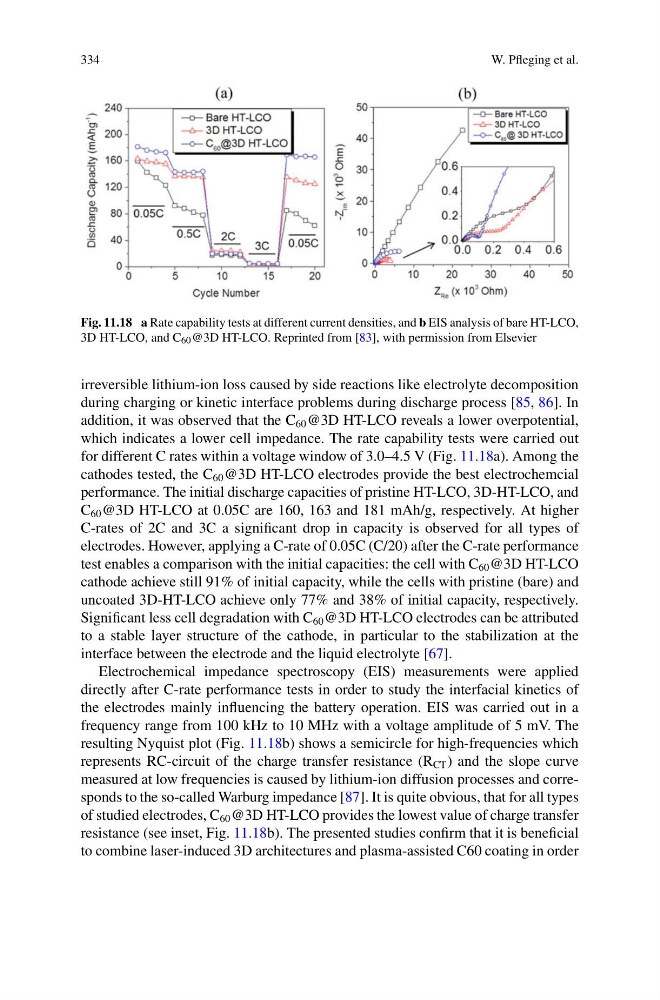
Fig. 11.18 a Rate capability tests at different current densities, and b EIS analysis of bare HT-LCO,
3D HT-LCO, and C 60 @3D HT-LCO. Reprinted from [83], with permission from Elsevier
irreversible lithium-ion loss caused by side reactions like electrolyte decomposition
during charging or kinetic interface problems during discharge process [85, 86]. In
addition, it was observed that the C 60 @3D HT-LCO reveals a lower overpotential,
which indicates a lower cell impedance. The rate capability tests were carried out
for different C rates within a voltage window of 3.0–4.5 V (Fig. 11.18a). Among the
cathodes tested, the C 60 @3D HT-LCO electrodes provide the best electrochemcial
performance. The initial discharge capacities of pristine HT-LCO, 3D-HT-LCO, and
C 60 @3D HT-LCO at 0.05C are 160, 163 and 181 mAh/g, respectively. At higher
C-rates of 2C and 3C a significant drop in capacity is observed for all types of
electrodes. However, applying a C-rate of 0.05C (C/20) after the C-rate performance
test enables a comparison with the initial capacities: the cell with C 60 @3D HT-LCO
cathode achieve still 91% of initial capacity, while the cells with pristine (bare) and
uncoated 3D-HT-LCO achieve only 77% and 38% of initial capacity, respectively.
Significant less cell degradation with C 60 @3D HT-LCO electrodes can be attributed
to a stable layer structure of the cathode, in particular to the stabilization at the
interface between the electrode and the liquid electrolyte [67].
Electrochemical impedance spectroscopy (EIS) measurements were applied
directly after C-rate performance tests in order to study the interfacial kinetics of
the electrodes mainly influencing the battery operation. EIS was carried out in a
frequency range from 100 kHz to 10 MHz with a voltage amplitude of 5 mV. The
resulting Nyquist plot (Fig. 11.18b) shows a semicircle for high-frequencies which
represents RC-circuit of the charge transfer resistance (R CT ) and the slope curve
measured at low frequencies is caused by lithium-ion diffusion processes and corresponds to the so-called Warburg impedance [87]. It is quite obvious, that for all types
of studied electrodes, C 60 @3D HT-LCO provides the lowest value of charge transfer
resistance (see inset, Fig. 11.18b). The presented studies confirm that it is beneficial
to combine laser-induced 3D architectures and plasma-assisted C60 coating in order
W. Pfleging et al.
Fig. 11.18 a Rate capability tests at different current densities, and b EIS analysis of bare HT-LCO,
3D HT-LCO, and C 60 @3D HT-LCO. Reprinted from [83], with permission from Elsevier
irreversible lithium-ion loss caused by side reactions like electrolyte decomposition
during charging or kinetic interface problems during discharge process [85, 86]. In
addition, it was observed that the C 60 @3D HT-LCO reveals a lower overpotential,
which indicates a lower cell impedance. The rate capability tests were carried out
for different C rates within a voltage window of 3.0–4.5 V (Fig. 11.18a). Among the
cathodes tested, the C 60 @3D HT-LCO electrodes provide the best electrochemcial
performance. The initial discharge capacities of pristine HT-LCO, 3D-HT-LCO, and
C 60 @3D HT-LCO at 0.05C are 160, 163 and 181 mAh/g, respectively. At higher
C-rates of 2C and 3C a significant drop in capacity is observed for all types of
electrodes. However, applying a C-rate of 0.05C (C/20) after the C-rate performance
test enables a comparison with the initial capacities: the cell with C 60 @3D HT-LCO
cathode achieve still 91% of initial capacity, while the cells with pristine (bare) and
uncoated 3D-HT-LCO achieve only 77% and 38% of initial capacity, respectively.
Significant less cell degradation with C 60 @3D HT-LCO electrodes can be attributed
to a stable layer structure of the cathode, in particular to the stabilization at the
interface between the electrode and the liquid electrolyte [67].
Electrochemical impedance spectroscopy (EIS) measurements were applied
directly after C-rate performance tests in order to study the interfacial kinetics of
the electrodes mainly influencing the battery operation. EIS was carried out in a
frequency range from 100 kHz to 10 MHz with a voltage amplitude of 5 mV. The
resulting Nyquist plot (Fig. 11.18b) shows a semicircle for high-frequencies which
represents RC-circuit of the charge transfer resistance (R CT ) and the slope curve
measured at low frequencies is caused by lithium-ion diffusion processes and corresponds to the so-called Warburg impedance [87]. It is quite obvious, that for all types
of studied electrodes, C 60 @3D HT-LCO provides the lowest value of charge transfer
resistance (see inset, Fig. 11.18b). The presented studies confirm that it is beneficial
to combine laser-induced 3D architectures and plasma-assisted C60 coating in order