

328
W. Pfleging et al.
potential behavior at this point clearly indicates a different diffusion-rate yielding to
a four times higher diffusion coefficient.
In order compare the influence of each specific cell design characteristics, the
voltage loss E i was determined. Immediately after the current was interrupted,
we measured a steep drop in voltage. This instantaneous drop is mainly due to
the ohmic resistance of the cell (ohmic drop), to which is added a contribution of
the polarization effects. Since the ohmic drop is a very fast process, it could not
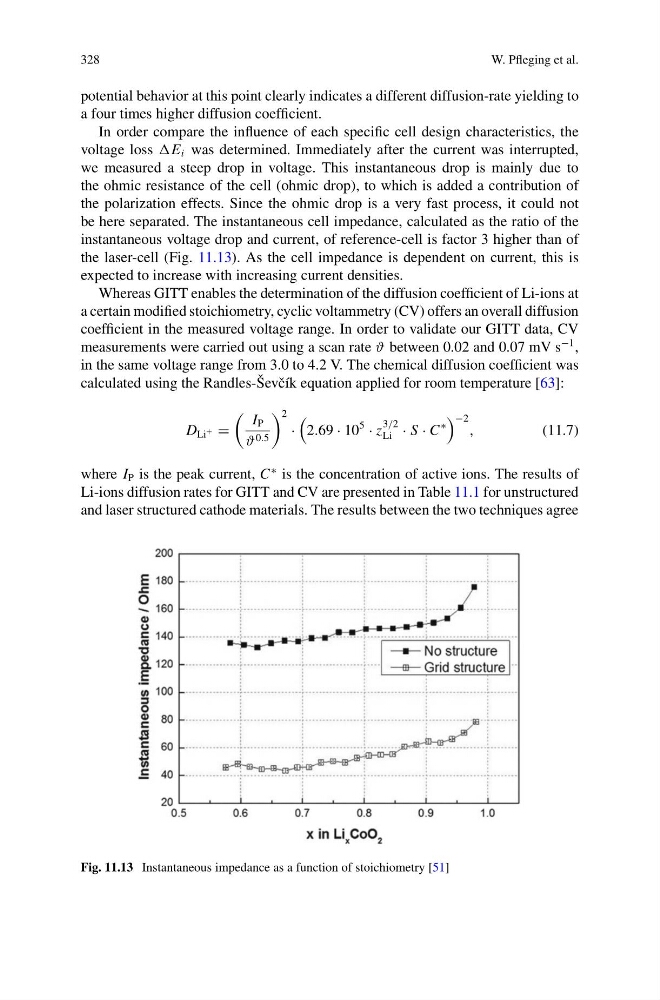
be here separated. The instantaneous cell impedance, calculated as the ratio of the
instantaneous voltage drop and current, of reference-cell is factor 3 higher than of
the laser-cell (Fig. 11.13). As the cell impedance is dependent on current, this is
expected to increase with increasing current densities.
Whereas GITT enables the determination of the diffusion coefficient of Li-ions at
a certain modified stoichiometry, cyclic voltammetry (CV) offers an overall diffusion
coefficient in the measured voltage range. In order to validate our GITT data, CV
measurements were carried out using a scan rate ϑ between 0.02 and 0.07 mV s
−1 ,
in the same voltage range from 3.0 to 4.2 V. The chemical diffusion coefficient was
calculated using the Randles-Ševˇ cík equation applied for room temperature [63]:
D Li
+ =
I P
ϑ 0.5
2
·
2.69 · 10
5
· z
3/2
Li · S · C
∗
−2 ,
(11.7)
where I P is the peak current, C
∗ is the concentration of active ions. The results of
Li-ions diffusion rates for GITT and CV are presented in Table 11.1 for unstructured
and laser structured cathode materials. The results between the two techniques agree
Fig. 11.13 Instantaneous impedance as a function of stoichiometry [51]
W. Pfleging et al.
potential behavior at this point clearly indicates a different diffusion-rate yielding to
a four times higher diffusion coefficient.
In order compare the influence of each specific cell design characteristics, the
voltage loss E i was determined. Immediately after the current was interrupted,
we measured a steep drop in voltage. This instantaneous drop is mainly due to
the ohmic resistance of the cell (ohmic drop), to which is added a contribution of
the polarization effects. Since the ohmic drop is a very fast process, it could not
be here separated. The instantaneous cell impedance, calculated as the ratio of the
instantaneous voltage drop and current, of reference-cell is factor 3 higher than of
the laser-cell (Fig. 11.13). As the cell impedance is dependent on current, this is
expected to increase with increasing current densities.
Whereas GITT enables the determination of the diffusion coefficient of Li-ions at
a certain modified stoichiometry, cyclic voltammetry (CV) offers an overall diffusion
coefficient in the measured voltage range. In order to validate our GITT data, CV
measurements were carried out using a scan rate ϑ between 0.02 and 0.07 mV s
−1 ,
in the same voltage range from 3.0 to 4.2 V. The chemical diffusion coefficient was
calculated using the Randles-Ševˇ cík equation applied for room temperature [63]:
D Li
+ =
I P
ϑ 0.5
2
·
2.69 · 10
5
· z
3/2
Li · S · C
∗
−2 ,
(11.7)
where I P is the peak current, C
∗ is the concentration of active ions. The results of
Li-ions diffusion rates for GITT and CV are presented in Table 11.1 for unstructured
and laser structured cathode materials. The results between the two techniques agree
Fig. 11.13 Instantaneous impedance as a function of stoichiometry [51]