

11 Lithium-Ion Battery—3D Micro-/Nano-Structuring, Modification …
323
charging and discharging rates. For a better understanding of electrochemical intercalation/deintercalation processes in laser modified electrodes, quantitative experiments of lithiation/delithiation rates were considered. The simplest quantitative
approach to determine the rate of effective Li-ion insertion in the active material
and the rate of Li-ion transport in the electrolyte is expressed by so-called chemical
diffusion coefficient values. For this purpose, one of the most common coulometric
titration techniques, the galvanostatic intermittent titration technique (GITT) has
been involved.
The focus is set on composite thick film commercial cathode materials (MTI
Corporation, USA) based on current collector layer represented by the aluminum
foil single side coated by a composite layer, with determined properties as described
previously [53]. Such cathode materials are produced by a tape cast process, followed
by calendering (final thickness of composite layer of 95 μm), during which the
particle–particle contact and the composite adhesion to the current collector are
substantially improved. The composite layer contains binder, conductive carbon,
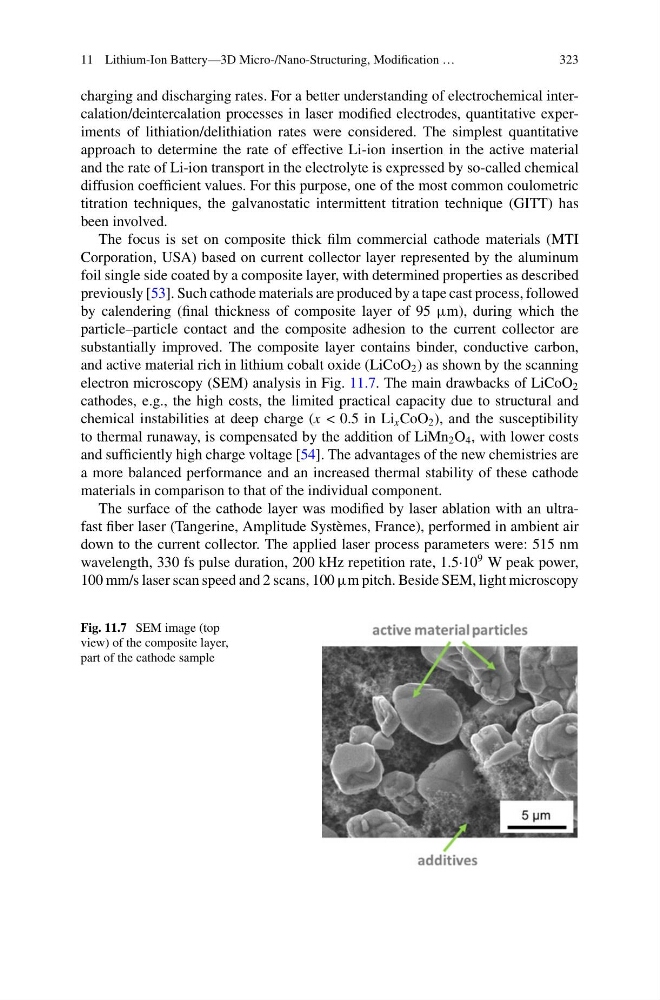
and active material rich in lithium cobalt oxide (LiCoO 2 ) as shown by the scanning
electron microscopy (SEM) analysis in Fig. 11.7. The main drawbacks of LiCoO 2
cathodes, e.g., the high costs, the limited practical capacity due to structural and
chemical instabilities at deep charge (x < 0.5 in Li x CoO 2 ), and the susceptibility
to thermal runaway, is compensated by the addition of LiMn 2 O 4 , with lower costs
and sufficiently high charge voltage [54]. The advantages of the new chemistries are
a more balanced performance and an increased thermal stability of these cathode
materials in comparison to that of the individual component.
The surface of the cathode layer was modified by laser ablation with an ultrafast fiber laser (Tangerine, Amplitude Systèmes, France), performed in ambient air
down to the current collector. The applied laser process parameters were: 515 nm
wavelength, 330 fs pulse duration, 200 kHz repetition rate, 1.5·10
9 W peak power,
100 mm/s laser scan speed and 2 scans, 100 μm pitch. Beside SEM, light microscopy
Fig. 11.7 SEM image (top
view) of the composite layer,
part of the cathode sample
323
charging and discharging rates. For a better understanding of electrochemical intercalation/deintercalation processes in laser modified electrodes, quantitative experiments of lithiation/delithiation rates were considered. The simplest quantitative
approach to determine the rate of effective Li-ion insertion in the active material
and the rate of Li-ion transport in the electrolyte is expressed by so-called chemical
diffusion coefficient values. For this purpose, one of the most common coulometric
titration techniques, the galvanostatic intermittent titration technique (GITT) has
been involved.
The focus is set on composite thick film commercial cathode materials (MTI
Corporation, USA) based on current collector layer represented by the aluminum
foil single side coated by a composite layer, with determined properties as described
previously [53]. Such cathode materials are produced by a tape cast process, followed
by calendering (final thickness of composite layer of 95 μm), during which the
particle–particle contact and the composite adhesion to the current collector are
substantially improved. The composite layer contains binder, conductive carbon,
and active material rich in lithium cobalt oxide (LiCoO 2 ) as shown by the scanning
electron microscopy (SEM) analysis in Fig. 11.7. The main drawbacks of LiCoO 2
cathodes, e.g., the high costs, the limited practical capacity due to structural and
chemical instabilities at deep charge (x < 0.5 in Li x CoO 2 ), and the susceptibility
to thermal runaway, is compensated by the addition of LiMn 2 O 4 , with lower costs
and sufficiently high charge voltage [54]. The advantages of the new chemistries are
a more balanced performance and an increased thermal stability of these cathode
materials in comparison to that of the individual component.
The surface of the cathode layer was modified by laser ablation with an ultrafast fiber laser (Tangerine, Amplitude Systèmes, France), performed in ambient air
down to the current collector. The applied laser process parameters were: 515 nm
wavelength, 330 fs pulse duration, 200 kHz repetition rate, 1.5·10
9 W peak power,
100 mm/s laser scan speed and 2 scans, 100 μm pitch. Beside SEM, light microscopy
Fig. 11.7 SEM image (top
view) of the composite layer,
part of the cathode sample