

322
W. Pfleging et al.
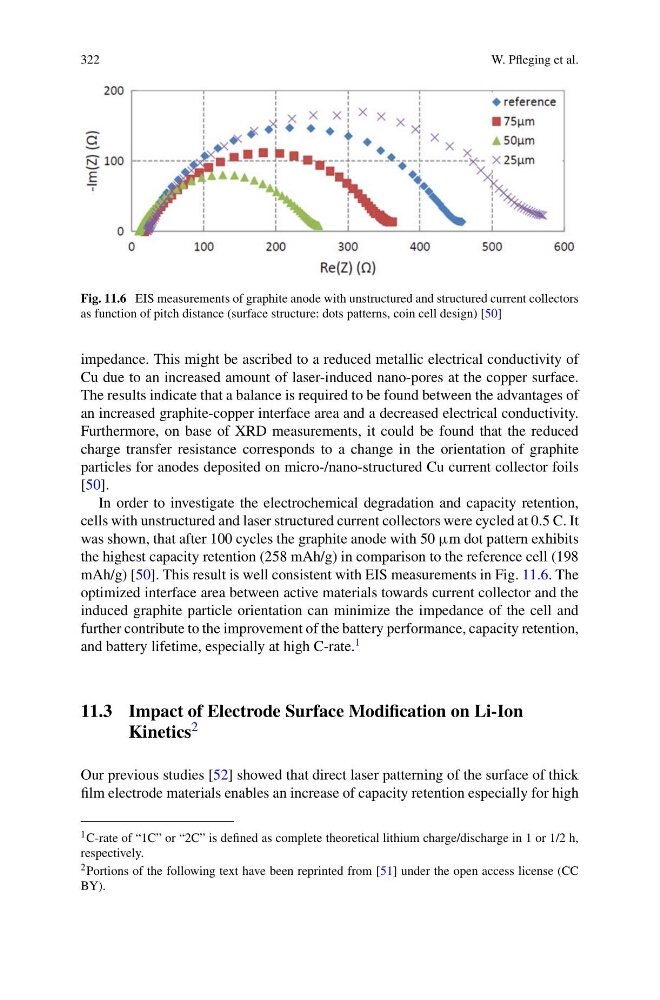
Fig. 11.6 EIS measurements of graphite anode with unstructured and structured current collectors
as function of pitch distance (surface structure: dots patterns, coin cell design) [50]
impedance. This might be ascribed to a reduced metallic electrical conductivity of
Cu due to an increased amount of laser-induced nano-pores at the copper surface.
The results indicate that a balance is required to be found between the advantages of
an increased graphite-copper interface area and a decreased electrical conductivity.
Furthermore, on base of XRD measurements, it could be found that the reduced
charge transfer resistance corresponds to a change in the orientation of graphite
particles for anodes deposited on micro-/nano-structured Cu current collector foils
[50].
In order to investigate the electrochemical degradation and capacity retention,
cells with unstructured and laser structured current collectors were cycled at 0.5 C. It
was shown, that after 100 cycles the graphite anode with 50 μm dot pattern exhibits
the highest capacity retention (258 mAh/g) in comparison to the reference cell (198
mAh/g) [50]. This result is well consistent with EIS measurements in Fig. 11.6. The
optimized interface area between active materials towards current collector and the
induced graphite particle orientation can minimize the impedance of the cell and
further contribute to the improvement of the battery performance, capacity retention,
and battery lifetime, especially at high C-rate.
1
11.3 Impact of Electrode Surface Modification on Li-Ion
Kinetics 2
Our previous studies [52] showed that direct laser patterning of the surface of thick
film electrode materials enables an increase of capacity retention especially for high
1 C-rate of “1C” or “2C” is defined as complete theoretical lithium charge/discharge in 1 or 1/2 h,
respectively.
2 Portions of the following text have been reprinted from [51] under the open access license (CC
BY).
W. Pfleging et al.
Fig. 11.6 EIS measurements of graphite anode with unstructured and structured current collectors
as function of pitch distance (surface structure: dots patterns, coin cell design) [50]
impedance. This might be ascribed to a reduced metallic electrical conductivity of
Cu due to an increased amount of laser-induced nano-pores at the copper surface.
The results indicate that a balance is required to be found between the advantages of
an increased graphite-copper interface area and a decreased electrical conductivity.
Furthermore, on base of XRD measurements, it could be found that the reduced
charge transfer resistance corresponds to a change in the orientation of graphite
particles for anodes deposited on micro-/nano-structured Cu current collector foils
[50].
In order to investigate the electrochemical degradation and capacity retention,
cells with unstructured and laser structured current collectors were cycled at 0.5 C. It
was shown, that after 100 cycles the graphite anode with 50 μm dot pattern exhibits
the highest capacity retention (258 mAh/g) in comparison to the reference cell (198
mAh/g) [50]. This result is well consistent with EIS measurements in Fig. 11.6. The
optimized interface area between active materials towards current collector and the
induced graphite particle orientation can minimize the impedance of the cell and
further contribute to the improvement of the battery performance, capacity retention,
and battery lifetime, especially at high C-rate.
1
11.3 Impact of Electrode Surface Modification on Li-Ion
Kinetics 2
Our previous studies [52] showed that direct laser patterning of the surface of thick
film electrode materials enables an increase of capacity retention especially for high
1 C-rate of “1C” or “2C” is defined as complete theoretical lithium charge/discharge in 1 or 1/2 h,
respectively.
2 Portions of the following text have been reprinted from [51] under the open access license (CC
BY).