

294
S. Papazoglou and I. Zergioti
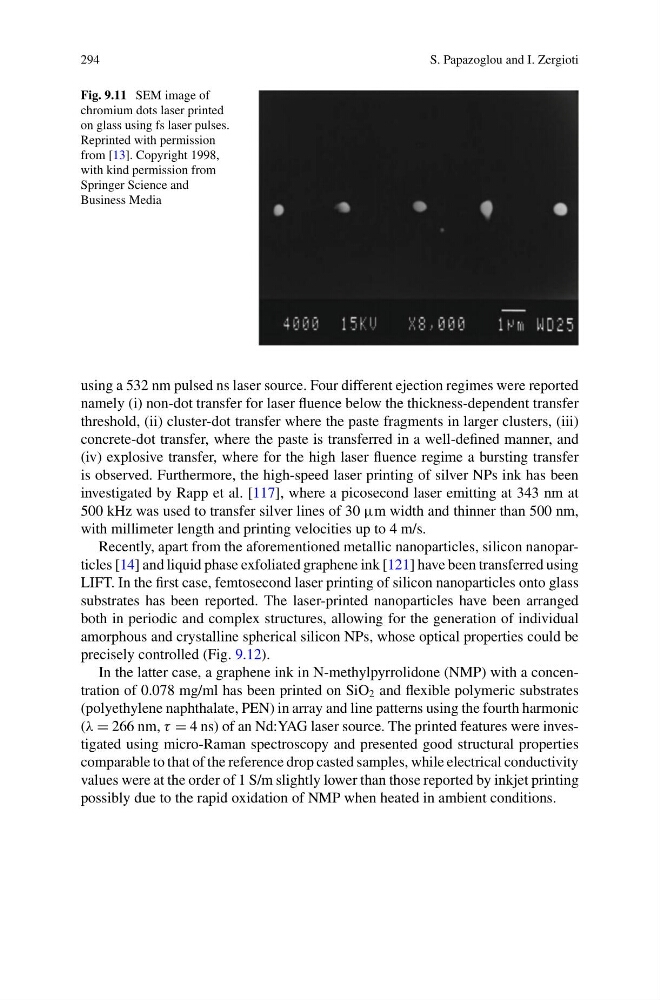
Fig. 9.11 SEM image of
chromium dots laser printed
on glass using fs laser pulses.
Reprinted with permission
from [13]. Copyright 1998,
with kind permission from
Springer Science and
Business Media
using a 532 nm pulsed ns laser source. Four different ejection regimes were reported
namely (i) non-dot transfer for laser fluence below the thickness-dependent transfer
threshold, (ii) cluster-dot transfer where the paste fragments in larger clusters, (iii)
concrete-dot transfer, where the paste is transferred in a well-defined manner, and
(iv) explosive transfer, where for the high laser fluence regime a bursting transfer
is observed. Furthermore, the high-speed laser printing of silver NPs ink has been
investigated by Rapp et al. [117], where a picosecond laser emitting at 343 nm at
500 kHz was used to transfer silver lines of 30 µm width and thinner than 500 nm,
with millimeter length and printing velocities up to 4 m/s.
Recently, apart from the aforementioned metallic nanoparticles, silicon nanoparticles [14] and liquid phase exfoliated graphene ink [121] have been transferred using
LIFT. In the first case, femtosecond laser printing of silicon nanoparticles onto glass
substrates has been reported. The laser-printed nanoparticles have been arranged
both in periodic and complex structures, allowing for the generation of individual
amorphous and crystalline spherical silicon NPs, whose optical properties could be
precisely controlled (Fig. 9.12).
In the latter case, a graphene ink in N-methylpyrrolidone (NMP) with a concentration of 0.078 mg/ml has been printed on SiO 2 and flexible polymeric substrates
(polyethylene naphthalate, PEN) in array and line patterns using the fourth harmonic
(λ = 266 nm, τ = 4 ns) of an Nd:YAG laser source. The printed features were investigated using micro-Raman spectroscopy and presented good structural properties
comparable to that of the reference drop casted samples, while electrical conductivity
values were at the order of 1 S/m slightly lower than those reported by inkjet printing
possibly due to the rapid oxidation of NMP when heated in ambient conditions.
S. Papazoglou and I. Zergioti
Fig. 9.11 SEM image of
chromium dots laser printed
on glass using fs laser pulses.
Reprinted with permission
from [13]. Copyright 1998,
with kind permission from
Springer Science and
Business Media
using a 532 nm pulsed ns laser source. Four different ejection regimes were reported
namely (i) non-dot transfer for laser fluence below the thickness-dependent transfer
threshold, (ii) cluster-dot transfer where the paste fragments in larger clusters, (iii)
concrete-dot transfer, where the paste is transferred in a well-defined manner, and
(iv) explosive transfer, where for the high laser fluence regime a bursting transfer
is observed. Furthermore, the high-speed laser printing of silver NPs ink has been
investigated by Rapp et al. [117], where a picosecond laser emitting at 343 nm at
500 kHz was used to transfer silver lines of 30 µm width and thinner than 500 nm,
with millimeter length and printing velocities up to 4 m/s.
Recently, apart from the aforementioned metallic nanoparticles, silicon nanoparticles [14] and liquid phase exfoliated graphene ink [121] have been transferred using
LIFT. In the first case, femtosecond laser printing of silicon nanoparticles onto glass
substrates has been reported. The laser-printed nanoparticles have been arranged
both in periodic and complex structures, allowing for the generation of individual
amorphous and crystalline spherical silicon NPs, whose optical properties could be
precisely controlled (Fig. 9.12).
In the latter case, a graphene ink in N-methylpyrrolidone (NMP) with a concentration of 0.078 mg/ml has been printed on SiO 2 and flexible polymeric substrates
(polyethylene naphthalate, PEN) in array and line patterns using the fourth harmonic
(λ = 266 nm, τ = 4 ns) of an Nd:YAG laser source. The printed features were investigated using micro-Raman spectroscopy and presented good structural properties
comparable to that of the reference drop casted samples, while electrical conductivity
values were at the order of 1 S/m slightly lower than those reported by inkjet printing
possibly due to the rapid oxidation of NMP when heated in ambient conditions.