

9 Laser-Induced Forward Transfer Towards Additive Manufacturing
293
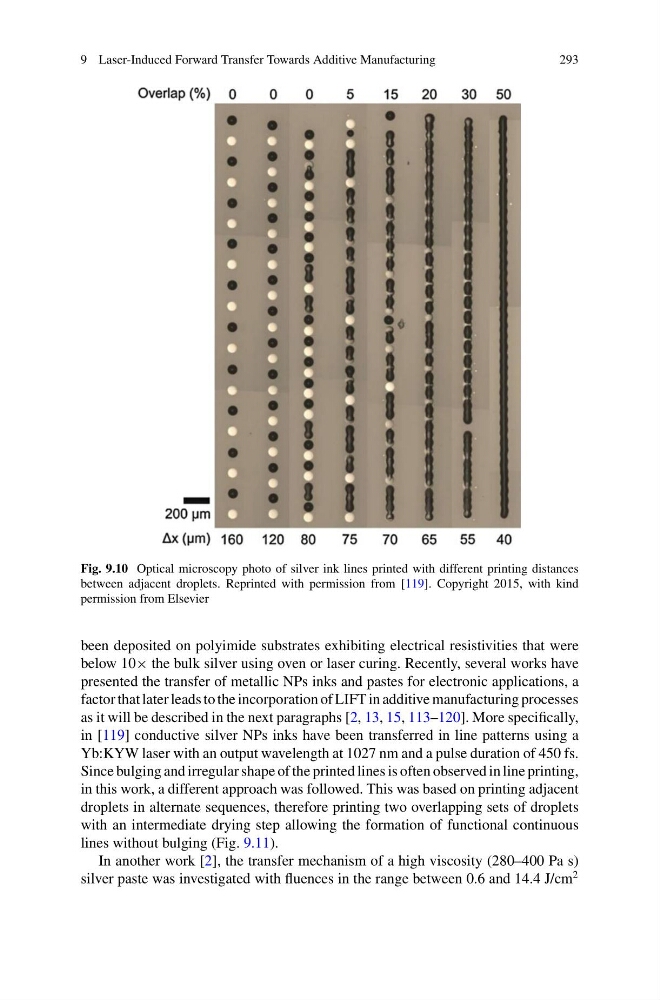
Fig. 9.10 Optical microscopy photo of silver ink lines printed with different printing distances
between adjacent droplets. Reprinted with permission from [119]. Copyright 2015, with kind
permission from Elsevier
been deposited on polyimide substrates exhibiting electrical resistivities that were
below 10× the bulk silver using oven or laser curing. Recently, several works have
presented the transfer of metallic NPs inks and pastes for electronic applications, a
factor that later leads to the incorporation of LIFT in additive manufacturing processes
as it will be described in the next paragraphs [2, 13, 15, 113–120]. More specifically,
in [119] conductive silver NPs inks have been transferred in line patterns using a
Yb:KYW laser with an output wavelength at 1027 nm and a pulse duration of 450 fs.
Since bulging and irregular shape of the printed lines is often observed in line printing,
in this work, a different approach was followed. This was based on printing adjacent
droplets in alternate sequences, therefore printing two overlapping sets of droplets
with an intermediate drying step allowing the formation of functional continuous
lines without bulging (Fig. 9.11).
In another work [2], the transfer mechanism of a high viscosity (280–400 Pa s)
silver paste was investigated with fluences in the range between 0.6 and 14.4 J/cm
2
293
Fig. 9.10 Optical microscopy photo of silver ink lines printed with different printing distances
between adjacent droplets. Reprinted with permission from [119]. Copyright 2015, with kind
permission from Elsevier
been deposited on polyimide substrates exhibiting electrical resistivities that were
below 10× the bulk silver using oven or laser curing. Recently, several works have
presented the transfer of metallic NPs inks and pastes for electronic applications, a
factor that later leads to the incorporation of LIFT in additive manufacturing processes
as it will be described in the next paragraphs [2, 13, 15, 113–120]. More specifically,
in [119] conductive silver NPs inks have been transferred in line patterns using a
Yb:KYW laser with an output wavelength at 1027 nm and a pulse duration of 450 fs.
Since bulging and irregular shape of the printed lines is often observed in line printing,
in this work, a different approach was followed. This was based on printing adjacent
droplets in alternate sequences, therefore printing two overlapping sets of droplets
with an intermediate drying step allowing the formation of functional continuous
lines without bulging (Fig. 9.11).
In another work [2], the transfer mechanism of a high viscosity (280–400 Pa s)
silver paste was investigated with fluences in the range between 0.6 and 14.4 J/cm
2