

292
S. Papazoglou and I. Zergioti
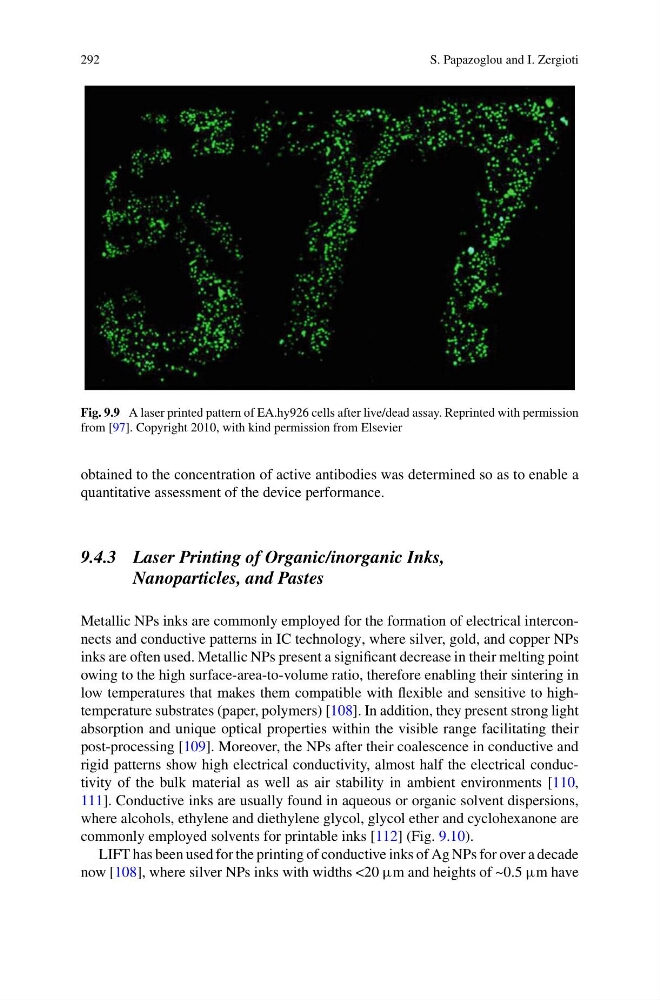
Fig. 9.9 A laser printed pattern of EA.hy926 cells after live/dead assay. Reprinted with permission
from [97]. Copyright 2010, with kind permission from Elsevier
obtained to the concentration of active antibodies was determined so as to enable a
quantitative assessment of the device performance.
9.4.3 Laser Printing of Organic/inorganic Inks,
Nanoparticles, and Pastes
Metallic NPs inks are commonly employed for the formation of electrical interconnects and conductive patterns in IC technology, where silver, gold, and copper NPs
inks are often used. Metallic NPs present a significant decrease in their melting point
owing to the high surface-area-to-volume ratio, therefore enabling their sintering in
low temperatures that makes them compatible with flexible and sensitive to hightemperature substrates (paper, polymers) [108]. In addition, they present strong light
absorption and unique optical properties within the visible range facilitating their
post-processing [109]. Moreover, the NPs after their coalescence in conductive and
rigid patterns show high electrical conductivity, almost half the electrical conductivity of the bulk material as well as air stability in ambient environments [110,
111]. Conductive inks are usually found in aqueous or organic solvent dispersions,
where alcohols, ethylene and diethylene glycol, glycol ether and cyclohexanone are
commonly employed solvents for printable inks [112] (Fig. 9.10).
LIFT has been used for the printing of conductive inks of Ag NPs for over a decade
now [108], where silver NPs inks with widths <20 µm and heights of ~0.5 µm have
S. Papazoglou and I. Zergioti
Fig. 9.9 A laser printed pattern of EA.hy926 cells after live/dead assay. Reprinted with permission
from [97]. Copyright 2010, with kind permission from Elsevier
obtained to the concentration of active antibodies was determined so as to enable a
quantitative assessment of the device performance.
9.4.3 Laser Printing of Organic/inorganic Inks,
Nanoparticles, and Pastes
Metallic NPs inks are commonly employed for the formation of electrical interconnects and conductive patterns in IC technology, where silver, gold, and copper NPs
inks are often used. Metallic NPs present a significant decrease in their melting point
owing to the high surface-area-to-volume ratio, therefore enabling their sintering in
low temperatures that makes them compatible with flexible and sensitive to hightemperature substrates (paper, polymers) [108]. In addition, they present strong light
absorption and unique optical properties within the visible range facilitating their
post-processing [109]. Moreover, the NPs after their coalescence in conductive and
rigid patterns show high electrical conductivity, almost half the electrical conductivity of the bulk material as well as air stability in ambient environments [110,
111]. Conductive inks are usually found in aqueous or organic solvent dispersions,
where alcohols, ethylene and diethylene glycol, glycol ether and cyclohexanone are
commonly employed solvents for printable inks [112] (Fig. 9.10).
LIFT has been used for the printing of conductive inks of Ag NPs for over a decade
now [108], where silver NPs inks with widths <20 µm and heights of ~0.5 µm have