

286
S. Papazoglou and I. Zergioti
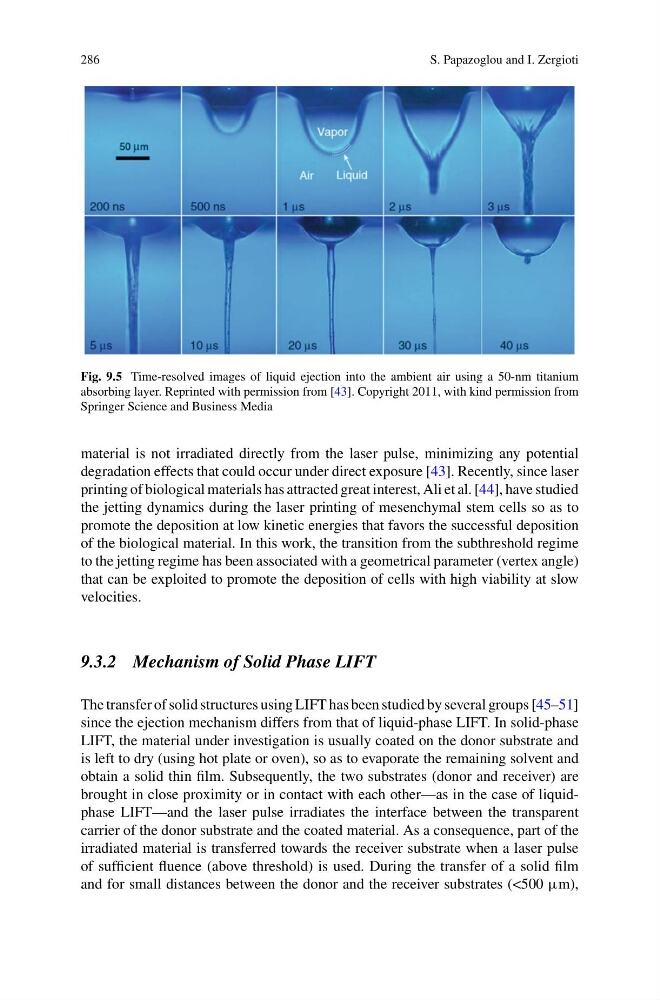
Fig. 9.5 Time-resolved images of liquid ejection into the ambient air using a 50-nm titanium
absorbing layer. Reprinted with permission from [43]. Copyright 2011, with kind permission from
Springer Science and Business Media
material is not irradiated directly from the laser pulse, minimizing any potential
degradation effects that could occur under direct exposure [43]. Recently, since laser
printing of biological materials has attracted great interest, Ali et al. [44], have studied
the jetting dynamics during the laser printing of mesenchymal stem cells so as to
promote the deposition at low kinetic energies that favors the successful deposition
of the biological material. In this work, the transition from the subthreshold regime
to the jetting regime has been associated with a geometrical parameter (vertex angle)
that can be exploited to promote the deposition of cells with high viability at slow
velocities.
9.3.2 Mechanism of Solid Phase LIFT
The transfer of solid structures using LIFT has been studied by several groups [45–51]
since the ejection mechanism differs from that of liquid-phase LIFT. In solid-phase
LIFT, the material under investigation is usually coated on the donor substrate and
is left to dry (using hot plate or oven), so as to evaporate the remaining solvent and
obtain a solid thin film. Subsequently, the two substrates (donor and receiver) are
brought in close proximity or in contact with each other—as in the case of liquidphase LIFT—and the laser pulse irradiates the interface between the transparent
carrier of the donor substrate and the coated material. As a consequence, part of the
irradiated material is transferred towards the receiver substrate when a laser pulse
of sufficient fluence (above threshold) is used. During the transfer of a solid film
and for small distances between the donor and the receiver substrates (<500 µm),
S. Papazoglou and I. Zergioti
Fig. 9.5 Time-resolved images of liquid ejection into the ambient air using a 50-nm titanium
absorbing layer. Reprinted with permission from [43]. Copyright 2011, with kind permission from
Springer Science and Business Media
material is not irradiated directly from the laser pulse, minimizing any potential
degradation effects that could occur under direct exposure [43]. Recently, since laser
printing of biological materials has attracted great interest, Ali et al. [44], have studied
the jetting dynamics during the laser printing of mesenchymal stem cells so as to
promote the deposition at low kinetic energies that favors the successful deposition
of the biological material. In this work, the transition from the subthreshold regime
to the jetting regime has been associated with a geometrical parameter (vertex angle)
that can be exploited to promote the deposition of cells with high viability at slow
velocities.
9.3.2 Mechanism of Solid Phase LIFT
The transfer of solid structures using LIFT has been studied by several groups [45–51]
since the ejection mechanism differs from that of liquid-phase LIFT. In solid-phase
LIFT, the material under investigation is usually coated on the donor substrate and
is left to dry (using hot plate or oven), so as to evaporate the remaining solvent and
obtain a solid thin film. Subsequently, the two substrates (donor and receiver) are
brought in close proximity or in contact with each other—as in the case of liquidphase LIFT—and the laser pulse irradiates the interface between the transparent
carrier of the donor substrate and the coated material. As a consequence, part of the
irradiated material is transferred towards the receiver substrate when a laser pulse
of sufficient fluence (above threshold) is used. During the transfer of a solid film
and for small distances between the donor and the receiver substrates (<500 µm),