

9 Laser-Induced Forward Transfer Towards Additive Manufacturing
287
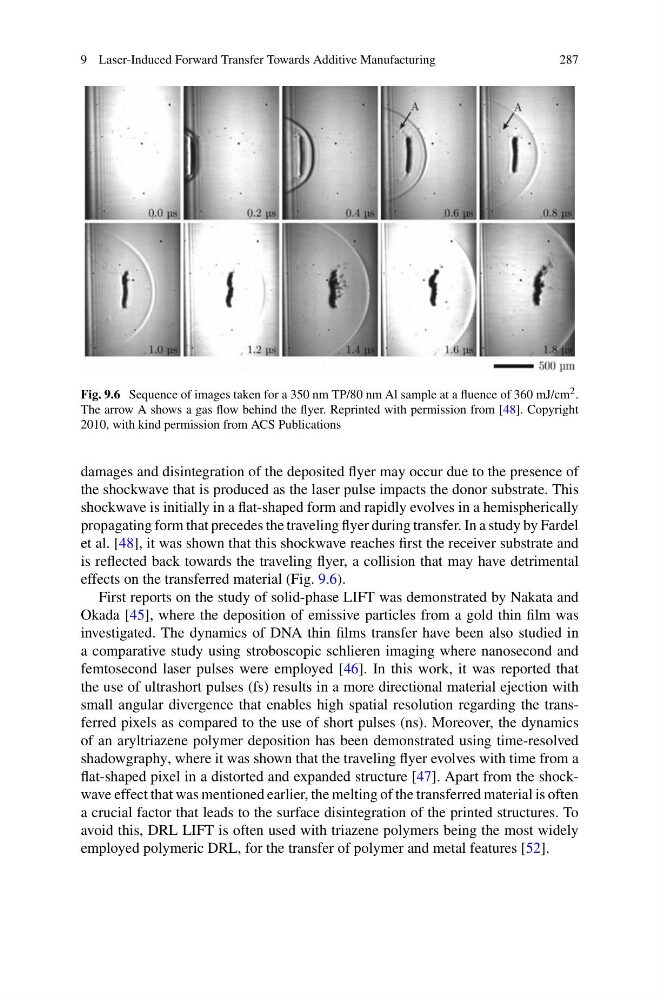
Fig. 9.6 Sequence of images taken for a 350 nm TP/80 nm Al sample at a fluence of 360 mJ/cm 2 .
The arrow A shows a gas flow behind the flyer. Reprinted with permission from [48]. Copyright
2010, with kind permission from ACS Publications
damages and disintegration of the deposited flyer may occur due to the presence of
the shockwave that is produced as the laser pulse impacts the donor substrate. This
shockwave is initially in a flat-shaped form and rapidly evolves in a hemispherically
propagating form that precedes the traveling flyer during transfer. In a study by Fardel
et al. [48], it was shown that this shockwave reaches first the receiver substrate and
is reflected back towards the traveling flyer, a collision that may have detrimental
effects on the transferred material (Fig. 9.6).
First reports on the study of solid-phase LIFT was demonstrated by Nakata and
Okada [45], where the deposition of emissive particles from a gold thin film was
investigated. The dynamics of DNA thin films transfer have been also studied in
a comparative study using stroboscopic schlieren imaging where nanosecond and
femtosecond laser pulses were employed [46]. In this work, it was reported that
the use of ultrashort pulses (fs) results in a more directional material ejection with
small angular divergence that enables high spatial resolution regarding the transferred pixels as compared to the use of short pulses (ns). Moreover, the dynamics
of an aryltriazene polymer deposition has been demonstrated using time-resolved
shadowgraphy, where it was shown that the traveling flyer evolves with time from a
flat-shaped pixel in a distorted and expanded structure [47]. Apart from the shockwave effect that was mentioned earlier, the melting of the transferred material is often
a crucial factor that leads to the surface disintegration of the printed structures. To
avoid this, DRL LIFT is often used with triazene polymers being the most widely
employed polymeric DRL, for the transfer of polymer and metal features [52].
287
Fig. 9.6 Sequence of images taken for a 350 nm TP/80 nm Al sample at a fluence of 360 mJ/cm 2 .
The arrow A shows a gas flow behind the flyer. Reprinted with permission from [48]. Copyright
2010, with kind permission from ACS Publications
damages and disintegration of the deposited flyer may occur due to the presence of
the shockwave that is produced as the laser pulse impacts the donor substrate. This
shockwave is initially in a flat-shaped form and rapidly evolves in a hemispherically
propagating form that precedes the traveling flyer during transfer. In a study by Fardel
et al. [48], it was shown that this shockwave reaches first the receiver substrate and
is reflected back towards the traveling flyer, a collision that may have detrimental
effects on the transferred material (Fig. 9.6).
First reports on the study of solid-phase LIFT was demonstrated by Nakata and
Okada [45], where the deposition of emissive particles from a gold thin film was
investigated. The dynamics of DNA thin films transfer have been also studied in
a comparative study using stroboscopic schlieren imaging where nanosecond and
femtosecond laser pulses were employed [46]. In this work, it was reported that
the use of ultrashort pulses (fs) results in a more directional material ejection with
small angular divergence that enables high spatial resolution regarding the transferred pixels as compared to the use of short pulses (ns). Moreover, the dynamics
of an aryltriazene polymer deposition has been demonstrated using time-resolved
shadowgraphy, where it was shown that the traveling flyer evolves with time from a
flat-shaped pixel in a distorted and expanded structure [47]. Apart from the shockwave effect that was mentioned earlier, the melting of the transferred material is often
a crucial factor that leads to the surface disintegration of the printed structures. To
avoid this, DRL LIFT is often used with triazene polymers being the most widely
employed polymeric DRL, for the transfer of polymer and metal features [52].