

9 Laser-Induced Forward Transfer Towards Additive Manufacturing
285
between the bubbles at the bottom of the jets occurs leading to a non-uniform droplet
deposition [38]. Adjacent laser pulse interaction has been also studied by another
group [39], where it was reported that the second jet shows the tendency to be tilted
towards or away from the first one, an effect that depends on the time delay between
the two pulses. At this point it is important to mention, that significant jet to jet
interactions are also observed at specific interbeam distances, a phenomenon that
is not observed in single beam LIFT and was reported by Patrascioiu et al. [40].
Time-resolved imaging of an alginate-based hydrogel laser printing using LIFT has
been also demonstrated [41], where two different laser fluences have been used (1.6
and 2.7 J/cm
2 ) with a gap between donor and receiver substrates of 450 µm. It was
shown, that the liquid jet widens in diameter at higher impact velocities while at
lower impact velocities caused a disk-lie spreading as well as a subsequent diameter
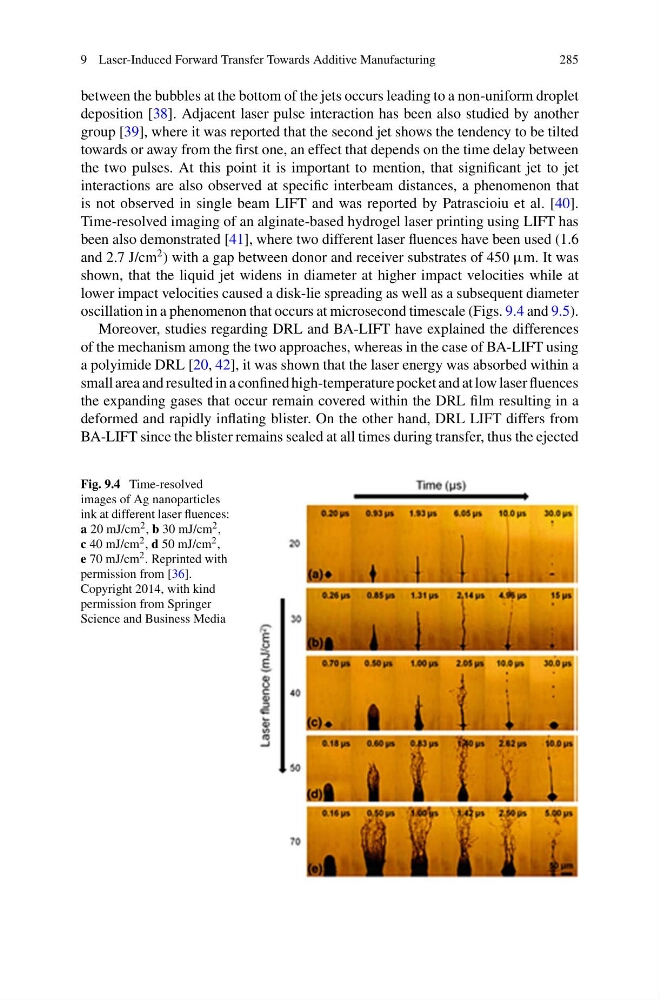
oscillation in a phenomenon that occurs at microsecond timescale (Figs. 9.4 and 9.5).
Moreover, studies regarding DRL and BA-LIFT have explained the differences
of the mechanism among the two approaches, whereas in the case of BA-LIFT using
a polyimide DRL [20, 42], it was shown that the laser energy was absorbed within a
small area and resulted in a confined high-temperature pocket and at low laser fluences
the expanding gases that occur remain covered within the DRL film resulting in a
deformed and rapidly inflating blister. On the other hand, DRL LIFT differs from
BA-LIFT since the blister remains sealed at all times during transfer, thus the ejected
Fig. 9.4 Time-resolved
images of Ag nanoparticles
ink at different laser fluences:
a 20 mJ/cm 2 , b 30 mJ/cm 2 ,
c 40 mJ/cm 2 , d 50 mJ/cm 2 ,
e 70 mJ/cm 2 . Reprinted with
permission from [36].
Copyright 2014, with kind
permission from Springer
Science and Business Media
285
between the bubbles at the bottom of the jets occurs leading to a non-uniform droplet
deposition [38]. Adjacent laser pulse interaction has been also studied by another
group [39], where it was reported that the second jet shows the tendency to be tilted
towards or away from the first one, an effect that depends on the time delay between
the two pulses. At this point it is important to mention, that significant jet to jet
interactions are also observed at specific interbeam distances, a phenomenon that
is not observed in single beam LIFT and was reported by Patrascioiu et al. [40].
Time-resolved imaging of an alginate-based hydrogel laser printing using LIFT has
been also demonstrated [41], where two different laser fluences have been used (1.6
and 2.7 J/cm
2 ) with a gap between donor and receiver substrates of 450 µm. It was
shown, that the liquid jet widens in diameter at higher impact velocities while at
lower impact velocities caused a disk-lie spreading as well as a subsequent diameter
oscillation in a phenomenon that occurs at microsecond timescale (Figs. 9.4 and 9.5).
Moreover, studies regarding DRL and BA-LIFT have explained the differences
of the mechanism among the two approaches, whereas in the case of BA-LIFT using
a polyimide DRL [20, 42], it was shown that the laser energy was absorbed within a
small area and resulted in a confined high-temperature pocket and at low laser fluences
the expanding gases that occur remain covered within the DRL film resulting in a
deformed and rapidly inflating blister. On the other hand, DRL LIFT differs from
BA-LIFT since the blister remains sealed at all times during transfer, thus the ejected
Fig. 9.4 Time-resolved
images of Ag nanoparticles
ink at different laser fluences:
a 20 mJ/cm 2 , b 30 mJ/cm 2 ,
c 40 mJ/cm 2 , d 50 mJ/cm 2 ,
e 70 mJ/cm 2 . Reprinted with
permission from [36].
Copyright 2014, with kind
permission from Springer
Science and Business Media