

8 Femtosecond Laser Direct Writing for 3D Microfluidic Biochip …
267
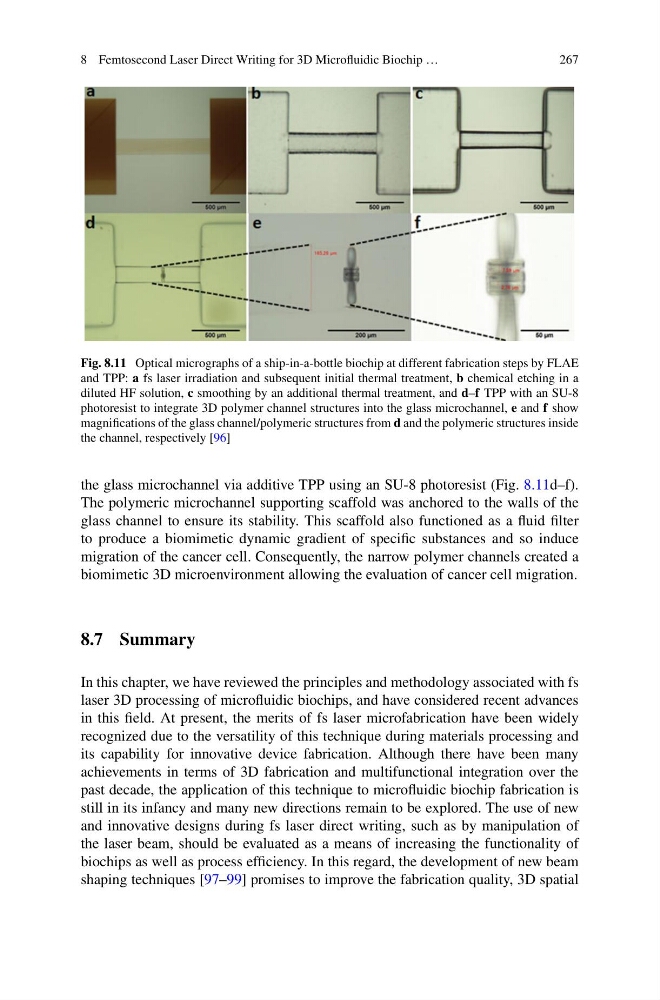
Fig. 8.11 Optical micrographs of a ship-in-a-bottle biochip at different fabrication steps by FLAE
and TPP: a fs laser irradiation and subsequent initial thermal treatment, b chemical etching in a
diluted HF solution, c smoothing by an additional thermal treatment, and d–f TPP with an SU-8
photoresist to integrate 3D polymer channel structures into the glass microchannel, e and f show
magnifications of the glass channel/polymeric structures from d and the polymeric structures inside
the channel, respectively [96]
the glass microchannel via additive TPP using an SU-8 photoresist (Fig. 8.11d–f).
The polymeric microchannel supporting scaffold was anchored to the walls of the
glass channel to ensure its stability. This scaffold also functioned as a fluid filter
to produce a biomimetic dynamic gradient of specific substances and so induce
migration of the cancer cell. Consequently, the narrow polymer channels created a
biomimetic 3D microenvironment allowing the evaluation of cancer cell migration.
8.7 Summary
In this chapter, we have reviewed the principles and methodology associated with fs
laser 3D processing of microfluidic biochips, and have considered recent advances
in this field. At present, the merits of fs laser microfabrication have been widely
recognized due to the versatility of this technique during materials processing and
its capability for innovative device fabrication. Although there have been many
achievements in terms of 3D fabrication and multifunctional integration over the
past decade, the application of this technique to microfluidic biochip fabrication is
still in its infancy and many new directions remain to be explored. The use of new
and innovative designs during fs laser direct writing, such as by manipulation of
the laser beam, should be evaluated as a means of increasing the functionality of
biochips as well as process efficiency. In this regard, the development of new beam
shaping techniques [97–99] promises to improve the fabrication quality, 3D spatial
267
Fig. 8.11 Optical micrographs of a ship-in-a-bottle biochip at different fabrication steps by FLAE
and TPP: a fs laser irradiation and subsequent initial thermal treatment, b chemical etching in a
diluted HF solution, c smoothing by an additional thermal treatment, and d–f TPP with an SU-8
photoresist to integrate 3D polymer channel structures into the glass microchannel, e and f show
magnifications of the glass channel/polymeric structures from d and the polymeric structures inside
the channel, respectively [96]
the glass microchannel via additive TPP using an SU-8 photoresist (Fig. 8.11d–f).
The polymeric microchannel supporting scaffold was anchored to the walls of the
glass channel to ensure its stability. This scaffold also functioned as a fluid filter
to produce a biomimetic dynamic gradient of specific substances and so induce
migration of the cancer cell. Consequently, the narrow polymer channels created a
biomimetic 3D microenvironment allowing the evaluation of cancer cell migration.
8.7 Summary
In this chapter, we have reviewed the principles and methodology associated with fs
laser 3D processing of microfluidic biochips, and have considered recent advances
in this field. At present, the merits of fs laser microfabrication have been widely
recognized due to the versatility of this technique during materials processing and
its capability for innovative device fabrication. Although there have been many
achievements in terms of 3D fabrication and multifunctional integration over the
past decade, the application of this technique to microfluidic biochip fabrication is
still in its infancy and many new directions remain to be explored. The use of new
and innovative designs during fs laser direct writing, such as by manipulation of
the laser beam, should be evaluated as a means of increasing the functionality of
biochips as well as process efficiency. In this regard, the development of new beam
shaping techniques [97–99] promises to improve the fabrication quality, 3D spatial