

266
J. Xu et al.
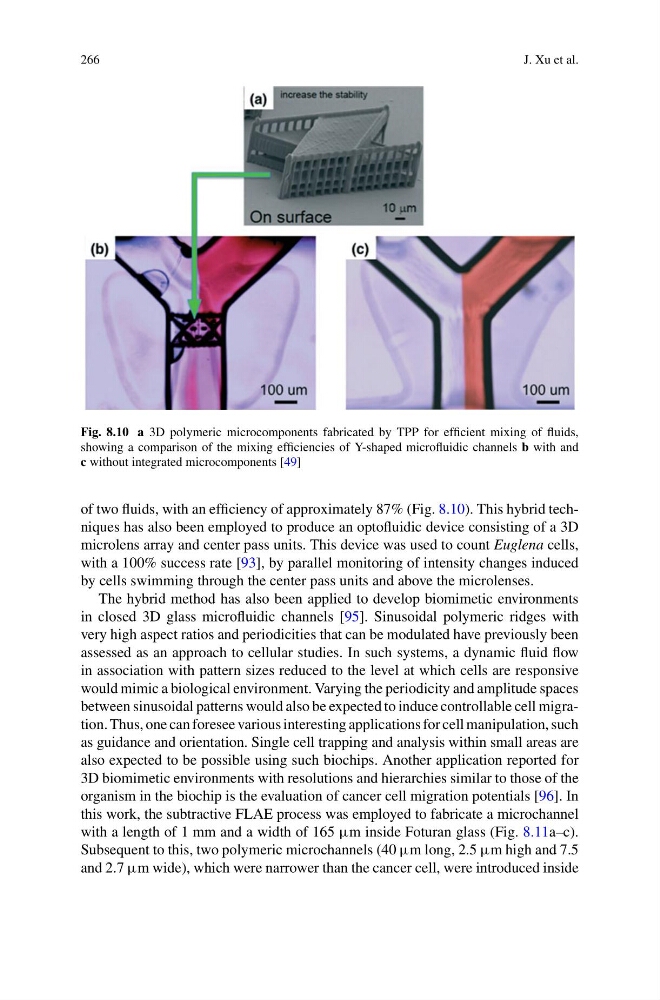
Fig. 8.10 a 3D polymeric microcomponents fabricated by TPP for efficient mixing of fluids,
showing a comparison of the mixing efficiencies of Y-shaped microfluidic channels b with and
c without integrated microcomponents [49]
of two fluids, with an efficiency of approximately 87% (Fig. 8.10). This hybrid techniques has also been employed to produce an optofluidic device consisting of a 3D
microlens array and center pass units. This device was used to count Euglena cells,
with a 100% success rate [93], by parallel monitoring of intensity changes induced
by cells swimming through the center pass units and above the microlenses.
The hybrid method has also been applied to develop biomimetic environments
in closed 3D glass microfluidic channels [95]. Sinusoidal polymeric ridges with
very high aspect ratios and periodicities that can be modulated have previously been
assessed as an approach to cellular studies. In such systems, a dynamic fluid flow
in association with pattern sizes reduced to the level at which cells are responsive
would mimic a biological environment. Varying the periodicity and amplitude spaces
between sinusoidal patterns would also be expected to induce controllable cell migration. Thus, one can foresee various interesting applications for cell manipulation, such
as guidance and orientation. Single cell trapping and analysis within small areas are
also expected to be possible using such biochips. Another application reported for
3D biomimetic environments with resolutions and hierarchies similar to those of the
organism in the biochip is the evaluation of cancer cell migration potentials [96]. In
this work, the subtractive FLAE process was employed to fabricate a microchannel
with a length of 1 mm and a width of 165 µm inside Foturan glass (Fig. 8.11a–c).
Subsequent to this, two polymeric microchannels (40 µm long, 2.5 µm high and 7.5
and 2.7 µm wide), which were narrower than the cancer cell, were introduced inside
J. Xu et al.
Fig. 8.10 a 3D polymeric microcomponents fabricated by TPP for efficient mixing of fluids,
showing a comparison of the mixing efficiencies of Y-shaped microfluidic channels b with and
c without integrated microcomponents [49]
of two fluids, with an efficiency of approximately 87% (Fig. 8.10). This hybrid techniques has also been employed to produce an optofluidic device consisting of a 3D
microlens array and center pass units. This device was used to count Euglena cells,
with a 100% success rate [93], by parallel monitoring of intensity changes induced
by cells swimming through the center pass units and above the microlenses.
The hybrid method has also been applied to develop biomimetic environments
in closed 3D glass microfluidic channels [95]. Sinusoidal polymeric ridges with
very high aspect ratios and periodicities that can be modulated have previously been
assessed as an approach to cellular studies. In such systems, a dynamic fluid flow
in association with pattern sizes reduced to the level at which cells are responsive
would mimic a biological environment. Varying the periodicity and amplitude spaces
between sinusoidal patterns would also be expected to induce controllable cell migration. Thus, one can foresee various interesting applications for cell manipulation, such
as guidance and orientation. Single cell trapping and analysis within small areas are
also expected to be possible using such biochips. Another application reported for
3D biomimetic environments with resolutions and hierarchies similar to those of the
organism in the biochip is the evaluation of cancer cell migration potentials [96]. In
this work, the subtractive FLAE process was employed to fabricate a microchannel
with a length of 1 mm and a width of 165 µm inside Foturan glass (Fig. 8.11a–c).
Subsequent to this, two polymeric microchannels (40 µm long, 2.5 µm high and 7.5
and 2.7 µm wide), which were narrower than the cancer cell, were introduced inside