

8 Femtosecond Laser Direct Writing for 3D Microfluidic Biochip …
265
glass substrates. In contrast, TPP in conjunction with negative-tone photoresists is
categorized as an additive laser process and is capable of producing 3D micro- and
nanopatterns in biocompatible polymers. This hybrid technique exploits the specific
advantages of both processes while avoiding some of the drawbacks of each. Both
glass and polymers are transparent materials with good potential for fabrication of
functional biochips. This hybrid approach provides both scale-down and scale-up
characteristics that allow ready manipulation of the assembled device in conjunction
with increased analytical sensitivity by reducing the dimensions of fabricated structures in microfluidic devices. The dimensions of the structures can actually be reduced
to below those of a single cell, thus allowing individual cells to be examined and
manipulated inside a glass channel. These biochips can therefore permit the exploration of phenomena at cellular levels with sub-micron resolution, representing an
excellent opportunity to obtain additional insights into biological processes. Transparent microfluidic and optofluidic biochips are achievable via the integration of
microoptical polymer components to build suitable 3D microenvironments for the
study of living microorganisms and to improve cell detection or sorting. In addition,
there is significant potential for the manufacture of biomimetic structures tailored
for specific cellular analyses.
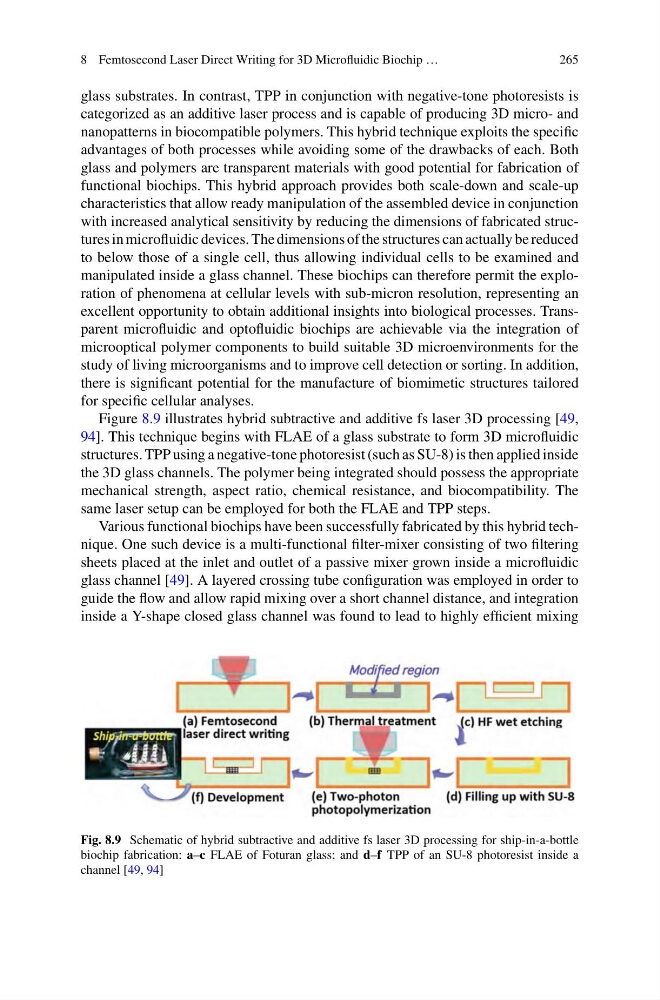
Figure 8.9 illustrates hybrid subtractive and additive fs laser 3D processing [49,
94]. This technique begins with FLAE of a glass substrate to form 3D microfluidic
structures. TPP using a negative-tone photoresist (such as SU-8) is then applied inside
the 3D glass channels. The polymer being integrated should possess the appropriate
mechanical strength, aspect ratio, chemical resistance, and biocompatibility. The
same laser setup can be employed for both the FLAE and TPP steps.
Various functional biochips have been successfully fabricated by this hybrid technique. One such device is a multi-functional filter-mixer consisting of two filtering
sheets placed at the inlet and outlet of a passive mixer grown inside a microfluidic
glass channel [49]. A layered crossing tube configuration was employed in order to
guide the flow and allow rapid mixing over a short channel distance, and integration
inside a Y-shape closed glass channel was found to lead to highly efficient mixing
Fig. 8.9 Schematic of hybrid subtractive and additive fs laser 3D processing for ship-in-a-bottle
biochip fabrication: a–c FLAE of Foturan glass; and d–f TPP of an SU-8 photoresist inside a
channel [49, 94]
265
glass substrates. In contrast, TPP in conjunction with negative-tone photoresists is
categorized as an additive laser process and is capable of producing 3D micro- and
nanopatterns in biocompatible polymers. This hybrid technique exploits the specific
advantages of both processes while avoiding some of the drawbacks of each. Both
glass and polymers are transparent materials with good potential for fabrication of
functional biochips. This hybrid approach provides both scale-down and scale-up
characteristics that allow ready manipulation of the assembled device in conjunction
with increased analytical sensitivity by reducing the dimensions of fabricated structures in microfluidic devices. The dimensions of the structures can actually be reduced
to below those of a single cell, thus allowing individual cells to be examined and
manipulated inside a glass channel. These biochips can therefore permit the exploration of phenomena at cellular levels with sub-micron resolution, representing an
excellent opportunity to obtain additional insights into biological processes. Transparent microfluidic and optofluidic biochips are achievable via the integration of
microoptical polymer components to build suitable 3D microenvironments for the
study of living microorganisms and to improve cell detection or sorting. In addition,
there is significant potential for the manufacture of biomimetic structures tailored
for specific cellular analyses.
Figure 8.9 illustrates hybrid subtractive and additive fs laser 3D processing [49,
94]. This technique begins with FLAE of a glass substrate to form 3D microfluidic
structures. TPP using a negative-tone photoresist (such as SU-8) is then applied inside
the 3D glass channels. The polymer being integrated should possess the appropriate
mechanical strength, aspect ratio, chemical resistance, and biocompatibility. The
same laser setup can be employed for both the FLAE and TPP steps.
Various functional biochips have been successfully fabricated by this hybrid technique. One such device is a multi-functional filter-mixer consisting of two filtering
sheets placed at the inlet and outlet of a passive mixer grown inside a microfluidic
glass channel [49]. A layered crossing tube configuration was employed in order to
guide the flow and allow rapid mixing over a short channel distance, and integration
inside a Y-shape closed glass channel was found to lead to highly efficient mixing
Fig. 8.9 Schematic of hybrid subtractive and additive fs laser 3D processing for ship-in-a-bottle
biochip fabrication: a–c FLAE of Foturan glass; and d–f TPP of an SU-8 photoresist inside a
channel [49, 94]