

7 Micro-hole Arrays and Net-like Structure Fabrication …
219
near the micro-holes produced by nanosecond and picosecond laser is more obvious,
and the recast layer is very obvious. However, the thermal effect of the micro-holes
produced by femtosecond laser is not obvious, and the micro-holes are also relatively
better. The figure shows the advantages of femtosecond laser micromachining.
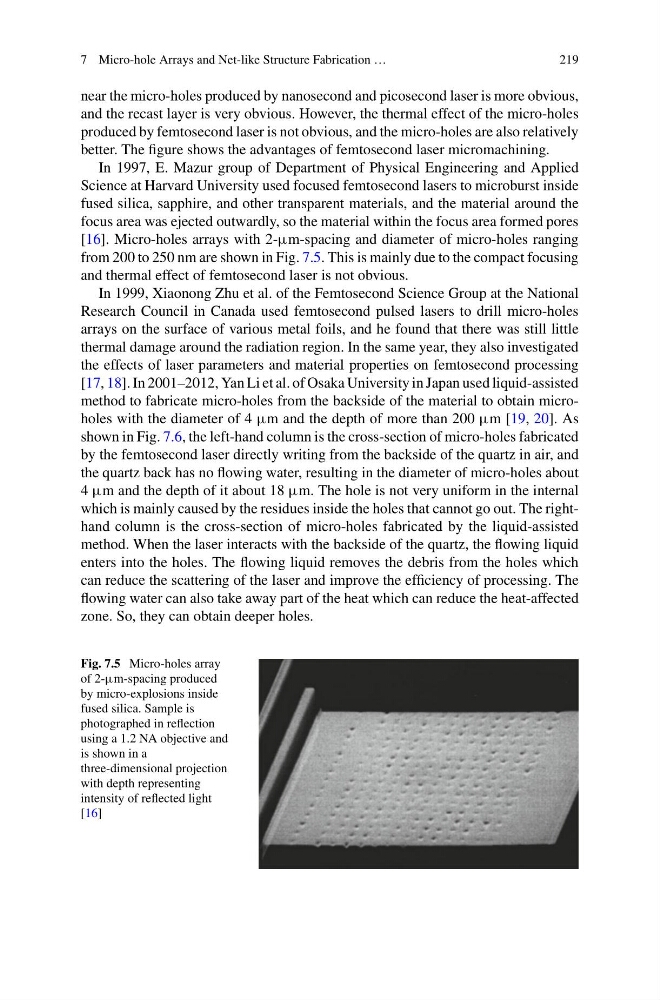
In 1997, E. Mazur group of Department of Physical Engineering and Applied
Science at Harvard University used focused femtosecond lasers to microburst inside
fused silica, sapphire, and other transparent materials, and the material around the
focus area was ejected outwardly, so the material within the focus area formed pores
[16]. Micro-holes arrays with 2-μm-spacing and diameter of micro-holes ranging
from 200 to 250 nm are shown in Fig. 7.5. This is mainly due to the compact focusing
and thermal effect of femtosecond laser is not obvious.
In 1999, Xiaonong Zhu et al. of the Femtosecond Science Group at the National
Research Council in Canada used femtosecond pulsed lasers to drill micro-holes
arrays on the surface of various metal foils, and he found that there was still little
thermal damage around the radiation region. In the same year, they also investigated
the effects of laser parameters and material properties on femtosecond processing
[17, 18]. In 2001–2012, Yan Li et al. of Osaka University in Japan used liquid-assisted
method to fabricate micro-holes from the backside of the material to obtain microholes with the diameter of 4 μm and the depth of more than 200 μm [19, 20]. As
shown in Fig. 7.6, the left-hand column is the cross-section of micro-holes fabricated
by the femtosecond laser directly writing from the backside of the quartz in air, and
the quartz back has no flowing water, resulting in the diameter of micro-holes about
4 μm and the depth of it about 18 μm. The hole is not very uniform in the internal
which is mainly caused by the residues inside the holes that cannot go out. The righthand column is the cross-section of micro-holes fabricated by the liquid-assisted
method. When the laser interacts with the backside of the quartz, the flowing liquid
enters into the holes. The flowing liquid removes the debris from the holes which
can reduce the scattering of the laser and improve the efficiency of processing. The
flowing water can also take away part of the heat which can reduce the heat-affected
zone. So, they can obtain deeper holes.
Fig. 7.5 Micro-holes array
of 2-μm-spacing produced
by micro-explosions inside
fused silica. Sample is
photographed in reflection
using a 1.2 NA objective and
is shown in a
three-dimensional projection
with depth representing
intensity of reflected light
[16]
219
near the micro-holes produced by nanosecond and picosecond laser is more obvious,
and the recast layer is very obvious. However, the thermal effect of the micro-holes
produced by femtosecond laser is not obvious, and the micro-holes are also relatively
better. The figure shows the advantages of femtosecond laser micromachining.
In 1997, E. Mazur group of Department of Physical Engineering and Applied
Science at Harvard University used focused femtosecond lasers to microburst inside
fused silica, sapphire, and other transparent materials, and the material around the
focus area was ejected outwardly, so the material within the focus area formed pores
[16]. Micro-holes arrays with 2-μm-spacing and diameter of micro-holes ranging
from 200 to 250 nm are shown in Fig. 7.5. This is mainly due to the compact focusing
and thermal effect of femtosecond laser is not obvious.
In 1999, Xiaonong Zhu et al. of the Femtosecond Science Group at the National
Research Council in Canada used femtosecond pulsed lasers to drill micro-holes
arrays on the surface of various metal foils, and he found that there was still little
thermal damage around the radiation region. In the same year, they also investigated
the effects of laser parameters and material properties on femtosecond processing
[17, 18]. In 2001–2012, Yan Li et al. of Osaka University in Japan used liquid-assisted
method to fabricate micro-holes from the backside of the material to obtain microholes with the diameter of 4 μm and the depth of more than 200 μm [19, 20]. As
shown in Fig. 7.6, the left-hand column is the cross-section of micro-holes fabricated
by the femtosecond laser directly writing from the backside of the quartz in air, and
the quartz back has no flowing water, resulting in the diameter of micro-holes about
4 μm and the depth of it about 18 μm. The hole is not very uniform in the internal
which is mainly caused by the residues inside the holes that cannot go out. The righthand column is the cross-section of micro-holes fabricated by the liquid-assisted
method. When the laser interacts with the backside of the quartz, the flowing liquid
enters into the holes. The flowing liquid removes the debris from the holes which
can reduce the scattering of the laser and improve the efficiency of processing. The
flowing water can also take away part of the heat which can reduce the heat-affected
zone. So, they can obtain deeper holes.
Fig. 7.5 Micro-holes array
of 2-μm-spacing produced
by micro-explosions inside
fused silica. Sample is
photographed in reflection
using a 1.2 NA objective and
is shown in a
three-dimensional projection
with depth representing
intensity of reflected light
[16]