

218
G. Feng et al.
[11], electron beam drilling [12], electric discharge machining (EDM) drilling [13],
and laser beam drilling [14].
In contrast, electrochemical drilling and EDM drilling are more common. EDM is
the way to process by discharge and generally only process shallow holes with diameter greater than 80 μm. Electrochemical drilling is mainly through the electrodeassisted chemical changes to micro-drilling, and the processing of micro-porous by
this way is higher in precision. However, two methods above can only be used for
micro-processing conductive materials, while it will cause the electrode wear and
tear during the process. At present, these two methods are the most common way to
process micro-holes, and they are mainly used to process shallow holes with more
than 5 μm.
Both electron beam drilling and ion beam drilling are common methods to
process submicron-sized micro-holes, but the depth-to-diameter ratio of micro-holes
processed by these two methods is generally no more than 10. The two-process
methods have harsh conditions that the expensive equipment should be working in
the high-vacuum conditions and the processing efficiency is relatively low. Therefore,
these two methods are low efficiency and high precision.
Laser beam drilling is widely used in many materials because of its wide applicability, high processing efficiency, low environmental requirements, simple equipment, relatively low cost, and non-contact processing. However, laser drilling usually
has shortcomings such as thermal effects and taper. With the rapid development of
laser technology, femtosecond laser has the advantages of extremely high peak power
and ultrashort pulse width. Therefore, femtosecond laser can process a wide range
of materials, and the thermal effect of it is not obvious and even not visible, which
is expected to solve the problem of high-quality micro-hole processing.
In 1995, P. P. Pronko et al. of Ultrafast Optical Center of University of Michigan
applied femtosecond lasers (central wavelength of 800 nm) to submicron micro-holes
fabrication and found that ultrashort pulsed lasers had little thermal impact during
the processing. Therefore, the femtosecond laser has advantages of little recast and
very high precision during the micro-processing [15]. In 1996, B.N. Chicbkov et al.
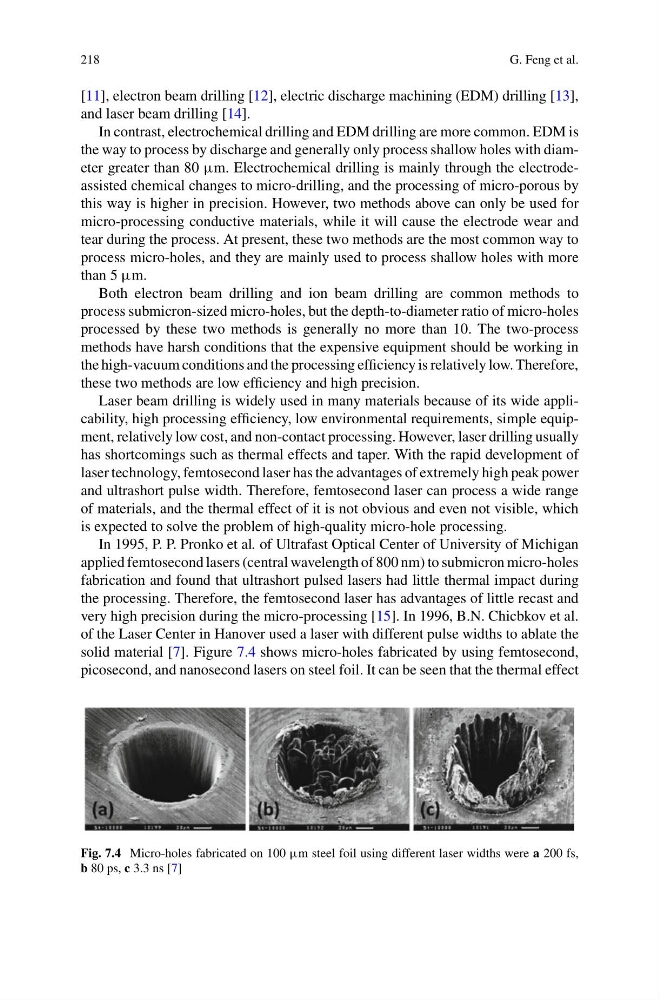
of the Laser Center in Hanover used a laser with different pulse widths to ablate the
solid material [7]. Figure 7.4 shows micro-holes fabricated by using femtosecond,
picosecond, and nanosecond lasers on steel foil. It can be seen that the thermal effect
Fig. 7.4 Micro-holes fabricated on 100 μm steel foil using different laser widths were a 200 fs,
b 80 ps, c 3.3 ns [7]
G. Feng et al.
[11], electron beam drilling [12], electric discharge machining (EDM) drilling [13],
and laser beam drilling [14].
In contrast, electrochemical drilling and EDM drilling are more common. EDM is
the way to process by discharge and generally only process shallow holes with diameter greater than 80 μm. Electrochemical drilling is mainly through the electrodeassisted chemical changes to micro-drilling, and the processing of micro-porous by
this way is higher in precision. However, two methods above can only be used for
micro-processing conductive materials, while it will cause the electrode wear and
tear during the process. At present, these two methods are the most common way to
process micro-holes, and they are mainly used to process shallow holes with more
than 5 μm.
Both electron beam drilling and ion beam drilling are common methods to
process submicron-sized micro-holes, but the depth-to-diameter ratio of micro-holes
processed by these two methods is generally no more than 10. The two-process
methods have harsh conditions that the expensive equipment should be working in
the high-vacuum conditions and the processing efficiency is relatively low. Therefore,
these two methods are low efficiency and high precision.
Laser beam drilling is widely used in many materials because of its wide applicability, high processing efficiency, low environmental requirements, simple equipment, relatively low cost, and non-contact processing. However, laser drilling usually
has shortcomings such as thermal effects and taper. With the rapid development of
laser technology, femtosecond laser has the advantages of extremely high peak power
and ultrashort pulse width. Therefore, femtosecond laser can process a wide range
of materials, and the thermal effect of it is not obvious and even not visible, which
is expected to solve the problem of high-quality micro-hole processing.
In 1995, P. P. Pronko et al. of Ultrafast Optical Center of University of Michigan
applied femtosecond lasers (central wavelength of 800 nm) to submicron micro-holes
fabrication and found that ultrashort pulsed lasers had little thermal impact during
the processing. Therefore, the femtosecond laser has advantages of little recast and
very high precision during the micro-processing [15]. In 1996, B.N. Chicbkov et al.
of the Laser Center in Hanover used a laser with different pulse widths to ablate the
solid material [7]. Figure 7.4 shows micro-holes fabricated by using femtosecond,
picosecond, and nanosecond lasers on steel foil. It can be seen that the thermal effect
Fig. 7.4 Micro-holes fabricated on 100 μm steel foil using different laser widths were a 200 fs,
b 80 ps, c 3.3 ns [7]