

4
A. Hu et al.
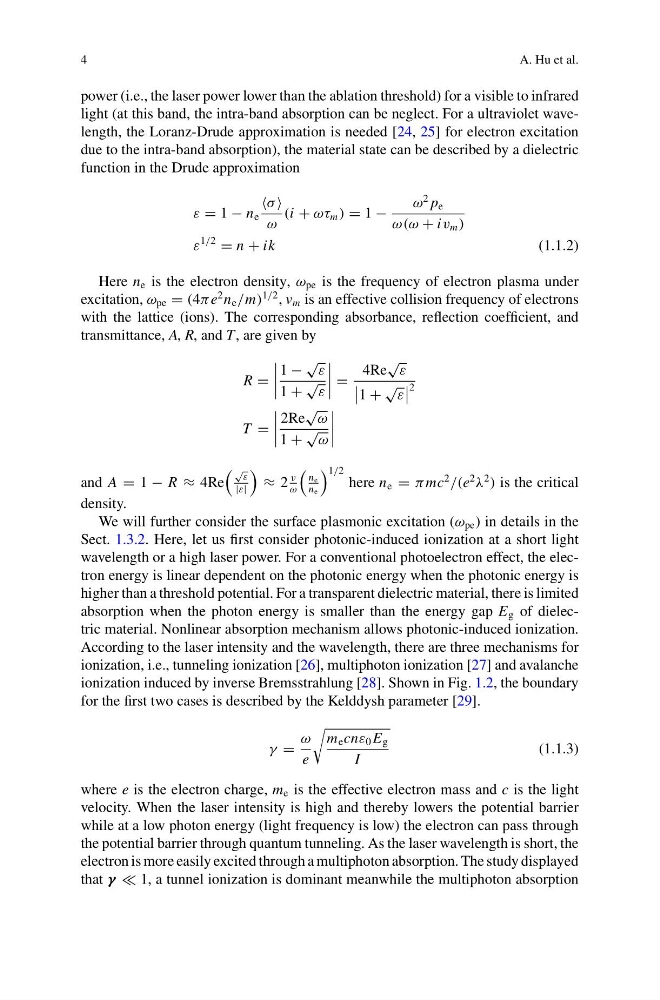
power (i.e., the laser power lower than the ablation threshold) for a visible to infrared
light (at this band, the intra-band absorption can be neglect. For a ultraviolet wavelength, the Loranz-Drude approximation is needed [24, 25] for electron excitation
due to the intra-band absorption), the material state can be described by a dielectric
function in the Drude approximation
ε = 1 − n e
σ
ω
(i + ωτ m ) = 1 −
ω
2 p e
ω(ω + iv m )
ε
1/2
= n + ik
(1.1.2)
Here n e is the electron density, ω pe is the frequency of electron plasma under
excitation, ω pe = (4π e
2 n e /m)
1/2 , v m is an effective collision frequency of electrons
with the lattice (ions). The corresponding absorbance, reflection coefficient, and
transmittance, A, R, and T, are given by
R =
1 −
√ ε
1 +
√ ε
=
4Re
√ ε
1 +
√
ε
2
T =
2Re
√ ω
1 +
√ ω
and A = 1 − R ≈ 4Re
√
ε
|ε|
≈ 2
ν
ω
n e
n e
1/2
here n e = π mc
2
/(e
2
λ
2
) is the critical
density.
We will further consider the surface plasmonic excitation (ω pe ) in details in the
Sect. 1.3.2. Here, let us first consider photonic-induced ionization at a short light
wavelength or a high laser power. For a conventional photoelectron effect, the electron energy is linear dependent on the photonic energy when the photonic energy is
higher than a threshold potential. For a transparent dielectric material, there is limited
absorption when the photon energy is smaller than the energy gap E g of dielectric material. Nonlinear absorption mechanism allows photonic-induced ionization.
According to the laser intensity and the wavelength, there are three mechanisms for
ionization, i.e., tunneling ionization [26], multiphoton ionization [27] and avalanche
ionization induced by inverse Bremsstrahlung [28]. Shown in Fig. 1.2, the boundary
for the first two cases is described by the Kelddysh parameter [29].
γ =
ω
e
m e cnε 0 E g
I
(1.1.3)
where e is the electron charge, m e is the effective electron mass and c is the light
velocity. When the laser intensity is high and thereby lowers the potential barrier
while at a low photon energy (light frequency is low) the electron can pass through
the potential barrier through quantum tunneling. As the laser wavelength is short, the
electron is more easily excited through a multiphoton absorption. The study displayed
that γ 1, a tunnel ionization is dominant meanwhile the multiphoton absorption
A. Hu et al.
power (i.e., the laser power lower than the ablation threshold) for a visible to infrared
light (at this band, the intra-band absorption can be neglect. For a ultraviolet wavelength, the Loranz-Drude approximation is needed [24, 25] for electron excitation
due to the intra-band absorption), the material state can be described by a dielectric
function in the Drude approximation
ε = 1 − n e
σ
ω
(i + ωτ m ) = 1 −
ω
2 p e
ω(ω + iv m )
ε
1/2
= n + ik
(1.1.2)
Here n e is the electron density, ω pe is the frequency of electron plasma under
excitation, ω pe = (4π e
2 n e /m)
1/2 , v m is an effective collision frequency of electrons
with the lattice (ions). The corresponding absorbance, reflection coefficient, and
transmittance, A, R, and T, are given by
R =
1 −
√ ε
1 +
√ ε
=
4Re
√ ε
1 +
√
ε
2
T =
2Re
√ ω
1 +
√ ω
and A = 1 − R ≈ 4Re
√
ε
|ε|
≈ 2
ν
ω
n e
n e
1/2
here n e = π mc
2
/(e
2
λ
2
) is the critical
density.
We will further consider the surface plasmonic excitation (ω pe ) in details in the
Sect. 1.3.2. Here, let us first consider photonic-induced ionization at a short light
wavelength or a high laser power. For a conventional photoelectron effect, the electron energy is linear dependent on the photonic energy when the photonic energy is
higher than a threshold potential. For a transparent dielectric material, there is limited
absorption when the photon energy is smaller than the energy gap E g of dielectric material. Nonlinear absorption mechanism allows photonic-induced ionization.
According to the laser intensity and the wavelength, there are three mechanisms for
ionization, i.e., tunneling ionization [26], multiphoton ionization [27] and avalanche
ionization induced by inverse Bremsstrahlung [28]. Shown in Fig. 1.2, the boundary
for the first two cases is described by the Kelddysh parameter [29].
γ =
ω
e
m e cnε 0 E g
I
(1.1.3)
where e is the electron charge, m e is the effective electron mass and c is the light
velocity. When the laser intensity is high and thereby lowers the potential barrier
while at a low photon energy (light frequency is low) the electron can pass through
the potential barrier through quantum tunneling. As the laser wavelength is short, the
electron is more easily excited through a multiphoton absorption. The study displayed
that γ 1, a tunnel ionization is dominant meanwhile the multiphoton absorption