

1 Introduction to Laser Micro-to-Nano Manufacturing
3
This chapter is organized as follows: starting from the absorption, ionization
and surface plasmonic excitation we will briefly review the fundamentals of lasermatter interaction based on a electron-hole plasma frame. We will specially discuss
the differences of two kinds of laser, ultrafast pulsed laser and long pulsed or
continuous-wave laser interacting with a dielectric material and metal. Based on
these physical pictures, we will introduce unique electromagnetic properties of
nanomaterials through the scaling law, and then we will briefly overview nanophotonics and plasmonics. In the Sect. 1.4, we will focus on the unique thermal and
nonthermal phenomena dominantly induced by long laser pulses and short pulses,
separately. In the following two sections, we can review two key fields for micro-tonanomanufacturing, i.e., nanomanipulation and nanojoining. At last, we will review
the latest progress on the nanomanufacturing overcoming the optical diffraction limit.
1.2 Laser-Matter Interaction: Absorption and Ionization
Light-matter interaction is based on the photonic energy is reflected (and/or scattered)
by the surface and the absorption of molecules. According to the Lambert-Beer law,
the transmittance T can be expressed as (1.1.1)
T = I /I 0 = e
−αx
(1.1.1)
where, x is the width of media, I 0 , I and I
stand for incident, transmitted and reflected
light intensities, respectively. Thus, the interaction only happens in the surface layer
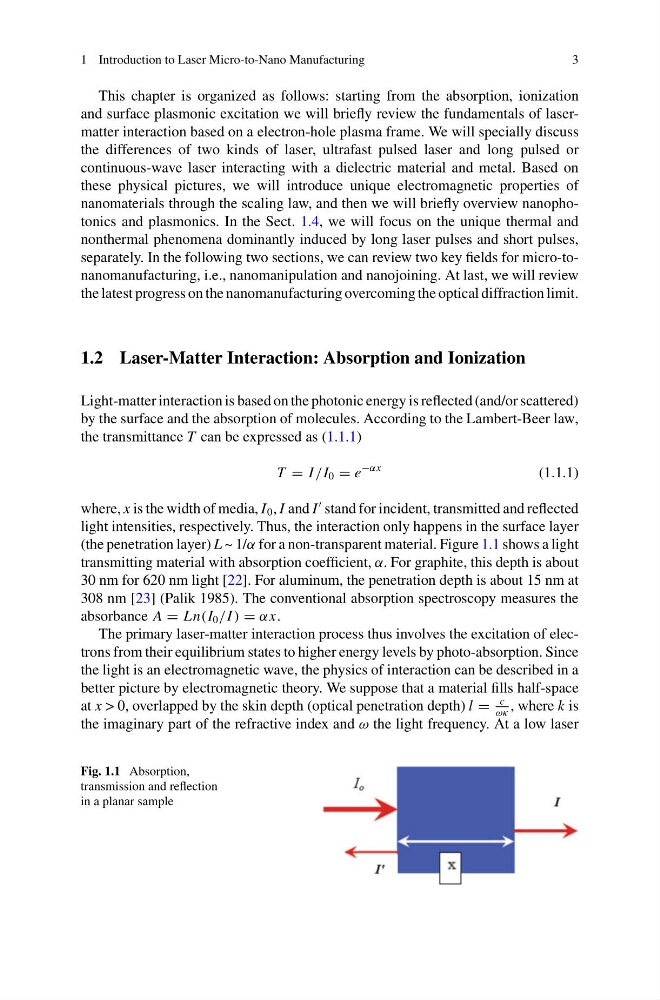
(the penetration layer) L ~ 1/α for a non-transparent material. Figure 1.1 shows a light
transmitting material with absorption coefficient, α. For graphite, this depth is about
30 nm for 620 nm light [22]. For aluminum, the penetration depth is about 15 nm at
308 nm [23] (Palik 1985). The conventional absorption spectroscopy measures the
absorbance A = Ln(I 0 /I ) = αx.
The primary laser-matter interaction process thus involves the excitation of electrons from their equilibrium states to higher energy levels by photo-absorption. Since
the light is an electromagnetic wave, the physics of interaction can be described in a
better picture by electromagnetic theory. We suppose that a material fills half-space
at x > 0, overlapped by the skin depth (optical penetration depth) l =
c
ωκ
, where k is
the imaginary part of the refractive index and ω the light frequency. At a low laser
Fig. 1.1 Absorption,
transmission and reflection
in a planar sample
3
This chapter is organized as follows: starting from the absorption, ionization
and surface plasmonic excitation we will briefly review the fundamentals of lasermatter interaction based on a electron-hole plasma frame. We will specially discuss
the differences of two kinds of laser, ultrafast pulsed laser and long pulsed or
continuous-wave laser interacting with a dielectric material and metal. Based on
these physical pictures, we will introduce unique electromagnetic properties of
nanomaterials through the scaling law, and then we will briefly overview nanophotonics and plasmonics. In the Sect. 1.4, we will focus on the unique thermal and
nonthermal phenomena dominantly induced by long laser pulses and short pulses,
separately. In the following two sections, we can review two key fields for micro-tonanomanufacturing, i.e., nanomanipulation and nanojoining. At last, we will review
the latest progress on the nanomanufacturing overcoming the optical diffraction limit.
1.2 Laser-Matter Interaction: Absorption and Ionization
Light-matter interaction is based on the photonic energy is reflected (and/or scattered)
by the surface and the absorption of molecules. According to the Lambert-Beer law,
the transmittance T can be expressed as (1.1.1)
T = I /I 0 = e
−αx
(1.1.1)
where, x is the width of media, I 0 , I and I
stand for incident, transmitted and reflected
light intensities, respectively. Thus, the interaction only happens in the surface layer
(the penetration layer) L ~ 1/α for a non-transparent material. Figure 1.1 shows a light
transmitting material with absorption coefficient, α. For graphite, this depth is about
30 nm for 620 nm light [22]. For aluminum, the penetration depth is about 15 nm at
308 nm [23] (Palik 1985). The conventional absorption spectroscopy measures the
absorbance A = Ln(I 0 /I ) = αx.
The primary laser-matter interaction process thus involves the excitation of electrons from their equilibrium states to higher energy levels by photo-absorption. Since
the light is an electromagnetic wave, the physics of interaction can be described in a
better picture by electromagnetic theory. We suppose that a material fills half-space
at x > 0, overlapped by the skin depth (optical penetration depth) l =
c
ωκ
, where k is
the imaginary part of the refractive index and ω the light frequency. At a low laser
Fig. 1.1 Absorption,
transmission and reflection
in a planar sample