

1 Introduction to Laser Micro-to-Nano Manufacturing
5
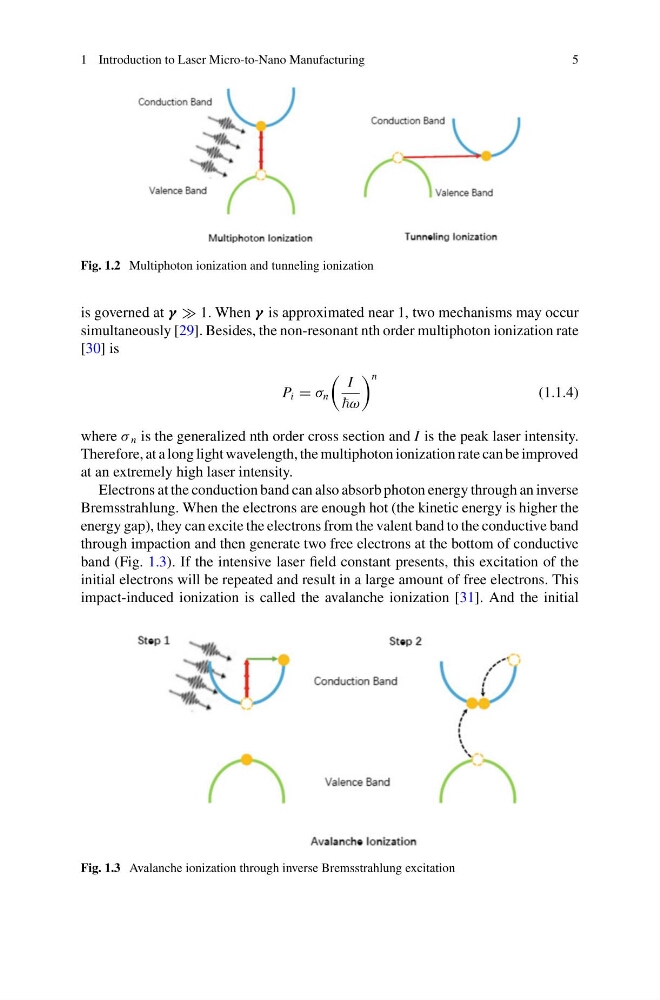
Fig. 1.2 Multiphoton ionization and tunneling ionization
is governed at γ 1. When γ is approximated near 1, two mechanisms may occur
simultaneously [29]. Besides, the non-resonant nth order multiphoton ionization rate
[30] is
P i = σ n
I
ω
n
(1.1.4)
where σ n is the generalized nth order cross section and I is the peak laser intensity.
Therefore, at a long light wavelength, the multiphoton ionization rate can be improved
at an extremely high laser intensity.
Electrons at the conduction band can also absorb photon energy through an inverse
Bremsstrahlung. When the electrons are enough hot (the kinetic energy is higher the
energy gap), they can excite the electrons from the valent band to the conductive band
through impaction and then generate two free electrons at the bottom of conductive
band (Fig. 1.3). If the intensive laser field constant presents, this excitation of the
initial electrons will be repeated and result in a large amount of free electrons. This
impact-induced ionization is called the avalanche ionization [31]. And the initial
Fig. 1.3 Avalanche ionization through inverse Bremsstrahlung excitation
5
Fig. 1.2 Multiphoton ionization and tunneling ionization
is governed at γ 1. When γ is approximated near 1, two mechanisms may occur
simultaneously [29]. Besides, the non-resonant nth order multiphoton ionization rate
[30] is
P i = σ n
I
ω
n
(1.1.4)
where σ n is the generalized nth order cross section and I is the peak laser intensity.
Therefore, at a long light wavelength, the multiphoton ionization rate can be improved
at an extremely high laser intensity.
Electrons at the conduction band can also absorb photon energy through an inverse
Bremsstrahlung. When the electrons are enough hot (the kinetic energy is higher the
energy gap), they can excite the electrons from the valent band to the conductive band
through impaction and then generate two free electrons at the bottom of conductive
band (Fig. 1.3). If the intensive laser field constant presents, this excitation of the
initial electrons will be repeated and result in a large amount of free electrons. This
impact-induced ionization is called the avalanche ionization [31]. And the initial
Fig. 1.3 Avalanche ionization through inverse Bremsstrahlung excitation