

6 Direct Femtosecond Laser Writing of Optical Waveguides …
189
the focusing optics, thus requiring a careful initial characterization [31]. As reference
values, for a tight focusing with NA 0.20–0.40, Type-I modifications are produced
with few hundreds of nano-Joules, and Type-II appear as the pulse energy approaches
the micro-Joule level (Fig. 6.2).
In addition to the described modifications, that can be induced with just a single
femtosecond laser pulse, other effects may appear when the target is irradiated with
a pulse train with certain repetition rate. In such case, when several pulses impinge
on the same point of the target, the cumulative effect of all of them may produce
a final modification that could not be induced with a single pulse [32]. Generally,
this effect is related to the heat transferred by the laser pulse to the sample, and
the key parameters are the repetition rate of the pulse train and the heat diffusion
time of the target. In this way, we may distinguish between two irradiation regimes:
thermal and non-thermal. In the thermal regime, the heating produced by one pulse
overlaps with the heating produced by the subsequent one, leading to a very high local
temperature increase by heat accumulation that may lead to the material melting and,
therefore, to the local modification [33]. In the non-thermal regime, the time interval
between subsequent pulses is large enough so that local heating is dissipated and no
net temperature increase is produced at the end. The transition between both regimes
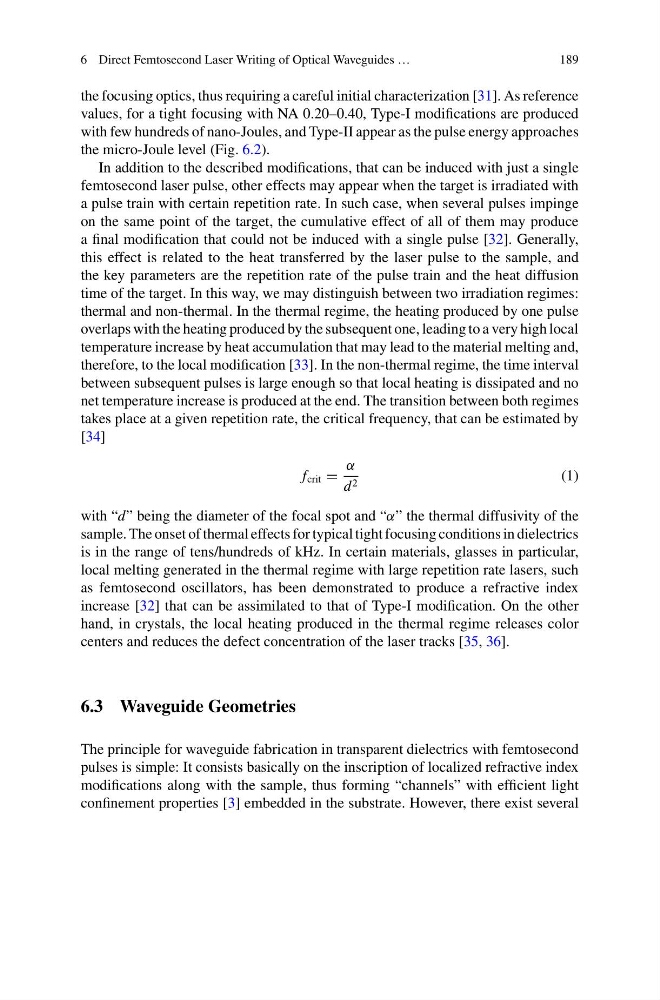
takes place at a given repetition rate, the critical frequency, that can be estimated by
[34]
f crit =
α
d 2
(1)
with “d” being the diameter of the focal spot and “α” the thermal diffusivity of the
sample. The onset of thermal effects for typical tight focusing conditions in dielectrics
is in the range of tens/hundreds of kHz. In certain materials, glasses in particular,
local melting generated in the thermal regime with large repetition rate lasers, such
as femtosecond oscillators, has been demonstrated to produce a refractive index
increase [32] that can be assimilated to that of Type-I modification. On the other
hand, in crystals, the local heating produced in the thermal regime releases color
centers and reduces the defect concentration of the laser tracks [35, 36].
6.3 Waveguide Geometries
The principle for waveguide fabrication in transparent dielectrics with femtosecond
pulses is simple: It consists basically on the inscription of localized refractive index
modifications along with the sample, thus forming “channels” with efficient light
confinement properties [3] embedded in the substrate. However, there exist several
189
the focusing optics, thus requiring a careful initial characterization [31]. As reference
values, for a tight focusing with NA 0.20–0.40, Type-I modifications are produced
with few hundreds of nano-Joules, and Type-II appear as the pulse energy approaches
the micro-Joule level (Fig. 6.2).
In addition to the described modifications, that can be induced with just a single
femtosecond laser pulse, other effects may appear when the target is irradiated with
a pulse train with certain repetition rate. In such case, when several pulses impinge
on the same point of the target, the cumulative effect of all of them may produce
a final modification that could not be induced with a single pulse [32]. Generally,
this effect is related to the heat transferred by the laser pulse to the sample, and
the key parameters are the repetition rate of the pulse train and the heat diffusion
time of the target. In this way, we may distinguish between two irradiation regimes:
thermal and non-thermal. In the thermal regime, the heating produced by one pulse
overlaps with the heating produced by the subsequent one, leading to a very high local
temperature increase by heat accumulation that may lead to the material melting and,
therefore, to the local modification [33]. In the non-thermal regime, the time interval
between subsequent pulses is large enough so that local heating is dissipated and no
net temperature increase is produced at the end. The transition between both regimes
takes place at a given repetition rate, the critical frequency, that can be estimated by
[34]
f crit =
α
d 2
(1)
with “d” being the diameter of the focal spot and “α” the thermal diffusivity of the
sample. The onset of thermal effects for typical tight focusing conditions in dielectrics
is in the range of tens/hundreds of kHz. In certain materials, glasses in particular,
local melting generated in the thermal regime with large repetition rate lasers, such
as femtosecond oscillators, has been demonstrated to produce a refractive index
increase [32] that can be assimilated to that of Type-I modification. On the other
hand, in crystals, the local heating produced in the thermal regime releases color
centers and reduces the defect concentration of the laser tracks [35, 36].
6.3 Waveguide Geometries
The principle for waveguide fabrication in transparent dielectrics with femtosecond
pulses is simple: It consists basically on the inscription of localized refractive index
modifications along with the sample, thus forming “channels” with efficient light
confinement properties [3] embedded in the substrate. However, there exist several