

188
F. Chen and J. R. V. de Aldana
strong thermal expansion (such as BK7) the laser irradiation usually induces negative refractive index modifications. It should be noticed that Type-I modifications are
liable to be completely or partially “erased” by thermal treatment of the sample after
laser exposition [23].
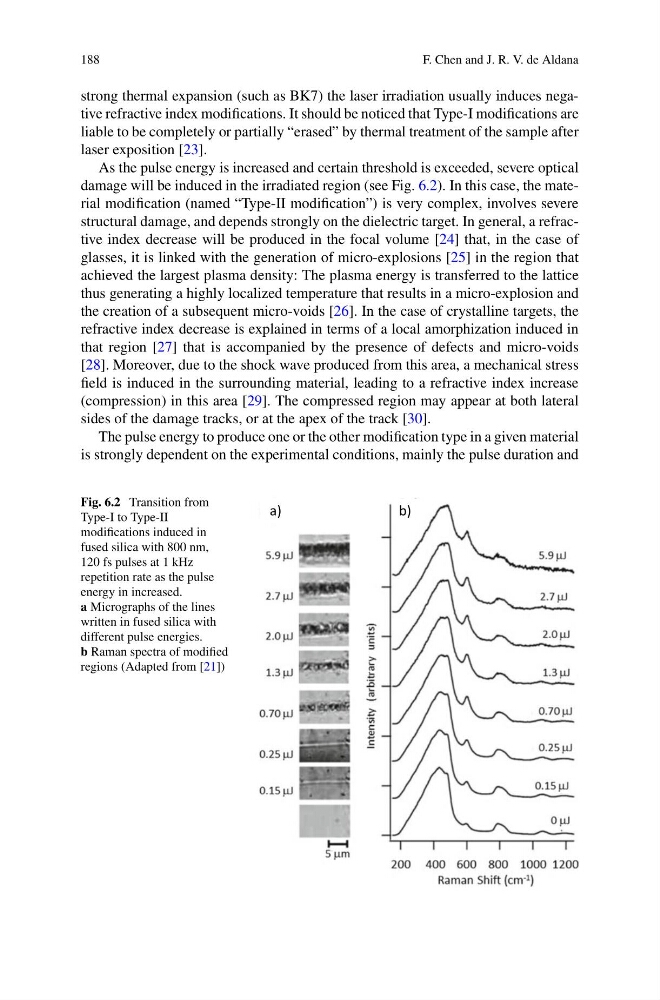
As the pulse energy is increased and certain threshold is exceeded, severe optical
damage will be induced in the irradiated region (see Fig. 6.2). In this case, the material modification (named “Type-II modification”) is very complex, involves severe
structural damage, and depends strongly on the dielectric target. In general, a refractive index decrease will be produced in the focal volume [24] that, in the case of
glasses, it is linked with the generation of micro-explosions [25] in the region that
achieved the largest plasma density: The plasma energy is transferred to the lattice
thus generating a highly localized temperature that results in a micro-explosion and
the creation of a subsequent micro-voids [26]. In the case of crystalline targets, the
refractive index decrease is explained in terms of a local amorphization induced in
that region [27] that is accompanied by the presence of defects and micro-voids
[28]. Moreover, due to the shock wave produced from this area, a mechanical stress
field is induced in the surrounding material, leading to a refractive index increase
(compression) in this area [29]. The compressed region may appear at both lateral
sides of the damage tracks, or at the apex of the track [30].
The pulse energy to produce one or the other modification type in a given material
is strongly dependent on the experimental conditions, mainly the pulse duration and
Fig. 6.2 Transition from
Type-I to Type-II
modifications induced in
fused silica with 800 nm,
120 fs pulses at 1 kHz
repetition rate as the pulse
energy in increased.
a Micrographs of the lines
written in fused silica with
different pulse energies.
b Raman spectra of modified
regions (Adapted from [21])
a)
b)
F. Chen and J. R. V. de Aldana
strong thermal expansion (such as BK7) the laser irradiation usually induces negative refractive index modifications. It should be noticed that Type-I modifications are
liable to be completely or partially “erased” by thermal treatment of the sample after
laser exposition [23].
As the pulse energy is increased and certain threshold is exceeded, severe optical
damage will be induced in the irradiated region (see Fig. 6.2). In this case, the material modification (named “Type-II modification”) is very complex, involves severe
structural damage, and depends strongly on the dielectric target. In general, a refractive index decrease will be produced in the focal volume [24] that, in the case of
glasses, it is linked with the generation of micro-explosions [25] in the region that
achieved the largest plasma density: The plasma energy is transferred to the lattice
thus generating a highly localized temperature that results in a micro-explosion and
the creation of a subsequent micro-voids [26]. In the case of crystalline targets, the
refractive index decrease is explained in terms of a local amorphization induced in
that region [27] that is accompanied by the presence of defects and micro-voids
[28]. Moreover, due to the shock wave produced from this area, a mechanical stress
field is induced in the surrounding material, leading to a refractive index increase
(compression) in this area [29]. The compressed region may appear at both lateral
sides of the damage tracks, or at the apex of the track [30].
The pulse energy to produce one or the other modification type in a given material
is strongly dependent on the experimental conditions, mainly the pulse duration and
Fig. 6.2 Transition from
Type-I to Type-II
modifications induced in
fused silica with 800 nm,
120 fs pulses at 1 kHz
repetition rate as the pulse
energy in increased.
a Micrographs of the lines
written in fused silica with
different pulse energies.
b Raman spectra of modified
regions (Adapted from [21])
a)
b)