

138
G. Compagnini et al.
are obtained using a variety of different laser pulses and target submerged in many
liquids and solutions [9–14].
Here, we want to report and discuss a quite unusual experiment in which PLAL
in water, using a titanium target, is performed using only a single nanosecond
laser pulse. In this case, we plan to gain some information on the specific material produced, avoiding re-irradiation effects, typical in the case of the production of
massive materials.
It is known that the repeated pulsed laser ablation of titanium in water gives the
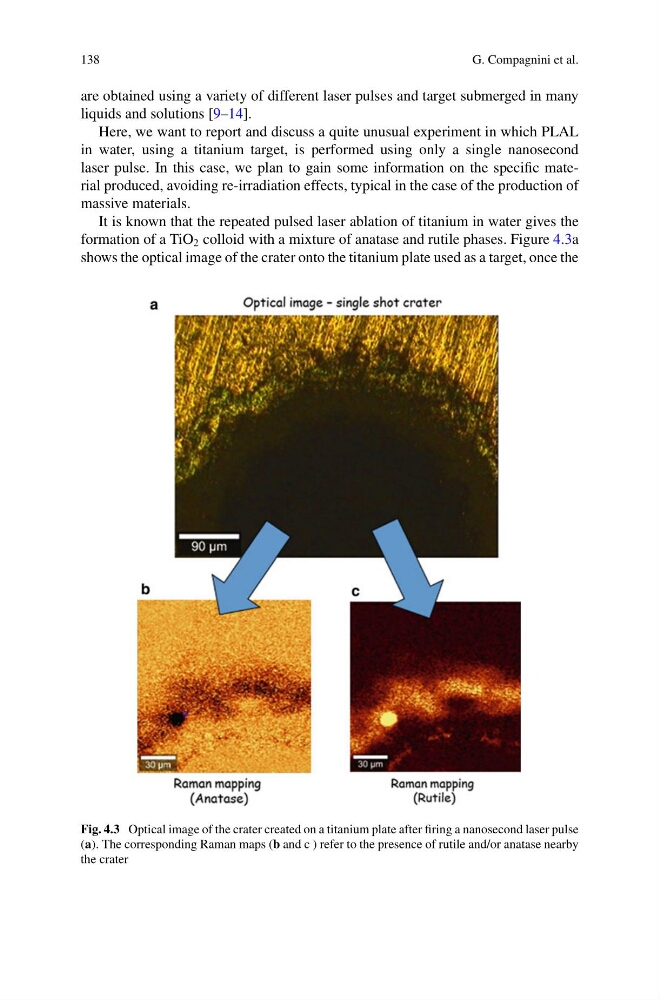
formation of a TiO 2 colloid with a mixture of anatase and rutile phases. Figure 4.3a
shows the optical image of the crater onto the titanium plate used as a target, once the
Fig. 4.3 Optical image of the crater created on a titanium plate after firing a nanosecond laser pulse
(a). The corresponding Raman maps (b and c ) refer to the presence of rutile and/or anatase nearby
the crater
G. Compagnini et al.
are obtained using a variety of different laser pulses and target submerged in many
liquids and solutions [9–14].
Here, we want to report and discuss a quite unusual experiment in which PLAL
in water, using a titanium target, is performed using only a single nanosecond
laser pulse. In this case, we plan to gain some information on the specific material produced, avoiding re-irradiation effects, typical in the case of the production of
massive materials.
It is known that the repeated pulsed laser ablation of titanium in water gives the
formation of a TiO 2 colloid with a mixture of anatase and rutile phases. Figure 4.3a
shows the optical image of the crater onto the titanium plate used as a target, once the
Fig. 4.3 Optical image of the crater created on a titanium plate after firing a nanosecond laser pulse
(a). The corresponding Raman maps (b and c ) refer to the presence of rutile and/or anatase nearby
the crater