

4 Laser-Induced Synthesis and Processing of Nanoparticles …
137
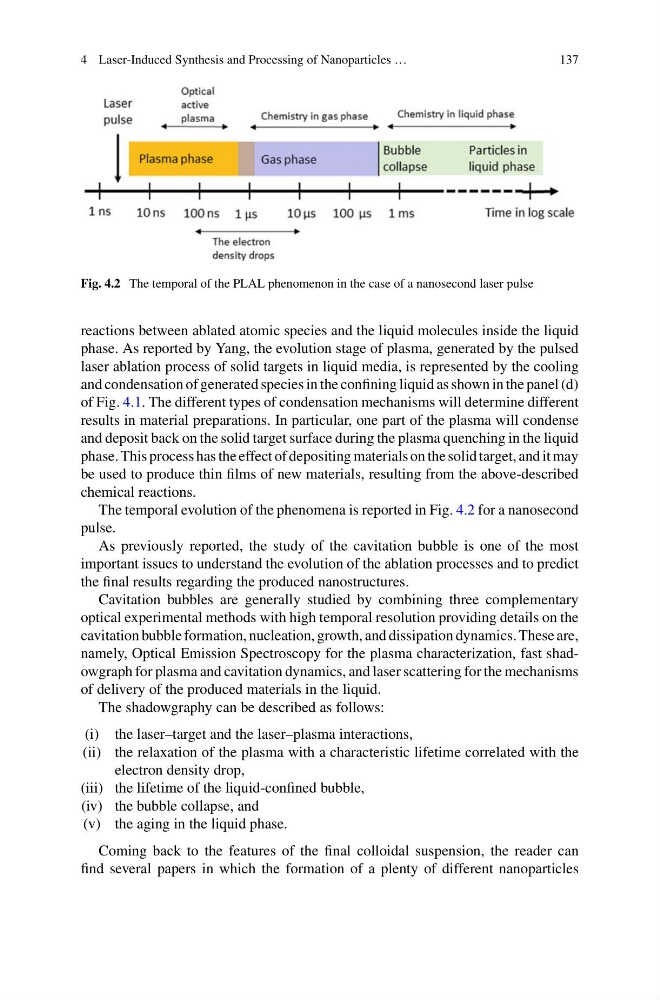
Fig. 4.2 The temporal of the PLAL phenomenon in the case of a nanosecond laser pulse
reactions between ablated atomic species and the liquid molecules inside the liquid
phase. As reported by Yang, the evolution stage of plasma, generated by the pulsed
laser ablation process of solid targets in liquid media, is represented by the cooling
and condensation of generated species in the confining liquid as shown in the panel (d)
of Fig. 4.1. The different types of condensation mechanisms will determine different
results in material preparations. In particular, one part of the plasma will condense
and deposit back on the solid target surface during the plasma quenching in the liquid
phase. This process has the effect of depositing materials on the solid target, and it may
be used to produce thin films of new materials, resulting from the above-described
chemical reactions.
The temporal evolution of the phenomena is reported in Fig. 4.2 for a nanosecond
pulse.
As previously reported, the study of the cavitation bubble is one of the most
important issues to understand the evolution of the ablation processes and to predict
the final results regarding the produced nanostructures.
Cavitation bubbles are generally studied by combining three complementary
optical experimental methods with high temporal resolution providing details on the
cavitation bubble formation, nucleation, growth, and dissipation dynamics. These are,
namely, Optical Emission Spectroscopy for the plasma characterization, fast shadowgraph for plasma and cavitation dynamics, and laser scattering for the mechanisms
of delivery of the produced materials in the liquid.
The shadowgraphy can be described as follows:
(i) the laser–target and the laser–plasma interactions,
(ii) the relaxation of the plasma with a characteristic lifetime correlated with the
electron density drop,
(iii) the lifetime of the liquid-confined bubble,
(iv) the bubble collapse, and
(v) the aging in the liquid phase.
Coming back to the features of the final colloidal suspension, the reader can
find several papers in which the formation of a plenty of different nanoparticles
137
Fig. 4.2 The temporal of the PLAL phenomenon in the case of a nanosecond laser pulse
reactions between ablated atomic species and the liquid molecules inside the liquid
phase. As reported by Yang, the evolution stage of plasma, generated by the pulsed
laser ablation process of solid targets in liquid media, is represented by the cooling
and condensation of generated species in the confining liquid as shown in the panel (d)
of Fig. 4.1. The different types of condensation mechanisms will determine different
results in material preparations. In particular, one part of the plasma will condense
and deposit back on the solid target surface during the plasma quenching in the liquid
phase. This process has the effect of depositing materials on the solid target, and it may
be used to produce thin films of new materials, resulting from the above-described
chemical reactions.
The temporal evolution of the phenomena is reported in Fig. 4.2 for a nanosecond
pulse.
As previously reported, the study of the cavitation bubble is one of the most
important issues to understand the evolution of the ablation processes and to predict
the final results regarding the produced nanostructures.
Cavitation bubbles are generally studied by combining three complementary
optical experimental methods with high temporal resolution providing details on the
cavitation bubble formation, nucleation, growth, and dissipation dynamics. These are,
namely, Optical Emission Spectroscopy for the plasma characterization, fast shadowgraph for plasma and cavitation dynamics, and laser scattering for the mechanisms
of delivery of the produced materials in the liquid.
The shadowgraphy can be described as follows:
(i) the laser–target and the laser–plasma interactions,
(ii) the relaxation of the plasma with a characteristic lifetime correlated with the
electron density drop,
(iii) the lifetime of the liquid-confined bubble,
(iv) the bubble collapse, and
(v) the aging in the liquid phase.
Coming back to the features of the final colloidal suspension, the reader can
find several papers in which the formation of a plenty of different nanoparticles