

136
G. Compagnini et al.
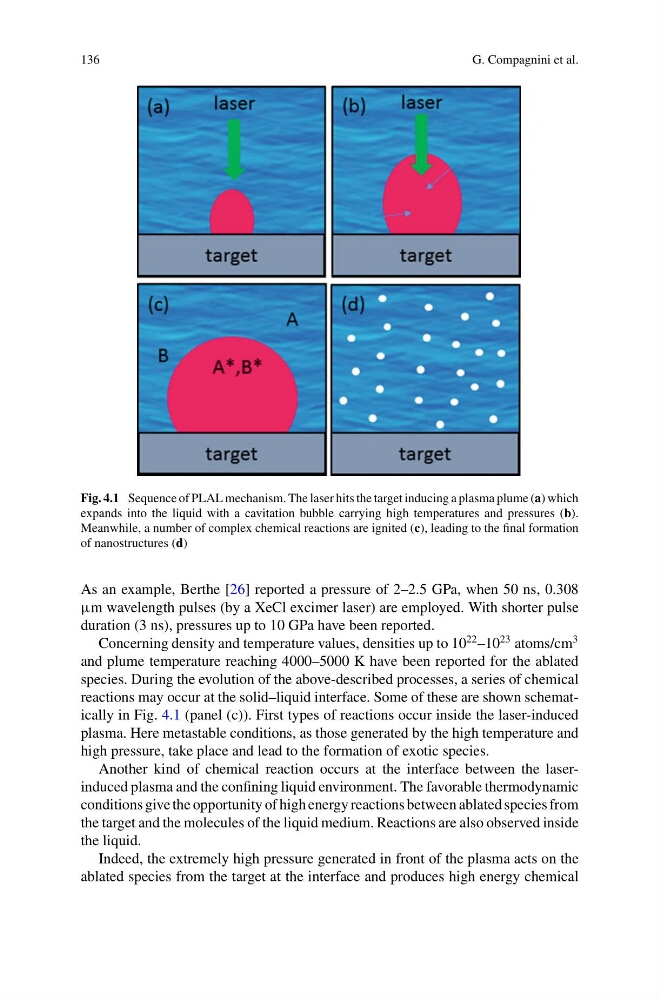
Fig. 4.1 Sequence of PLAL mechanism. The laser hits the target inducing a plasma plume (a) which
expands into the liquid with a cavitation bubble carrying high temperatures and pressures (b).
Meanwhile, a number of complex chemical reactions are ignited (c), leading to the final formation
of nanostructures (d)
As an example, Berthe [26] reported a pressure of 2–2.5 GPa, when 50 ns, 0.308
µm wavelength pulses (by a XeCl excimer laser) are employed. With shorter pulse
duration (3 ns), pressures up to 10 GPa have been reported.
Concerning density and temperature values, densities up to 10
22 –10
23 atoms/cm
3
and plume temperature reaching 4000–5000 K have been reported for the ablated
species. During the evolution of the above-described processes, a series of chemical
reactions may occur at the solid–liquid interface. Some of these are shown schematically in Fig. 4.1 (panel (c)). First types of reactions occur inside the laser-induced
plasma. Here metastable conditions, as those generated by the high temperature and
high pressure, take place and lead to the formation of exotic species.
Another kind of chemical reaction occurs at the interface between the laserinduced plasma and the confining liquid environment. The favorable thermodynamic
conditions give the opportunity of high energy reactions between ablated species from
the target and the molecules of the liquid medium. Reactions are also observed inside
the liquid.
Indeed, the extremely high pressure generated in front of the plasma acts on the
ablated species from the target at the interface and produces high energy chemical
G. Compagnini et al.
Fig. 4.1 Sequence of PLAL mechanism. The laser hits the target inducing a plasma plume (a) which
expands into the liquid with a cavitation bubble carrying high temperatures and pressures (b).
Meanwhile, a number of complex chemical reactions are ignited (c), leading to the final formation
of nanostructures (d)
As an example, Berthe [26] reported a pressure of 2–2.5 GPa, when 50 ns, 0.308
µm wavelength pulses (by a XeCl excimer laser) are employed. With shorter pulse
duration (3 ns), pressures up to 10 GPa have been reported.
Concerning density and temperature values, densities up to 10
22 –10
23 atoms/cm
3
and plume temperature reaching 4000–5000 K have been reported for the ablated
species. During the evolution of the above-described processes, a series of chemical
reactions may occur at the solid–liquid interface. Some of these are shown schematically in Fig. 4.1 (panel (c)). First types of reactions occur inside the laser-induced
plasma. Here metastable conditions, as those generated by the high temperature and
high pressure, take place and lead to the formation of exotic species.
Another kind of chemical reaction occurs at the interface between the laserinduced plasma and the confining liquid environment. The favorable thermodynamic
conditions give the opportunity of high energy reactions between ablated species from
the target and the molecules of the liquid medium. Reactions are also observed inside
the liquid.
Indeed, the extremely high pressure generated in front of the plasma acts on the
ablated species from the target at the interface and produces high energy chemical