

3 Apertureless Scanning Near-Field Optical Lithography
127
0
2
4
6
8
1 0
0.5
1.0
1.5
2.0
2.5
Number of laser pulses (10
6 )
Depth (nm)
0
2
4
6
8
1 0
0
20
40
60
80
100
Number of laser pulses (10
6 )
Width (nm)
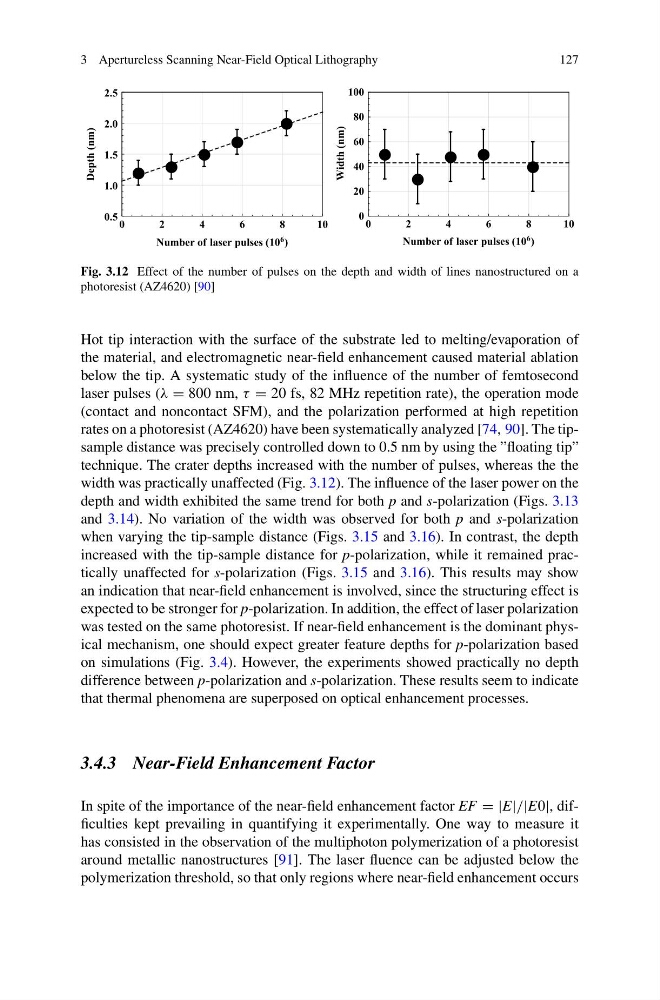
Fig. 3.12 Effect of the number of pulses on the depth and width of lines nanostructured on a
photoresist (AZ4620) [90]
Hot tip interaction with the surface of the substrate led to melting/evaporation of
the material, and electromagnetic near-field enhancement caused material ablation
below the tip. A systematic study of the influence of the number of femtosecond
laser pulses (λ = 800 nm, τ = 20 fs, 82 MHz repetition rate), the operation mode
(contact and noncontact SFM), and the polarization performed at high repetition
rates on a photoresist (AZ4620) have been systematically analyzed [74, 90]. The tipsample distance was precisely controlled down to 0.5 nm by using the ”floating tip”
technique. The crater depths increased with the number of pulses, whereas the the
width was practically unaffected (Fig. 3.12). The influence of the laser power on the
depth and width exhibited the same trend for both p and s-polarization (Figs. 3.13
and 3.14). No variation of the width was observed for both p and s-polarization
when varying the tip-sample distance (Figs. 3.15 and 3.16). In contrast, the depth
increased with the tip-sample distance for p-polarization, while it remained practically unaffected for s-polarization (Figs. 3.15 and 3.16). This results may show
an indication that near-field enhancement is involved, since the structuring effect is
expected to be stronger for p-polarization. In addition, the effect of laser polarization
was tested on the same photoresist. If near-field enhancement is the dominant physical mechanism, one should expect greater feature depths for p-polarization based
on simulations (Fig. 3.4). However, the experiments showed practically no depth
difference between p-polarization and s-polarization. These results seem to indicate
that thermal phenomena are superposed on optical enhancement processes.
3.4.3 Near-Field Enhancement Factor
In spite of the importance of the near-field enhancement factor EF = |E|/|E0|, difficulties kept prevailing in quantifying it experimentally. One way to measure it
has consisted in the observation of the multiphoton polymerization of a photoresist
around metallic nanostructures [91]. The laser fluence can be adjusted below the
polymerization threshold, so that only regions where near-field enhancement occurs
127
0
2
4
6
8
1 0
0.5
1.0
1.5
2.0
2.5
Number of laser pulses (10
6 )
Depth (nm)
0
2
4
6
8
1 0
0
20
40
60
80
100
Number of laser pulses (10
6 )
Width (nm)
Fig. 3.12 Effect of the number of pulses on the depth and width of lines nanostructured on a
photoresist (AZ4620) [90]
Hot tip interaction with the surface of the substrate led to melting/evaporation of
the material, and electromagnetic near-field enhancement caused material ablation
below the tip. A systematic study of the influence of the number of femtosecond
laser pulses (λ = 800 nm, τ = 20 fs, 82 MHz repetition rate), the operation mode
(contact and noncontact SFM), and the polarization performed at high repetition
rates on a photoresist (AZ4620) have been systematically analyzed [74, 90]. The tipsample distance was precisely controlled down to 0.5 nm by using the ”floating tip”
technique. The crater depths increased with the number of pulses, whereas the the
width was practically unaffected (Fig. 3.12). The influence of the laser power on the
depth and width exhibited the same trend for both p and s-polarization (Figs. 3.13
and 3.14). No variation of the width was observed for both p and s-polarization
when varying the tip-sample distance (Figs. 3.15 and 3.16). In contrast, the depth
increased with the tip-sample distance for p-polarization, while it remained practically unaffected for s-polarization (Figs. 3.15 and 3.16). This results may show
an indication that near-field enhancement is involved, since the structuring effect is
expected to be stronger for p-polarization. In addition, the effect of laser polarization
was tested on the same photoresist. If near-field enhancement is the dominant physical mechanism, one should expect greater feature depths for p-polarization based
on simulations (Fig. 3.4). However, the experiments showed practically no depth
difference between p-polarization and s-polarization. These results seem to indicate
that thermal phenomena are superposed on optical enhancement processes.
3.4.3 Near-Field Enhancement Factor
In spite of the importance of the near-field enhancement factor EF = |E|/|E0|, difficulties kept prevailing in quantifying it experimentally. One way to measure it
has consisted in the observation of the multiphoton polymerization of a photoresist
around metallic nanostructures [91]. The laser fluence can be adjusted below the
polymerization threshold, so that only regions where near-field enhancement occurs