

2 Ultrafast Laser Enabling Versatile Fabrication of Surface …
93
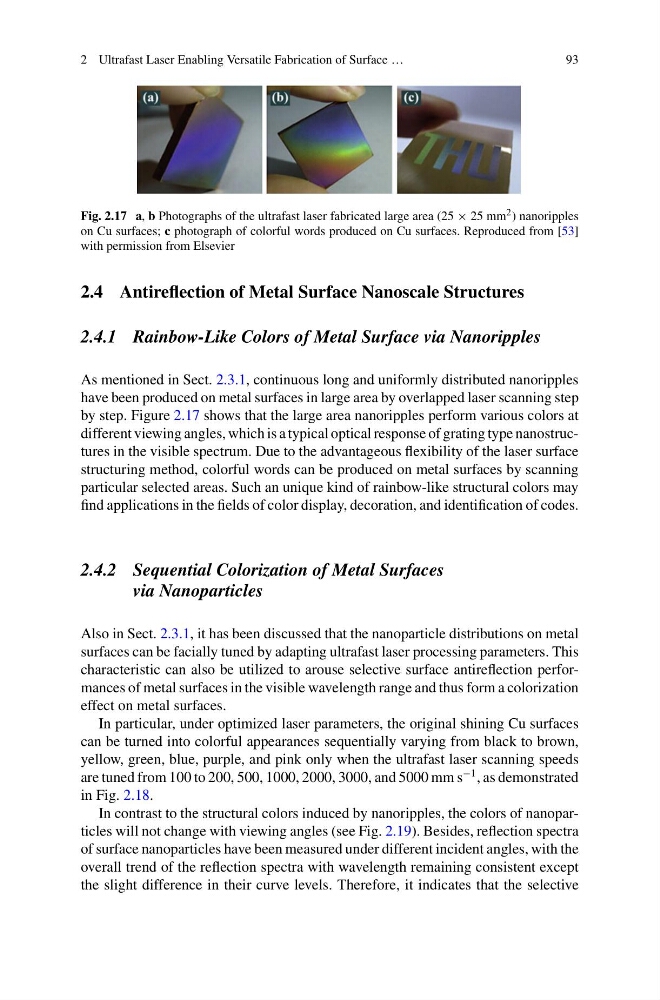
Fig. 2.17 a, b Photographs of the ultrafast laser fabricated large area (25 × 25 mm 2 ) nanoripples
on Cu surfaces; c photograph of colorful words produced on Cu surfaces. Reproduced from [53]
with permission from Elsevier
2.4 Antireflection of Metal Surface Nanoscale Structures
2.4.1 Rainbow-Like Colors of Metal Surface via Nanoripples
As mentioned in Sect. 2.3.1, continuous long and uniformly distributed nanoripples
have been produced on metal surfaces in large area by overlapped laser scanning step
by step. Figure 2.17 shows that the large area nanoripples perform various colors at
different viewing angles, which is a typical optical response of grating type nanostructures in the visible spectrum. Due to the advantageous flexibility of the laser surface
structuring method, colorful words can be produced on metal surfaces by scanning
particular selected areas. Such an unique kind of rainbow-like structural colors may
find applications in the fields of color display, decoration, and identification of codes.
2.4.2 Sequential Colorization of Metal Surfaces
via Nanoparticles
Also in Sect. 2.3.1, it has been discussed that the nanoparticle distributions on metal
surfaces can be facially tuned by adapting ultrafast laser processing parameters. This
characteristic can also be utilized to arouse selective surface antireflection performances of metal surfaces in the visible wavelength range and thus form a colorization
effect on metal surfaces.
In particular, under optimized laser parameters, the original shining Cu surfaces
can be turned into colorful appearances sequentially varying from black to brown,
yellow, green, blue, purple, and pink only when the ultrafast laser scanning speeds
are tuned from 100 to 200, 500, 1000, 2000, 3000, and 5000 mm s
−1 , as demonstrated
in Fig. 2.18.
In contrast to the structural colors induced by nanoripples, the colors of nanoparticles will not change with viewing angles (see Fig. 2.19). Besides, reflection spectra
of surface nanoparticles have been measured under different incident angles, with the
overall trend of the reflection spectra with wavelength remaining consistent except
the slight difference in their curve levels. Therefore, it indicates that the selective
93
Fig. 2.17 a, b Photographs of the ultrafast laser fabricated large area (25 × 25 mm 2 ) nanoripples
on Cu surfaces; c photograph of colorful words produced on Cu surfaces. Reproduced from [53]
with permission from Elsevier
2.4 Antireflection of Metal Surface Nanoscale Structures
2.4.1 Rainbow-Like Colors of Metal Surface via Nanoripples
As mentioned in Sect. 2.3.1, continuous long and uniformly distributed nanoripples
have been produced on metal surfaces in large area by overlapped laser scanning step
by step. Figure 2.17 shows that the large area nanoripples perform various colors at
different viewing angles, which is a typical optical response of grating type nanostructures in the visible spectrum. Due to the advantageous flexibility of the laser surface
structuring method, colorful words can be produced on metal surfaces by scanning
particular selected areas. Such an unique kind of rainbow-like structural colors may
find applications in the fields of color display, decoration, and identification of codes.
2.4.2 Sequential Colorization of Metal Surfaces
via Nanoparticles
Also in Sect. 2.3.1, it has been discussed that the nanoparticle distributions on metal
surfaces can be facially tuned by adapting ultrafast laser processing parameters. This
characteristic can also be utilized to arouse selective surface antireflection performances of metal surfaces in the visible wavelength range and thus form a colorization
effect on metal surfaces.
In particular, under optimized laser parameters, the original shining Cu surfaces
can be turned into colorful appearances sequentially varying from black to brown,
yellow, green, blue, purple, and pink only when the ultrafast laser scanning speeds
are tuned from 100 to 200, 500, 1000, 2000, 3000, and 5000 mm s
−1 , as demonstrated
in Fig. 2.18.
In contrast to the structural colors induced by nanoripples, the colors of nanoparticles will not change with viewing angles (see Fig. 2.19). Besides, reflection spectra
of surface nanoparticles have been measured under different incident angles, with the
overall trend of the reflection spectra with wavelength remaining consistent except
the slight difference in their curve levels. Therefore, it indicates that the selective