

94
M. Zhong and P. Fan
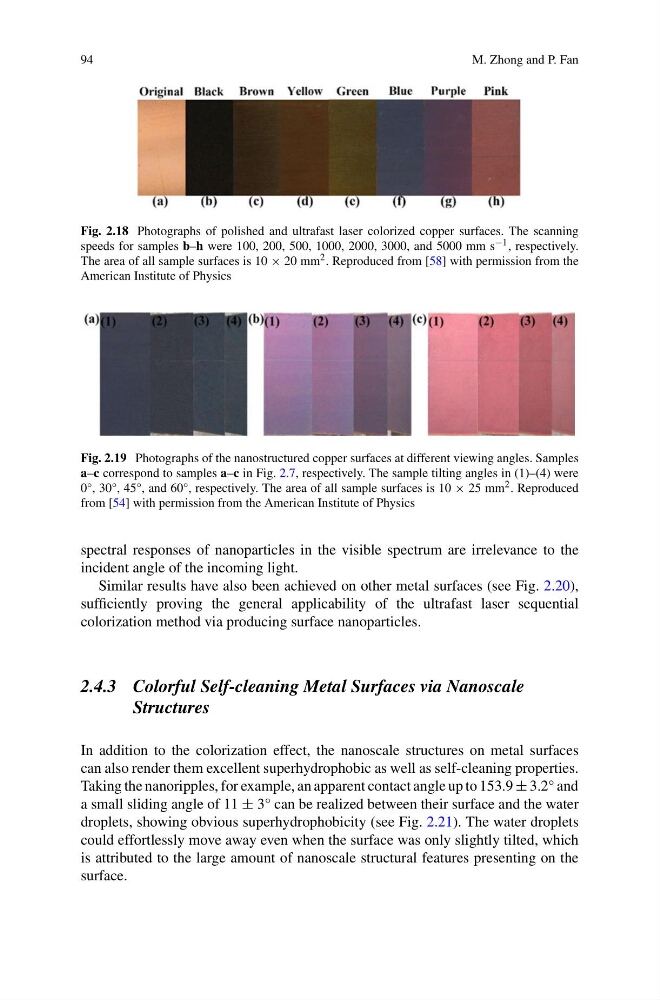
Fig. 2.18 Photographs of polished and ultrafast laser colorized copper surfaces. The scanning
speeds for samples b–h were 100, 200, 500, 1000, 2000, 3000, and 5000 mm s −1 , respectively.
The area of all sample surfaces is 10 × 20 mm 2 . Reproduced from [58] with permission from the
American Institute of Physics
Fig. 2.19 Photographs of the nanostructured copper surfaces at different viewing angles. Samples
a–c correspond to samples a–c in Fig. 2.7, respectively. The sample tilting angles in (1)–(4) were
0°, 30°, 45°, and 60°, respectively. The area of all sample surfaces is 10 × 25 mm 2 . Reproduced
from [54] with permission from the American Institute of Physics
spectral responses of nanoparticles in the visible spectrum are irrelevance to the
incident angle of the incoming light.
Similar results have also been achieved on other metal surfaces (see Fig. 2.20),
sufficiently proving the general applicability of the ultrafast laser sequential
colorization method via producing surface nanoparticles.
2.4.3 Colorful Self-cleaning Metal Surfaces via Nanoscale
Structures
In addition to the colorization effect, the nanoscale structures on metal surfaces
can also render them excellent superhydrophobic as well as self-cleaning properties.
Taking the nanoripples, for example, an apparent contact angle up to 153.9 ± 3.2° and
a small sliding angle of 11 ± 3° can be realized between their surface and the water
droplets, showing obvious superhydrophobicity (see Fig. 2.21). The water droplets
could effortlessly move away even when the surface was only slightly tilted, which
is attributed to the large amount of nanoscale structural features presenting on the
surface.
M. Zhong and P. Fan
Fig. 2.18 Photographs of polished and ultrafast laser colorized copper surfaces. The scanning
speeds for samples b–h were 100, 200, 500, 1000, 2000, 3000, and 5000 mm s −1 , respectively.
The area of all sample surfaces is 10 × 20 mm 2 . Reproduced from [58] with permission from the
American Institute of Physics
Fig. 2.19 Photographs of the nanostructured copper surfaces at different viewing angles. Samples
a–c correspond to samples a–c in Fig. 2.7, respectively. The sample tilting angles in (1)–(4) were
0°, 30°, 45°, and 60°, respectively. The area of all sample surfaces is 10 × 25 mm 2 . Reproduced
from [54] with permission from the American Institute of Physics
spectral responses of nanoparticles in the visible spectrum are irrelevance to the
incident angle of the incoming light.
Similar results have also been achieved on other metal surfaces (see Fig. 2.20),
sufficiently proving the general applicability of the ultrafast laser sequential
colorization method via producing surface nanoparticles.
2.4.3 Colorful Self-cleaning Metal Surfaces via Nanoscale
Structures
In addition to the colorization effect, the nanoscale structures on metal surfaces
can also render them excellent superhydrophobic as well as self-cleaning properties.
Taking the nanoripples, for example, an apparent contact angle up to 153.9 ± 3.2° and
a small sliding angle of 11 ± 3° can be realized between their surface and the water
droplets, showing obvious superhydrophobicity (see Fig. 2.21). The water droplets
could effortlessly move away even when the surface was only slightly tilted, which
is attributed to the large amount of nanoscale structural features presenting on the
surface.