

90
M. Zhong and P. Fan
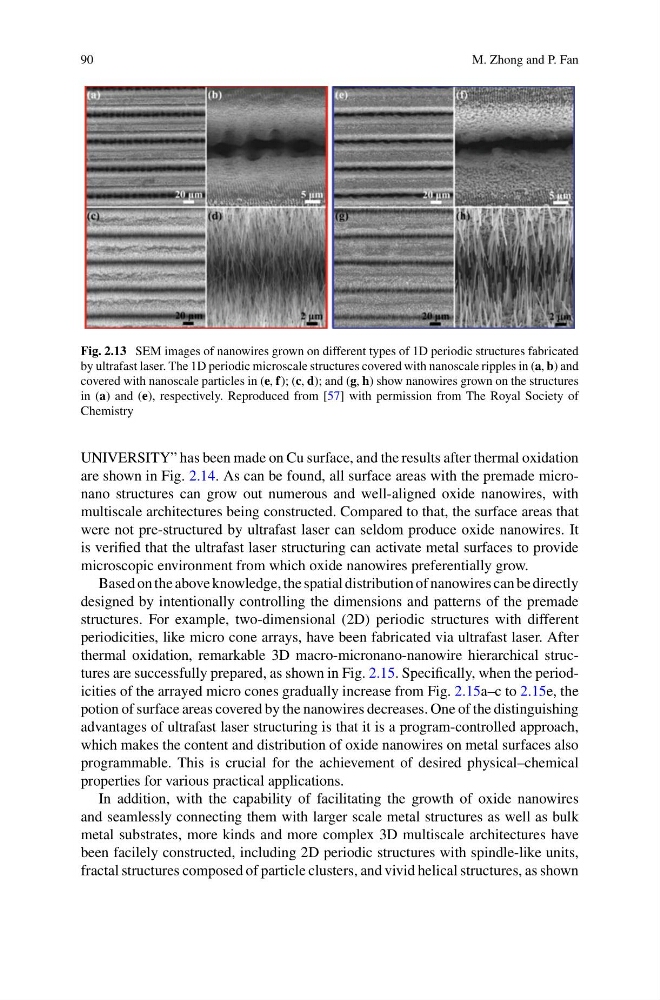
Fig. 2.13 SEM images of nanowires grown on different types of 1D periodic structures fabricated
by ultrafast laser. The 1D periodic microscale structures covered with nanoscale ripples in (a, b) and
covered with nanoscale particles in (e, f); (c, d); and (g, h) show nanowires grown on the structures
in (a) and (e), respectively. Reproduced from [57] with permission from The Royal Society of
Chemistry
UNIVERSITY” has been made on Cu surface, and the results after thermal oxidation
are shown in Fig. 2.14. As can be found, all surface areas with the premade micronano structures can grow out numerous and well-aligned oxide nanowires, with
multiscale architectures being constructed. Compared to that, the surface areas that
were not pre-structured by ultrafast laser can seldom produce oxide nanowires. It
is verified that the ultrafast laser structuring can activate metal surfaces to provide
microscopic environment from which oxide nanowires preferentially grow.
Based on the above knowledge, the spatial distribution of nanowires can be directly
designed by intentionally controlling the dimensions and patterns of the premade
structures. For example, two-dimensional (2D) periodic structures with different
periodicities, like micro cone arrays, have been fabricated via ultrafast laser. After
thermal oxidation, remarkable 3D macro-micronano-nanowire hierarchical structures are successfully prepared, as shown in Fig. 2.15. Specifically, when the periodicities of the arrayed micro cones gradually increase from Fig. 2.15a–c to 2.15e, the
potion of surface areas covered by the nanowires decreases. One of the distinguishing
advantages of ultrafast laser structuring is that it is a program-controlled approach,
which makes the content and distribution of oxide nanowires on metal surfaces also
programmable. This is crucial for the achievement of desired physical–chemical
properties for various practical applications.
In addition, with the capability of facilitating the growth of oxide nanowires
and seamlessly connecting them with larger scale metal structures as well as bulk
metal substrates, more kinds and more complex 3D multiscale architectures have
been facilely constructed, including 2D periodic structures with spindle-like units,
fractal structures composed of particle clusters, and vivid helical structures, as shown
M. Zhong and P. Fan
Fig. 2.13 SEM images of nanowires grown on different types of 1D periodic structures fabricated
by ultrafast laser. The 1D periodic microscale structures covered with nanoscale ripples in (a, b) and
covered with nanoscale particles in (e, f); (c, d); and (g, h) show nanowires grown on the structures
in (a) and (e), respectively. Reproduced from [57] with permission from The Royal Society of
Chemistry
UNIVERSITY” has been made on Cu surface, and the results after thermal oxidation
are shown in Fig. 2.14. As can be found, all surface areas with the premade micronano structures can grow out numerous and well-aligned oxide nanowires, with
multiscale architectures being constructed. Compared to that, the surface areas that
were not pre-structured by ultrafast laser can seldom produce oxide nanowires. It
is verified that the ultrafast laser structuring can activate metal surfaces to provide
microscopic environment from which oxide nanowires preferentially grow.
Based on the above knowledge, the spatial distribution of nanowires can be directly
designed by intentionally controlling the dimensions and patterns of the premade
structures. For example, two-dimensional (2D) periodic structures with different
periodicities, like micro cone arrays, have been fabricated via ultrafast laser. After
thermal oxidation, remarkable 3D macro-micronano-nanowire hierarchical structures are successfully prepared, as shown in Fig. 2.15. Specifically, when the periodicities of the arrayed micro cones gradually increase from Fig. 2.15a–c to 2.15e, the
potion of surface areas covered by the nanowires decreases. One of the distinguishing
advantages of ultrafast laser structuring is that it is a program-controlled approach,
which makes the content and distribution of oxide nanowires on metal surfaces also
programmable. This is crucial for the achievement of desired physical–chemical
properties for various practical applications.
In addition, with the capability of facilitating the growth of oxide nanowires
and seamlessly connecting them with larger scale metal structures as well as bulk
metal substrates, more kinds and more complex 3D multiscale architectures have
been facilely constructed, including 2D periodic structures with spindle-like units,
fractal structures composed of particle clusters, and vivid helical structures, as shown