

2 Ultrafast Laser Enabling Versatile Fabrication of Surface …
89
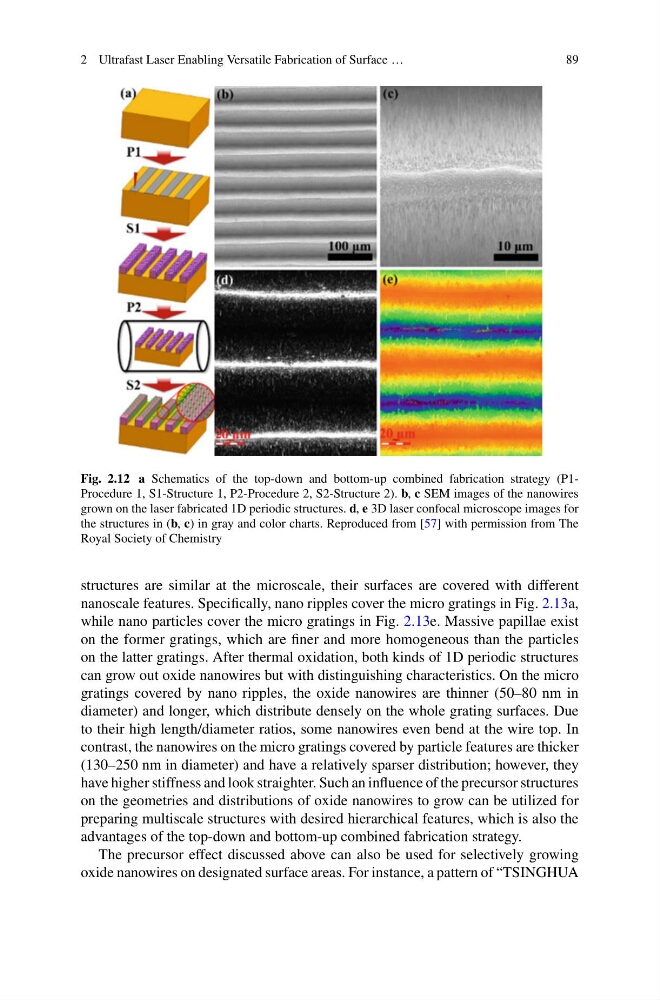
Fig. 2.12 a Schematics of the top-down and bottom-up combined fabrication strategy (P1Procedure 1, S1-Structure 1, P2-Procedure 2, S2-Structure 2). b, c SEM images of the nanowires
grown on the laser fabricated 1D periodic structures. d, e 3D laser confocal microscope images for
the structures in (b, c) in gray and color charts. Reproduced from [57] with permission from The
Royal Society of Chemistry
structures are similar at the microscale, their surfaces are covered with different
nanoscale features. Specifically, nano ripples cover the micro gratings in Fig. 2.13a,
while nano particles cover the micro gratings in Fig. 2.13e. Massive papillae exist
on the former gratings, which are finer and more homogeneous than the particles
on the latter gratings. After thermal oxidation, both kinds of 1D periodic structures
can grow out oxide nanowires but with distinguishing characteristics. On the micro
gratings covered by nano ripples, the oxide nanowires are thinner (50–80 nm in
diameter) and longer, which distribute densely on the whole grating surfaces. Due
to their high length/diameter ratios, some nanowires even bend at the wire top. In
contrast, the nanowires on the micro gratings covered by particle features are thicker
(130–250 nm in diameter) and have a relatively sparser distribution; however, they
have higher stiffness and look straighter. Such an influence of the precursor structures
on the geometries and distributions of oxide nanowires to grow can be utilized for
preparing multiscale structures with desired hierarchical features, which is also the
advantages of the top-down and bottom-up combined fabrication strategy.
The precursor effect discussed above can also be used for selectively growing
oxide nanowires on designated surface areas. For instance, a pattern of “TSINGHUA
89
Fig. 2.12 a Schematics of the top-down and bottom-up combined fabrication strategy (P1Procedure 1, S1-Structure 1, P2-Procedure 2, S2-Structure 2). b, c SEM images of the nanowires
grown on the laser fabricated 1D periodic structures. d, e 3D laser confocal microscope images for
the structures in (b, c) in gray and color charts. Reproduced from [57] with permission from The
Royal Society of Chemistry
structures are similar at the microscale, their surfaces are covered with different
nanoscale features. Specifically, nano ripples cover the micro gratings in Fig. 2.13a,
while nano particles cover the micro gratings in Fig. 2.13e. Massive papillae exist
on the former gratings, which are finer and more homogeneous than the particles
on the latter gratings. After thermal oxidation, both kinds of 1D periodic structures
can grow out oxide nanowires but with distinguishing characteristics. On the micro
gratings covered by nano ripples, the oxide nanowires are thinner (50–80 nm in
diameter) and longer, which distribute densely on the whole grating surfaces. Due
to their high length/diameter ratios, some nanowires even bend at the wire top. In
contrast, the nanowires on the micro gratings covered by particle features are thicker
(130–250 nm in diameter) and have a relatively sparser distribution; however, they
have higher stiffness and look straighter. Such an influence of the precursor structures
on the geometries and distributions of oxide nanowires to grow can be utilized for
preparing multiscale structures with desired hierarchical features, which is also the
advantages of the top-down and bottom-up combined fabrication strategy.
The precursor effect discussed above can also be used for selectively growing
oxide nanowires on designated surface areas. For instance, a pattern of “TSINGHUA