

8.1 Discrete Model
105
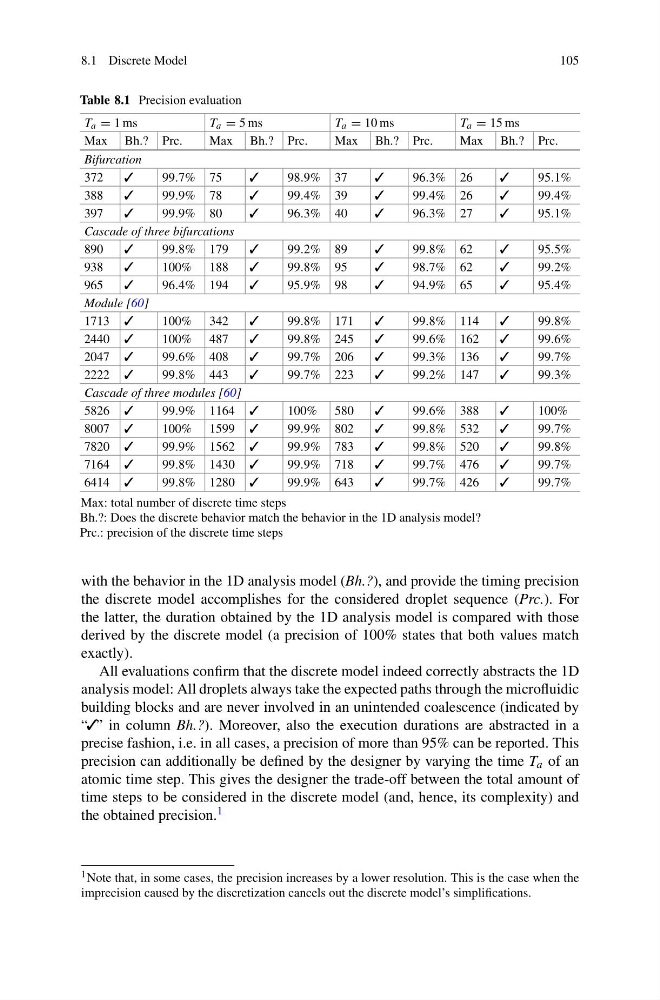
Table 8.1 Precision evaluation
T a = 1 ms
T a = 5 ms
T a = 10 ms
T a = 15 ms
Max Bh.? Prc.
Max Bh.? Prc.
Max Bh.? Prc.
Max Bh.? Prc.
Bifurcation
372
✓
99.7% 75
✓
98.9% 37
✓
96.3% 26
✓
95.1%
388
✓
99.9% 78
✓
99.4% 39
✓
99.4% 26
✓
99.4%
397
✓
99.9% 80
✓
96.3% 40
✓
96.3% 27
✓
95.1%
Cascade of three bifurcations
890
✓
99.8% 179
✓
99.2% 89
✓
99.8% 62
✓
95.5%
938
✓
100% 188
✓
99.8% 95
✓
98.7% 62
✓
99.2%
965
✓
96.4% 194
✓
95.9% 98
✓
94.9% 65
✓
95.4%
Module [60]
1713 ✓
100% 342
✓
99.8% 171
✓
99.8% 114
✓
99.8%
2440 ✓
100% 487
✓
99.8% 245
✓
99.6% 162
✓
99.6%
2047 ✓
99.6% 408
✓
99.7% 206
✓
99.3% 136
✓
99.7%
2222 ✓
99.8% 443
✓
99.7% 223
✓
99.2% 147
✓
99.3%
Cascade of three modules [60]
5826 ✓
99.9% 1164 ✓
100% 580
✓
99.6% 388
✓
100%
8007 ✓
100% 1599 ✓
99.9% 802
✓
99.8% 532
✓
99.7%
7820 ✓
99.9% 1562 ✓
99.9% 783
✓
99.8% 520
✓
99.8%
7164 ✓
99.8% 1430 ✓
99.9% 718
✓
99.7% 476
✓
99.7%
6414 ✓
99.8% 1280 ✓
99.9% 643
✓
99.7% 426
✓
99.7%
Max: total number of discrete time steps
Bh.?: Does the discrete behavior match the behavior in the 1D analysis model?
Prc.: precision of the discrete time steps
with the behavior in the 1D analysis model (Bh.?), and provide the timing precision
the discrete model accomplishes for the considered droplet sequence (Prc.). For
the latter, the duration obtained by the 1D analysis model is compared with those
derived by the discrete model (a precision of 100% states that both values match
exactly).
All evaluations confirm that the discrete model indeed correctly abstracts the 1D
analysis model: All droplets always take the expected paths through the microfluidic
building blocks and are never involved in an unintended coalescence (indicated by
“✓” in column Bh.?). Moreover, also the execution durations are abstracted in a
precise fashion, i.e. in all cases, a precision of more than 95% can be reported. This
precision can additionally be defined by the designer by varying the time T a of an
atomic time step. This gives the designer the trade-off between the total amount of
time steps to be considered in the discrete model (and, hence, its complexity) and
the obtained precision. 1
1 Note that, in some cases, the precision increases by a lower resolution. This is the case when the
imprecision caused by the discretization cancels out the discrete model’s simplifications.
105
Table 8.1 Precision evaluation
T a = 1 ms
T a = 5 ms
T a = 10 ms
T a = 15 ms
Max Bh.? Prc.
Max Bh.? Prc.
Max Bh.? Prc.
Max Bh.? Prc.
Bifurcation
372
✓
99.7% 75
✓
98.9% 37
✓
96.3% 26
✓
95.1%
388
✓
99.9% 78
✓
99.4% 39
✓
99.4% 26
✓
99.4%
397
✓
99.9% 80
✓
96.3% 40
✓
96.3% 27
✓
95.1%
Cascade of three bifurcations
890
✓
99.8% 179
✓
99.2% 89
✓
99.8% 62
✓
95.5%
938
✓
100% 188
✓
99.8% 95
✓
98.7% 62
✓
99.2%
965
✓
96.4% 194
✓
95.9% 98
✓
94.9% 65
✓
95.4%
Module [60]
1713 ✓
100% 342
✓
99.8% 171
✓
99.8% 114
✓
99.8%
2440 ✓
100% 487
✓
99.8% 245
✓
99.6% 162
✓
99.6%
2047 ✓
99.6% 408
✓
99.7% 206
✓
99.3% 136
✓
99.7%
2222 ✓
99.8% 443
✓
99.7% 223
✓
99.2% 147
✓
99.3%
Cascade of three modules [60]
5826 ✓
99.9% 1164 ✓
100% 580
✓
99.6% 388
✓
100%
8007 ✓
100% 1599 ✓
99.9% 802
✓
99.8% 532
✓
99.7%
7820 ✓
99.9% 1562 ✓
99.9% 783
✓
99.8% 520
✓
99.8%
7164 ✓
99.8% 1430 ✓
99.9% 718
✓
99.7% 476
✓
99.7%
6414 ✓
99.8% 1280 ✓
99.9% 643
✓
99.7% 426
✓
99.7%
Max: total number of discrete time steps
Bh.?: Does the discrete behavior match the behavior in the 1D analysis model?
Prc.: precision of the discrete time steps
with the behavior in the 1D analysis model (Bh.?), and provide the timing precision
the discrete model accomplishes for the considered droplet sequence (Prc.). For
the latter, the duration obtained by the 1D analysis model is compared with those
derived by the discrete model (a precision of 100% states that both values match
exactly).
All evaluations confirm that the discrete model indeed correctly abstracts the 1D
analysis model: All droplets always take the expected paths through the microfluidic
building blocks and are never involved in an unintended coalescence (indicated by
“✓” in column Bh.?). Moreover, also the execution durations are abstracted in a
precise fashion, i.e. in all cases, a precision of more than 95% can be reported. This
precision can additionally be defined by the designer by varying the time T a of an
atomic time step. This gives the designer the trade-off between the total amount of
time steps to be considered in the discrete model (and, hence, its complexity) and
the obtained precision. 1
1 Note that, in some cases, the precision increases by a lower resolution. This is the case when the
imprecision caused by the discretization cancels out the discrete model’s simplifications.