

62
7 The Crystalline Solid—Dislocations
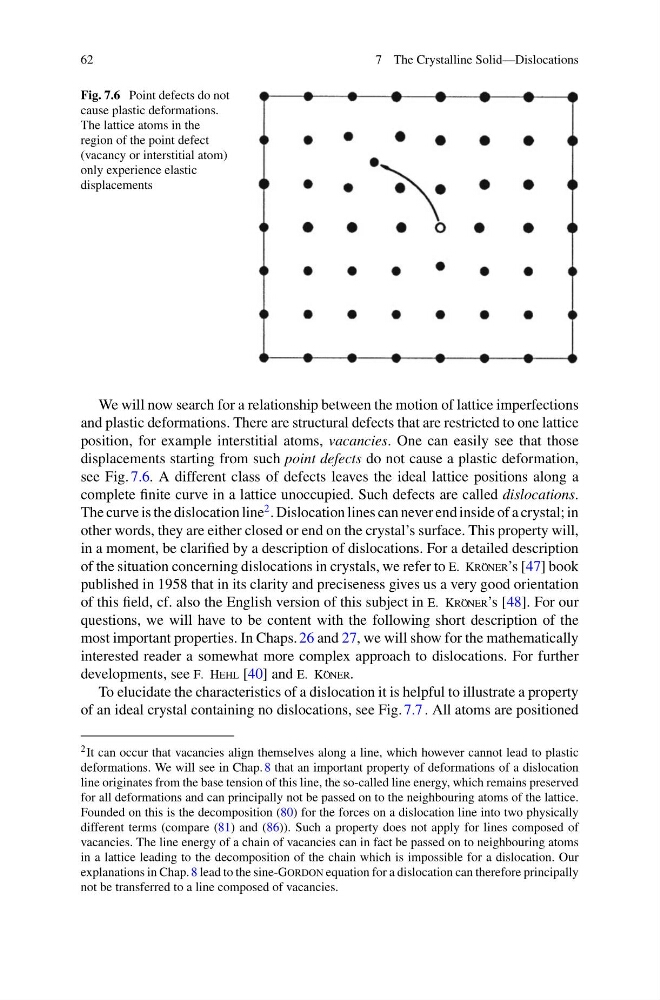
Fig. 7.6 Point defects do not
cause plastic deformations.
The lattice atoms in the
region of the point defect
(vacancy or interstitial atom)
only experience elastic
displacements
We will now search for a relationship between the motion of lattice imperfections
and plastic deformations. There are structural defects that are restricted to one lattice
position, for example interstitial atoms, vacancies. One can easily see that those
displacements starting from such point defects do not cause a plastic deformation,
see Fig. 7.6. A different class of defects leaves the ideal lattice positions along a
complete finite curve in a lattice unoccupied. Such defects are called dislocations.
The curve is the dislocation line
2 . Dislocation lines can never end inside of a crystal; in
other words, they are either closed or end on the crystal’s surface. This property will,
in a moment, be clarified by a description of dislocations. For a detailed description
of the situation concerning dislocations in crystals, we refer to E. Kröner’s [47] book
published in 1958 that in its clarity and preciseness gives us a very good orientation
of this field, cf. also the English version of this subject in E. Kröner’s [48]. For our
questions, we will have to be content with the following short description of the
most important properties. In Chaps. 26 and 27, we will show for the mathematically
interested reader a somewhat more complex approach to dislocations. For further
developments, see F. Hehl [40] and E. Köner.
To elucidate the characteristics of a dislocation it is helpful to illustrate a property
of an ideal crystal containing no dislocations, see Fig. 7.7 . All atoms are positioned
2 It can occur that vacancies align themselves along a line, which however cannot lead to plastic
deformations. We will see in Chap. 8 that an important property of deformations of a dislocation
line originates from the base tension of this line, the so-called line energy, which remains preserved
for all deformations and can principally not be passed on to the neighbouring atoms of the lattice.
Founded on this is the decomposition (80) for the forces on a dislocation line into two physically
different terms (compare (81) and (86)). Such a property does not apply for lines composed of
vacancies. The line energy of a chain of vacancies can in fact be passed on to neighbouring atoms
in a lattice leading to the decomposition of the chain which is impossible for a dislocation. Our
explanations in Chap. 8 lead to the sine-Gordon equation for a dislocation can therefore principally
not be transferred to a line composed of vacancies.
7 The Crystalline Solid—Dislocations
Fig. 7.6 Point defects do not
cause plastic deformations.
The lattice atoms in the
region of the point defect
(vacancy or interstitial atom)
only experience elastic
displacements
We will now search for a relationship between the motion of lattice imperfections
and plastic deformations. There are structural defects that are restricted to one lattice
position, for example interstitial atoms, vacancies. One can easily see that those
displacements starting from such point defects do not cause a plastic deformation,
see Fig. 7.6. A different class of defects leaves the ideal lattice positions along a
complete finite curve in a lattice unoccupied. Such defects are called dislocations.
The curve is the dislocation line
2 . Dislocation lines can never end inside of a crystal; in
other words, they are either closed or end on the crystal’s surface. This property will,
in a moment, be clarified by a description of dislocations. For a detailed description
of the situation concerning dislocations in crystals, we refer to E. Kröner’s [47] book
published in 1958 that in its clarity and preciseness gives us a very good orientation
of this field, cf. also the English version of this subject in E. Kröner’s [48]. For our
questions, we will have to be content with the following short description of the
most important properties. In Chaps. 26 and 27, we will show for the mathematically
interested reader a somewhat more complex approach to dislocations. For further
developments, see F. Hehl [40] and E. Köner.
To elucidate the characteristics of a dislocation it is helpful to illustrate a property
of an ideal crystal containing no dislocations, see Fig. 7.7 . All atoms are positioned
2 It can occur that vacancies align themselves along a line, which however cannot lead to plastic
deformations. We will see in Chap. 8 that an important property of deformations of a dislocation
line originates from the base tension of this line, the so-called line energy, which remains preserved
for all deformations and can principally not be passed on to the neighbouring atoms of the lattice.
Founded on this is the decomposition (80) for the forces on a dislocation line into two physically
different terms (compare (81) and (86)). Such a property does not apply for lines composed of
vacancies. The line energy of a chain of vacancies can in fact be passed on to neighbouring atoms
in a lattice leading to the decomposition of the chain which is impossible for a dislocation. Our
explanations in Chap. 8 lead to the sine-Gordon equation for a dislocation can therefore principally
not be transferred to a line composed of vacancies.