

7 The Crystalline Solid—Dislocations
61
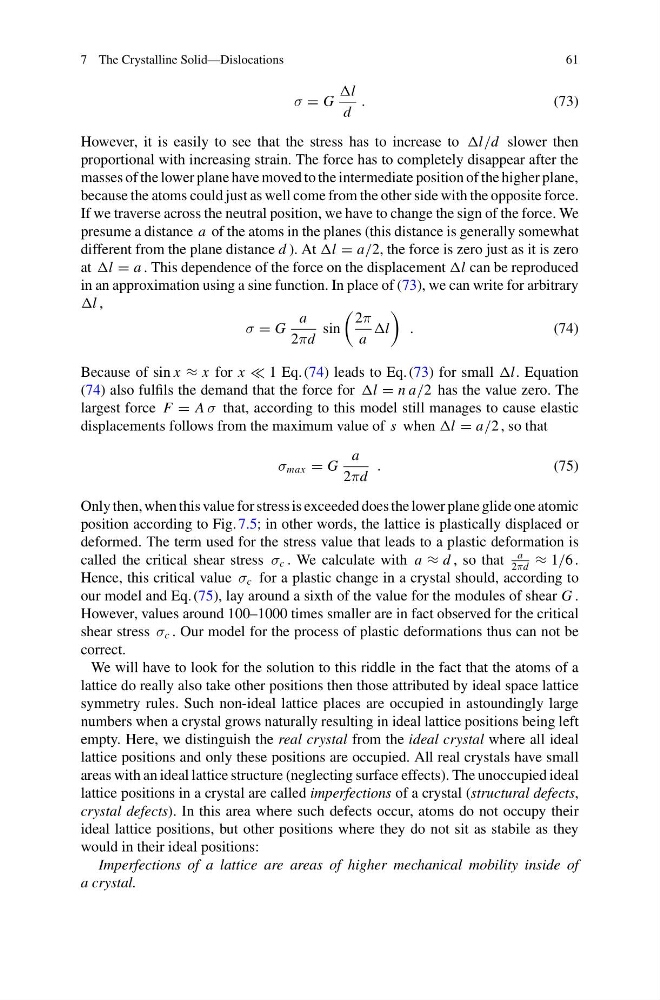
σ = G
l
d
.
(73)
However, it is easily to see that the stress has to increase to l/d slower then
proportional with increasing strain. The force has to completely disappear after the
masses of the lower plane have moved to the intermediate position of the higher plane,
because the atoms could just as well come from the other side with the opposite force.
If we traverse across the neutral position, we have to change the sign of the force. We
presume a distance a of the atoms in the planes (this distance is generally somewhat
different from the plane distance d ). At l = a/2, the force is zero just as it is zero
at l = a . This dependence of the force on the displacement l can be reproduced
in an approximation using a sine function. In place of (73), we can write for arbitrary
l ,
σ = G
a
2πd
sin
2π
a
l
.
(74)
Because of sin x ≈ x for x 1 Eq.(74) leads to Eq. (73) for small l. Equation
(74) also fulfils the demand that the force for l = n a/2 has the value zero. The
largest force F = A σ that, according to this model still manages to cause elastic
displacements follows from the maximum value of s when l = a/2 , so that
σ max = G
a
2πd
.
(75)
Only then, when this value for stress is exceeded does the lower plane glide one atomic
position according to Fig. 7.5; in other words, the lattice is plastically displaced or
deformed. The term used for the stress value that leads to a plastic deformation is
called the critical shear stress σ c . We calculate with a ≈ d , so that
a
2πd
≈ 1/6 .
Hence, this critical value σ c for a plastic change in a crystal should, according to
our model and Eq. (75), lay around a sixth of the value for the modules of shear G .
However, values around 100–1000 times smaller are in fact observed for the critical
shear stress σ c . Our model for the process of plastic deformations thus can not be
correct.
We will have to look for the solution to this riddle in the fact that the atoms of a
lattice do really also take other positions then those attributed by ideal space lattice
symmetry rules. Such non-ideal lattice places are occupied in astoundingly large
numbers when a crystal grows naturally resulting in ideal lattice positions being left
empty. Here, we distinguish the real crystal from the ideal crystal where all ideal
lattice positions and only these positions are occupied. All real crystals have small
areas with an ideal lattice structure (neglecting surface effects). The unoccupied ideal
lattice positions in a crystal are called imperfections of a crystal (structural defects,
crystal defects). In this area where such defects occur, atoms do not occupy their
ideal lattice positions, but other positions where they do not sit as stabile as they
would in their ideal positions:
Imperfections of a lattice are areas of higher mechanical mobility inside of
a crystal.
61
σ = G
l
d
.
(73)
However, it is easily to see that the stress has to increase to l/d slower then
proportional with increasing strain. The force has to completely disappear after the
masses of the lower plane have moved to the intermediate position of the higher plane,
because the atoms could just as well come from the other side with the opposite force.
If we traverse across the neutral position, we have to change the sign of the force. We
presume a distance a of the atoms in the planes (this distance is generally somewhat
different from the plane distance d ). At l = a/2, the force is zero just as it is zero
at l = a . This dependence of the force on the displacement l can be reproduced
in an approximation using a sine function. In place of (73), we can write for arbitrary
l ,
σ = G
a
2πd
sin
2π
a
l
.
(74)
Because of sin x ≈ x for x 1 Eq.(74) leads to Eq. (73) for small l. Equation
(74) also fulfils the demand that the force for l = n a/2 has the value zero. The
largest force F = A σ that, according to this model still manages to cause elastic
displacements follows from the maximum value of s when l = a/2 , so that
σ max = G
a
2πd
.
(75)
Only then, when this value for stress is exceeded does the lower plane glide one atomic
position according to Fig. 7.5; in other words, the lattice is plastically displaced or
deformed. The term used for the stress value that leads to a plastic deformation is
called the critical shear stress σ c . We calculate with a ≈ d , so that
a
2πd
≈ 1/6 .
Hence, this critical value σ c for a plastic change in a crystal should, according to
our model and Eq. (75), lay around a sixth of the value for the modules of shear G .
However, values around 100–1000 times smaller are in fact observed for the critical
shear stress σ c . Our model for the process of plastic deformations thus can not be
correct.
We will have to look for the solution to this riddle in the fact that the atoms of a
lattice do really also take other positions then those attributed by ideal space lattice
symmetry rules. Such non-ideal lattice places are occupied in astoundingly large
numbers when a crystal grows naturally resulting in ideal lattice positions being left
empty. Here, we distinguish the real crystal from the ideal crystal where all ideal
lattice positions and only these positions are occupied. All real crystals have small
areas with an ideal lattice structure (neglecting surface effects). The unoccupied ideal
lattice positions in a crystal are called imperfections of a crystal (structural defects,
crystal defects). In this area where such defects occur, atoms do not occupy their
ideal lattice positions, but other positions where they do not sit as stabile as they
would in their ideal positions:
Imperfections of a lattice are areas of higher mechanical mobility inside of
a crystal.