

60
7 The Crystalline Solid—Dislocations
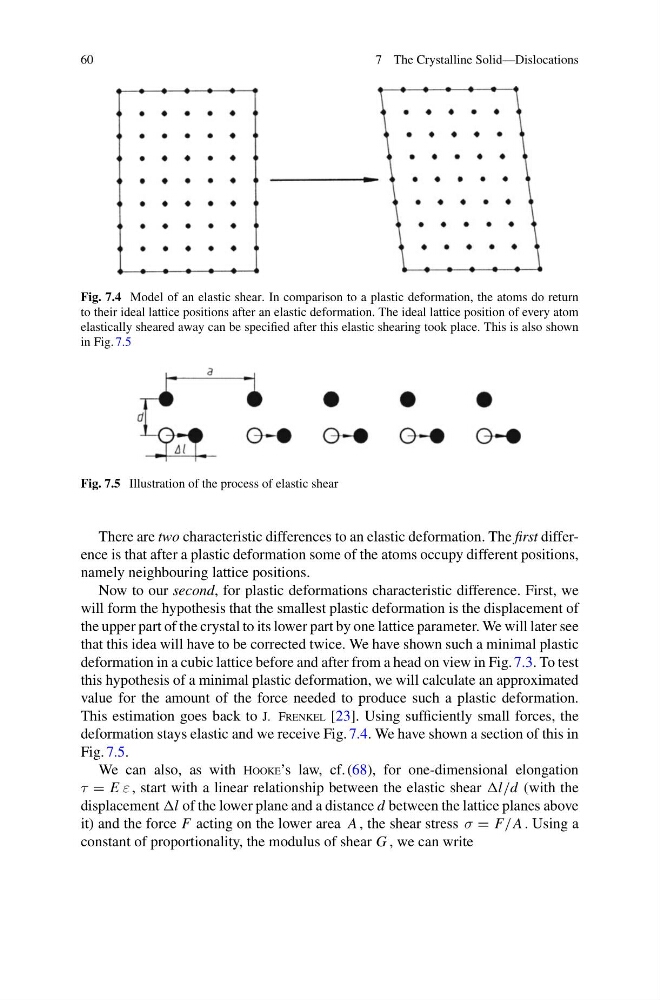
Fig. 7.4 Model of an elastic shear. In comparison to a plastic deformation, the atoms do return
to their ideal lattice positions after an elastic deformation. The ideal lattice position of every atom
elastically sheared away can be specified after this elastic shearing took place. This is also shown
in Fig. 7.5
Fig. 7.5 Illustration of the process of elastic shear
There are two characteristic differences to an elastic deformation. The first difference is that after a plastic deformation some of the atoms occupy different positions,
namely neighbouring lattice positions.
Now to our second, for plastic deformations characteristic difference. First, we
will form the hypothesis that the smallest plastic deformation is the displacement of
the upper part of the crystal to its lower part by one lattice parameter. We will later see
that this idea will have to be corrected twice. We have shown such a minimal plastic
deformation in a cubic lattice before and after from a head on view in Fig. 7.3. To test
this hypothesis of a minimal plastic deformation, we will calculate an approximated
value for the amount of the force needed to produce such a plastic deformation.
This estimation goes back to J. Frenkel [23]. Using sufficiently small forces, the
deformation stays elastic and we receive Fig. 7.4. We have shown a section of this in
Fig. 7.5.
We can also, as with Hooke’s law, cf. (68), for one-dimensional elongation
τ = E ε , start with a linear relationship between the elastic shear l/d (with the
displacement l of the lower plane and a distance d between the lattice planes above
it) and the force F acting on the lower area A , the shear stress σ = F/A . Using a
constant of proportionality, the modulus of shear G , we can write
7 The Crystalline Solid—Dislocations
Fig. 7.4 Model of an elastic shear. In comparison to a plastic deformation, the atoms do return
to their ideal lattice positions after an elastic deformation. The ideal lattice position of every atom
elastically sheared away can be specified after this elastic shearing took place. This is also shown
in Fig. 7.5
Fig. 7.5 Illustration of the process of elastic shear
There are two characteristic differences to an elastic deformation. The first difference is that after a plastic deformation some of the atoms occupy different positions,
namely neighbouring lattice positions.
Now to our second, for plastic deformations characteristic difference. First, we
will form the hypothesis that the smallest plastic deformation is the displacement of
the upper part of the crystal to its lower part by one lattice parameter. We will later see
that this idea will have to be corrected twice. We have shown such a minimal plastic
deformation in a cubic lattice before and after from a head on view in Fig. 7.3. To test
this hypothesis of a minimal plastic deformation, we will calculate an approximated
value for the amount of the force needed to produce such a plastic deformation.
This estimation goes back to J. Frenkel [23]. Using sufficiently small forces, the
deformation stays elastic and we receive Fig. 7.4. We have shown a section of this in
Fig. 7.5.
We can also, as with Hooke’s law, cf. (68), for one-dimensional elongation
τ = E ε , start with a linear relationship between the elastic shear l/d (with the
displacement l of the lower plane and a distance d between the lattice planes above
it) and the force F acting on the lower area A , the shear stress σ = F/A . Using a
constant of proportionality, the modulus of shear G , we can write