

28 Particles and Tachyons
305
of the tachyon has one and the same critical value m
T
∗ c o for both u −→ +∞ and
u −→ −∞. This condition must be met for the following reason.
We can immediately see from the composition of velocities (415): Not only the
tachyon with the velocity u
= +∞, as seen from
, but also the tachyon with the
velocity u
= −∞ in
has, when observed from o , one and the same velocity
u = c
2
o /V , where V the velocity of
is with respect to o . Seen from o , the
tachyon has the same momentum for both critical values. It can therefore not possess
two different critical values for the momentum in
. The factor δ is therefore
absolutely necessary in order to guarantee uniqueness for the momentum of the
tachyon.
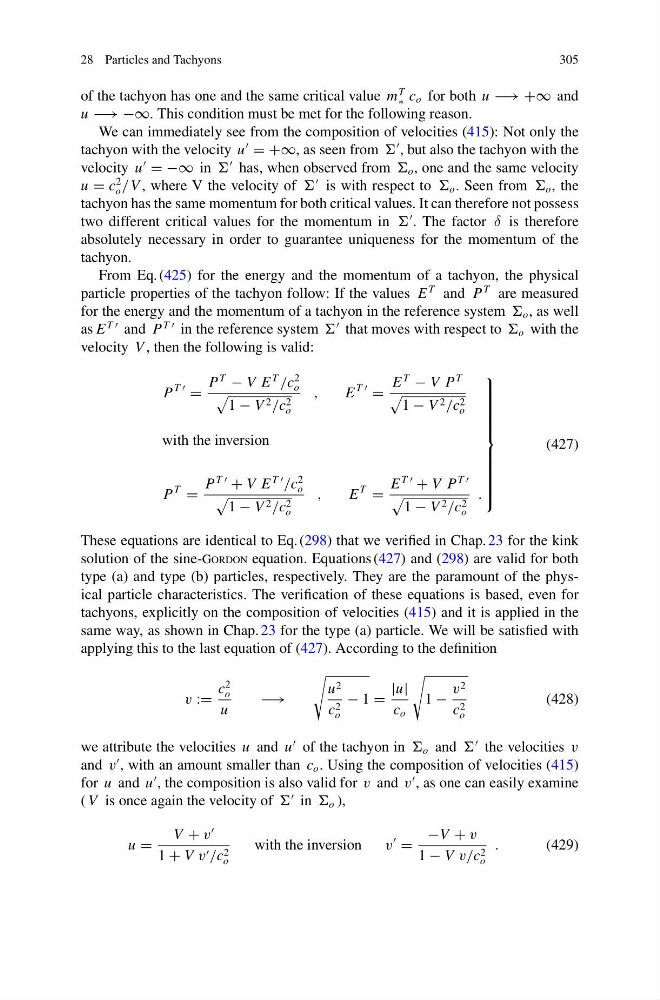
From Eq. (425) for the energy and the momentum of a tachyon, the physical
particle properties of the tachyon follow: If the values E
T and P
T are measured
for the energy and the momentum of a tachyon in the reference system o , as well
as E
T and P
T in the reference system
that moves with respect to o with the
velocity V , then the following is valid:
P
T
=
P
T
− V E
T
/c
2
o
1 − V 2 /c 2
o
,
E
T
=
E
T
− V P
T
1 − V 2 /c 2
o
with the inversion
P
T
=
P
T
+ V E
T
/c
2
o
1 − V 2 /c 2
o
,
E
T
=
E
T
+ V P
T
1 − V 2 /c 2
o
.
⎫
⎪ ⎪ ⎪ ⎪ ⎪ ⎪ ⎪ ⎪ ⎪ ⎬
⎪ ⎪ ⎪ ⎪ ⎪ ⎪ ⎪ ⎪ ⎪ ⎭
(427)
These equations are identical to Eq. (298) that we verified in Chap. 23 for the kink
solution of the sine-Gordon equation. Equations (427) and (298) are valid for both
type (a) and type (b) particles, respectively. They are the paramount of the physical particle characteristics. The verification of these equations is based, even for
tachyons, explicitly on the composition of velocities (415) and it is applied in the
same way, as shown in Chap. 23 for the type (a) particle. We will be satisfied with
applying this to the last equation of (427). According to the definition
v :=
c
2
o
u
−→
u 2
c 2
o
− 1 =
|u|
c o
1 −
v 2
c 2
o
(428)
we attribute the velocities u and u
of the tachyon in o and
the velocities v
and v
, with an amount smaller than c o . Using the composition of velocities (415)
for u and u
, the composition is also valid for v and v
, as one can easily examine
( V is once again the velocity of
in o ),
u =
V + v
1 + V v /c 2
o
with the inversion
v
=
−V + v
1 − V v/c 2
o
.
(429)
305
of the tachyon has one and the same critical value m
T
∗ c o for both u −→ +∞ and
u −→ −∞. This condition must be met for the following reason.
We can immediately see from the composition of velocities (415): Not only the
tachyon with the velocity u
= +∞, as seen from
, but also the tachyon with the
velocity u
= −∞ in
has, when observed from o , one and the same velocity
u = c
2
o /V , where V the velocity of
is with respect to o . Seen from o , the
tachyon has the same momentum for both critical values. It can therefore not possess
two different critical values for the momentum in
. The factor δ is therefore
absolutely necessary in order to guarantee uniqueness for the momentum of the
tachyon.
From Eq. (425) for the energy and the momentum of a tachyon, the physical
particle properties of the tachyon follow: If the values E
T and P
T are measured
for the energy and the momentum of a tachyon in the reference system o , as well
as E
T and P
T in the reference system
that moves with respect to o with the
velocity V , then the following is valid:
P
T
=
P
T
− V E
T
/c
2
o
1 − V 2 /c 2
o
,
E
T
=
E
T
− V P
T
1 − V 2 /c 2
o
with the inversion
P
T
=
P
T
+ V E
T
/c
2
o
1 − V 2 /c 2
o
,
E
T
=
E
T
+ V P
T
1 − V 2 /c 2
o
.
⎫
⎪ ⎪ ⎪ ⎪ ⎪ ⎪ ⎪ ⎪ ⎪ ⎬
⎪ ⎪ ⎪ ⎪ ⎪ ⎪ ⎪ ⎪ ⎪ ⎭
(427)
These equations are identical to Eq. (298) that we verified in Chap. 23 for the kink
solution of the sine-Gordon equation. Equations (427) and (298) are valid for both
type (a) and type (b) particles, respectively. They are the paramount of the physical particle characteristics. The verification of these equations is based, even for
tachyons, explicitly on the composition of velocities (415) and it is applied in the
same way, as shown in Chap. 23 for the type (a) particle. We will be satisfied with
applying this to the last equation of (427). According to the definition
v :=
c
2
o
u
−→
u 2
c 2
o
− 1 =
|u|
c o
1 −
v 2
c 2
o
(428)
we attribute the velocities u and u
of the tachyon in o and
the velocities v
and v
, with an amount smaller than c o . Using the composition of velocities (415)
for u and u
, the composition is also valid for v and v
, as one can easily examine
( V is once again the velocity of
in o ),
u =
V + v
1 + V v /c 2
o
with the inversion
v
=
−V + v
1 − V v/c 2
o
.
(429)