

304
28 Particles and Tachyons
P =
m o
1 − v 2 /c 2
o
v , E =
m o
1 − v 2 /c 2
o
c
2
o .
(424)
The parameter ξ o of this particle is called its restmass m o and it is
P o = 0 , E o = m o c
2
o .
(424a)
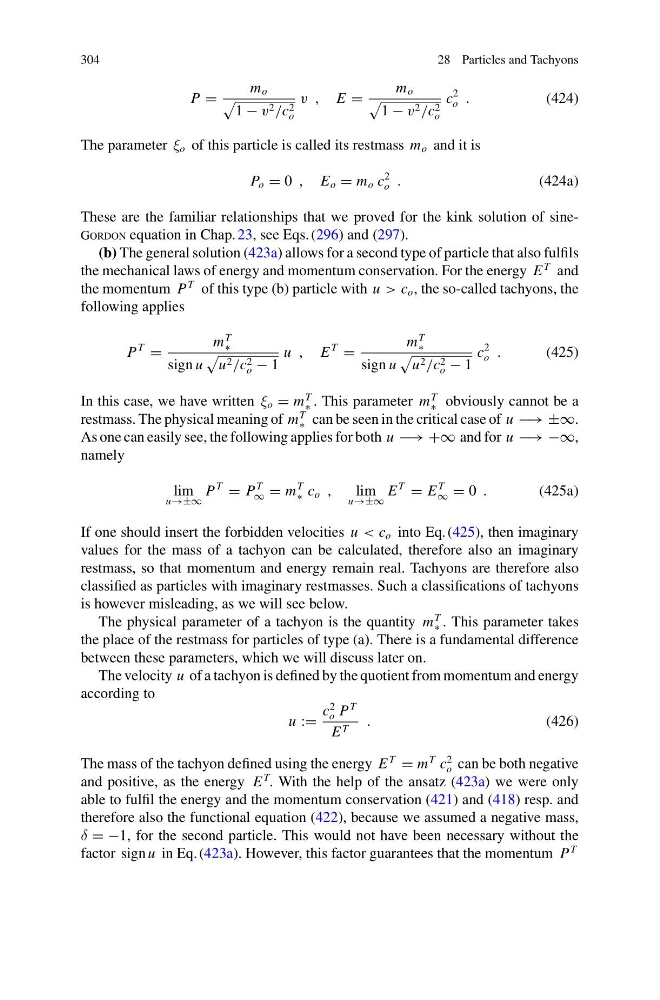
These are the familiar relationships that we proved for the kink solution of sineGordon equation in Chap. 23, see Eqs. (296) and (297).
(b) The general solution (423a) allows for a second type of particle that also fulfils
the mechanical laws of energy and momentum conservation. For the energy E
T and
the momentum P
T of this type (b) particle with u > c o , the so-called tachyons, the
following applies
P
T
=
m
T
∗
sign u
u 2 /c 2
o − 1
u , E
T
=
m
T
∗
sign u
u 2 /c 2
o − 1
c
2
o .
(425)
In this case, we have written ξ o = m
T
∗ . This parameter m
T
∗ obviously cannot be a
restmass. The physical meaning of m
T
∗ can be seen in the critical case of u −→ ±∞.
As one can easily see, the following applies for both u −→ +∞ and for u −→ −∞,
namely
lim
u→±∞
P
T
= P
T
∞ = m
T
∗ c o ,
lim
u→±∞
E
T
= E
T
∞ = 0 .
(425a)
If one should insert the forbidden velocities u < c o into Eq. (425), then imaginary
values for the mass of a tachyon can be calculated, therefore also an imaginary
restmass, so that momentum and energy remain real. Tachyons are therefore also
classified as particles with imaginary restmasses. Such a classifications of tachyons
is however misleading, as we will see below.
The physical parameter of a tachyon is the quantity m
T
∗ . This parameter takes
the place of the restmass for particles of type (a). There is a fundamental difference
between these parameters, which we will discuss later on.
The velocity u of a tachyon is defined by the quotient from momentum and energy
according to
u :=
c
2
o P
T
E T .
(426)
The mass of the tachyon defined using the energy E
T
= m
T c
2
o can be both negative
and positive, as the energy E
T
. With the help of the ansatz (423a) we were only
able to fulfil the energy and the momentum conservation (421) and (418) resp. and
therefore also the functional equation (422), because we assumed a negative mass,
δ = −1, for the second particle. This would not have been necessary without the
factor sign u in Eq. (423a). However, this factor guarantees that the momentum P
T
28 Particles and Tachyons
P =
m o
1 − v 2 /c 2
o
v , E =
m o
1 − v 2 /c 2
o
c
2
o .
(424)
The parameter ξ o of this particle is called its restmass m o and it is
P o = 0 , E o = m o c
2
o .
(424a)
These are the familiar relationships that we proved for the kink solution of sineGordon equation in Chap. 23, see Eqs. (296) and (297).
(b) The general solution (423a) allows for a second type of particle that also fulfils
the mechanical laws of energy and momentum conservation. For the energy E
T and
the momentum P
T of this type (b) particle with u > c o , the so-called tachyons, the
following applies
P
T
=
m
T
∗
sign u
u 2 /c 2
o − 1
u , E
T
=
m
T
∗
sign u
u 2 /c 2
o − 1
c
2
o .
(425)
In this case, we have written ξ o = m
T
∗ . This parameter m
T
∗ obviously cannot be a
restmass. The physical meaning of m
T
∗ can be seen in the critical case of u −→ ±∞.
As one can easily see, the following applies for both u −→ +∞ and for u −→ −∞,
namely
lim
u→±∞
P
T
= P
T
∞ = m
T
∗ c o ,
lim
u→±∞
E
T
= E
T
∞ = 0 .
(425a)
If one should insert the forbidden velocities u < c o into Eq. (425), then imaginary
values for the mass of a tachyon can be calculated, therefore also an imaginary
restmass, so that momentum and energy remain real. Tachyons are therefore also
classified as particles with imaginary restmasses. Such a classifications of tachyons
is however misleading, as we will see below.
The physical parameter of a tachyon is the quantity m
T
∗ . This parameter takes
the place of the restmass for particles of type (a). There is a fundamental difference
between these parameters, which we will discuss later on.
The velocity u of a tachyon is defined by the quotient from momentum and energy
according to
u :=
c
2
o P
T
E T .
(426)
The mass of the tachyon defined using the energy E
T
= m
T c
2
o can be both negative
and positive, as the energy E
T
. With the help of the ansatz (423a) we were only
able to fulfil the energy and the momentum conservation (421) and (418) resp. and
therefore also the functional equation (422), because we assumed a negative mass,
δ = −1, for the second particle. This would not have been necessary without the
factor sign u in Eq. (423a). However, this factor guarantees that the momentum P
T