

28 Particles and Tachyons
303
f (u) =
1
1 − u 2 /c 2
o
,
|u| < c o ,
if
sign u
1 − u 2 /c 2
o
,
|u| > c o .
⎫
⎪ ⎪ ⎪ ⎪ ⎪ ⎪ ⎬
⎪ ⎪ ⎪ ⎪ ⎪ ⎪ ⎭
(423a)
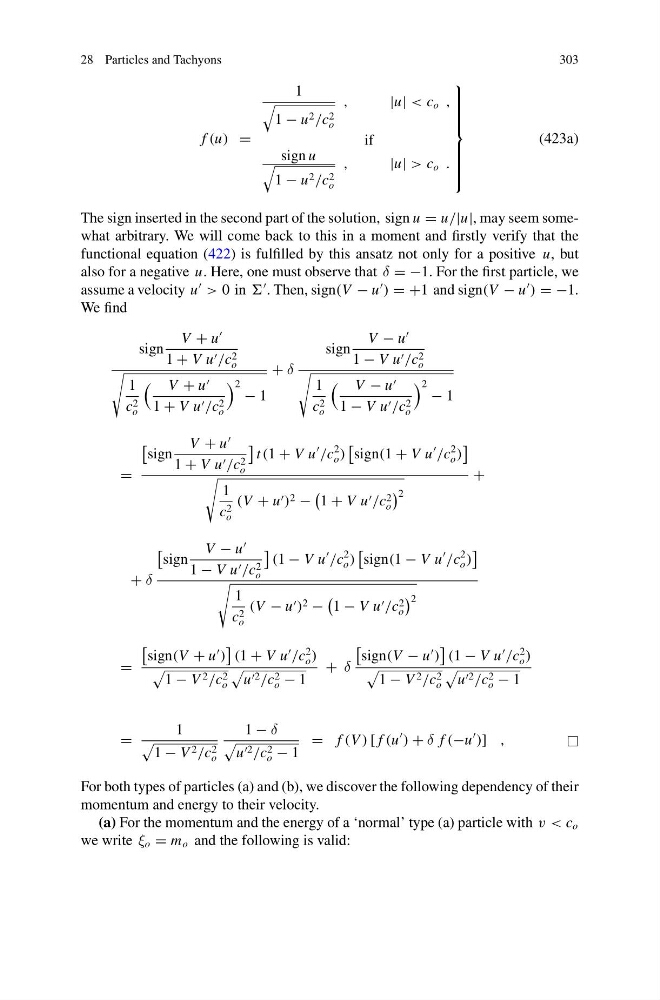
The sign inserted in the second part of the solution, sign u = u/|u|, may seem somewhat arbitrary. We will come back to this in a moment and firstly verify that the
functional equation (422) is fulfilled by this ansatz not only for a positive u, but
also for a negative u. Here, one must observe that δ = −1. For the first particle, we
assume a velocity u
> 0 in
. Then, sign(V − u
) = +1 and sign(V − u
) = −1.
We find
sign
V + u
1 + V u /c 2
o
1
c 2
o
V + u
1 + V u /c 2
o
2 − 1
+ δ
sign
V − u
1 − V u /c 2
o
1
c 2
o
V − u
1 − V u /c 2
o
2 − 1
=
sign
V + u
1 + V u /c 2
o
t (1 + V u
/c
2
o )
sign(1 + V u
/c
2
o )
1
c 2
o
(V + u ) 2 −
1 + V u /c 2
o
2
+
+ δ
sign
V − u
1 − V u /c 2
o
(1 − V u
/c
2
o )
sign(1 − V u
/c
2
o )
1
c 2
o
(V − u ) 2 −
1 − V u /c 2
o
2
=
sign(V + u
)
(1 + V u
/c
2
o )
1 − V 2 /c 2
o
u 2 /c 2
o − 1
+ δ
sign(V − u
)
(1 − V u
/c
2
o )
1 − V 2 /c 2
o
u 2 /c 2
o − 1
=
1
1 − V 2 /c 2
o
1 − δ
u 2 /c 2
o − 1
= f (V ) [ f (u
) + δ f (−u
)] ,
For both types of particles (a) and (b), we discover the following dependency of their
momentum and energy to their velocity.
(a) For the momentum and the energy of a ‘normal’ type (a) particle with v < c o
we write ξ o = m o and the following is valid:
303
f (u) =
1
1 − u 2 /c 2
o
,
|u| < c o ,
if
sign u
1 − u 2 /c 2
o
,
|u| > c o .
⎫
⎪ ⎪ ⎪ ⎪ ⎪ ⎪ ⎬
⎪ ⎪ ⎪ ⎪ ⎪ ⎪ ⎭
(423a)
The sign inserted in the second part of the solution, sign u = u/|u|, may seem somewhat arbitrary. We will come back to this in a moment and firstly verify that the
functional equation (422) is fulfilled by this ansatz not only for a positive u, but
also for a negative u. Here, one must observe that δ = −1. For the first particle, we
assume a velocity u
> 0 in
. Then, sign(V − u
) = +1 and sign(V − u
) = −1.
We find
sign
V + u
1 + V u /c 2
o
1
c 2
o
V + u
1 + V u /c 2
o
2 − 1
+ δ
sign
V − u
1 − V u /c 2
o
1
c 2
o
V − u
1 − V u /c 2
o
2 − 1
=
sign
V + u
1 + V u /c 2
o
t (1 + V u
/c
2
o )
sign(1 + V u
/c
2
o )
1
c 2
o
(V + u ) 2 −
1 + V u /c 2
o
2
+
+ δ
sign
V − u
1 − V u /c 2
o
(1 − V u
/c
2
o )
sign(1 − V u
/c
2
o )
1
c 2
o
(V − u ) 2 −
1 − V u /c 2
o
2
=
sign(V + u
)
(1 + V u
/c
2
o )
1 − V 2 /c 2
o
u 2 /c 2
o − 1
+ δ
sign(V − u
)
(1 − V u
/c
2
o )
1 − V 2 /c 2
o
u 2 /c 2
o − 1
=
1
1 − V 2 /c 2
o
1 − δ
u 2 /c 2
o − 1
= f (V ) [ f (u
) + δ f (−u
)] ,
For both types of particles (a) and (b), we discover the following dependency of their
momentum and energy to their velocity.
(a) For the momentum and the energy of a ‘normal’ type (a) particle with v < c o
we write ξ o = m o and the following is valid: