

302
28 Particles and Tachyons
ξ o f
V + u
1 + V u /c 2
o
c
2
o +
+ δ · ξ o f
V − u
1 − V u /c 2
o
c
2
o =M o f (V ) c
2
o .
Energy conservation
in o
(421)
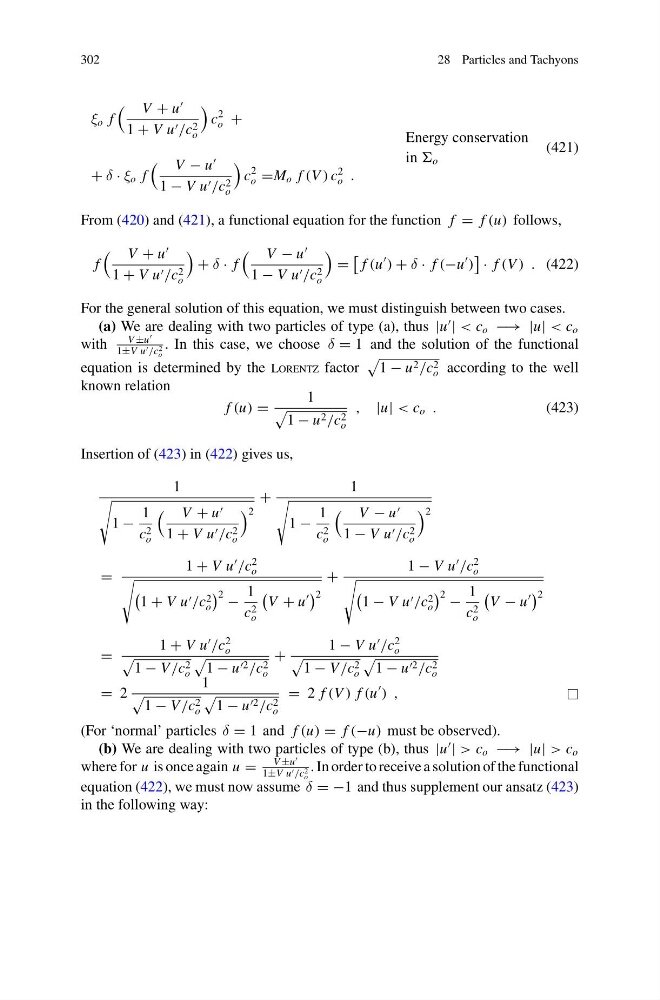
From (420) and (421), a functional equation for the function f = f (u) follows,
f
V + u
1 + V u /c 2
o
+ δ · f
V − u
1 − V u /c 2
o
=
f (u
) + δ · f (−u
)
· f (V ) . (422)
For the general solution of this equation, we must distinguish between two cases.
(a) We are dealing with two particles of type (a), thus |u
| < c o −→ |u| < c o
with
V ±u
1±V u /c 2
o
. In this case, we choose δ = 1 and the solution of the functional
equation is determined by the Lorentz factor
1 − u 2 /c 2
o according to the well
known relation
f (u) =
1
1 − u 2 /c 2
o
, |u| < c o .
(423)
Insertion of (423) in (422) gives us,
1
1 −
1
c 2
o
V + u
1 + V u /c 2
o
2
+
1
1 −
1
c 2
o
V − u
1 − V u /c 2
o
2
=
1 + V u
/c
2
o
1 + V u /c 2
o
2 −
1
c 2
o
V + u
2
+
1 − V u
/c
2
o
1 − V u /c 2
o
2 −
1
c 2
o
V − u
2
=
1 + V u
/c
2
o
1 − V /c 2
o
1 − u 2 /c 2
o
+
1 − V u
/c
2
o
1 − V /c 2
o
1 − u 2 /c 2
o
= 2
1
1 − V /c 2
o
1 − u 2 /c 2
o
= 2 f (V ) f (u
) ,
(For ‘normal’ particles δ = 1 and f (u) = f (−u) must be observed).
(b) We are dealing with two particles of type (b), thus |u
| > c o −→ |u| > c o
where for u is once again u =
V ±u
1±V u /c 2
o
. In order to receive a solution of the functional
equation (422), we must now assume δ = −1 and thus supplement our ansatz (423)
in the following way:
28 Particles and Tachyons
ξ o f
V + u
1 + V u /c 2
o
c
2
o +
+ δ · ξ o f
V − u
1 − V u /c 2
o
c
2
o =M o f (V ) c
2
o .
Energy conservation
in o
(421)
From (420) and (421), a functional equation for the function f = f (u) follows,
f
V + u
1 + V u /c 2
o
+ δ · f
V − u
1 − V u /c 2
o
=
f (u
) + δ · f (−u
)
· f (V ) . (422)
For the general solution of this equation, we must distinguish between two cases.
(a) We are dealing with two particles of type (a), thus |u
| < c o −→ |u| < c o
with
V ±u
1±V u /c 2
o
. In this case, we choose δ = 1 and the solution of the functional
equation is determined by the Lorentz factor
1 − u 2 /c 2
o according to the well
known relation
f (u) =
1
1 − u 2 /c 2
o
, |u| < c o .
(423)
Insertion of (423) in (422) gives us,
1
1 −
1
c 2
o
V + u
1 + V u /c 2
o
2
+
1
1 −
1
c 2
o
V − u
1 − V u /c 2
o
2
=
1 + V u
/c
2
o
1 + V u /c 2
o
2 −
1
c 2
o
V + u
2
+
1 − V u
/c
2
o
1 − V u /c 2
o
2 −
1
c 2
o
V − u
2
=
1 + V u
/c
2
o
1 − V /c 2
o
1 − u 2 /c 2
o
+
1 − V u
/c
2
o
1 − V /c 2
o
1 − u 2 /c 2
o
= 2
1
1 − V /c 2
o
1 − u 2 /c 2
o
= 2 f (V ) f (u
) ,
(For ‘normal’ particles δ = 1 and f (u) = f (−u) must be observed).
(b) We are dealing with two particles of type (b), thus |u
| > c o −→ |u| > c o
where for u is once again u =
V ±u
1±V u /c 2
o
. In order to receive a solution of the functional
equation (422), we must now assume δ = −1 and thus supplement our ansatz (423)
in the following way: