

306
28 Particles and Tachyons
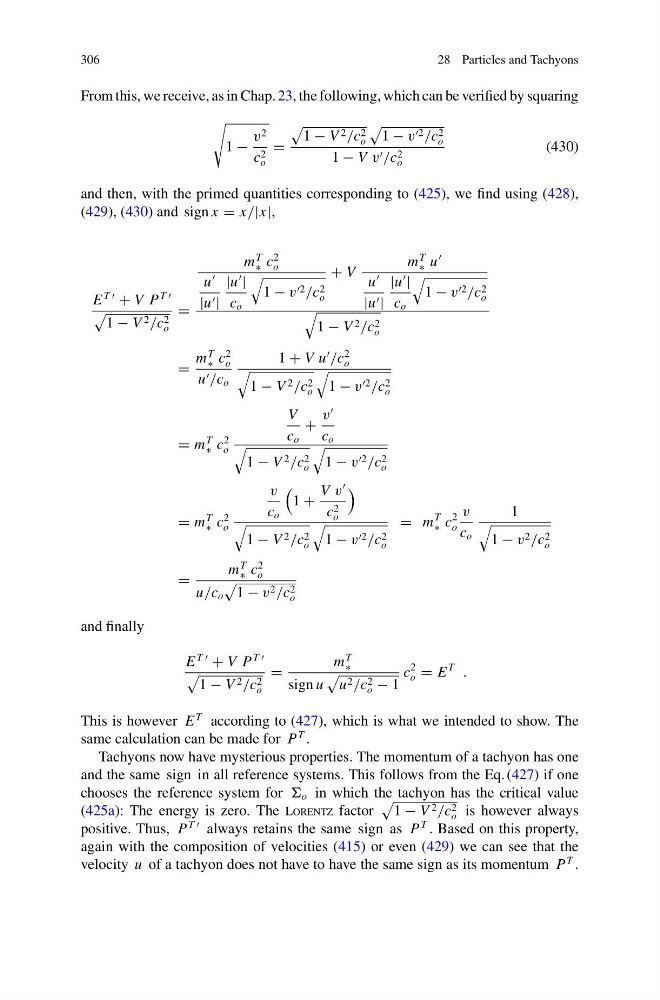
From this, we receive, as in Chap. 23, the following, which can be verified by squaring
1 −
v 2
c 2
o
=
1 − V 2 /c 2
o
1 − v 2 /c 2
o
1 − V v /c 2
o
(430)
and then, with the primed quantities corresponding to (425), we find using (428),
(429), (430) and sign x = x/|x|,
E
T
+ V P
T
1 − V 2 /c 2
o
=
m
T
∗ c
2
o
u
|u |
|u
|
c o
1 − v 2 /c 2
o
+ V
m
T
∗ u
u
|u |
|u
|
c o
1 − v 2 /c 2
o
1 − V 2 /c 2
o
=
m
T
∗ c
2
o
u /c o
1 + V u
/c
2
o
1 − V 2 /c 2
o
1 − v 2 /c 2
o
= m
T
∗ c
2
o
V
c o
+
v
c o
1 − V 2 /c 2
o
1 − v 2 /c 2
o
= m
T
∗ c
2
o
v
c o
1 +
V v
c 2
o
1 − V 2 /c 2
o
1 − v 2 /c 2
o
= m
T
∗ c
2
o
v
c o
1
1 − v 2 /c 2
o
=
m
T
∗ c
2
o
u/c o
1 − v 2 /c 2
o
and finally
E
T
+ V P
T
1 − V 2 /c 2
o
=
m
T
∗
sign u
u 2 /c 2
o − 1
c
2
o = E
T
.
This is however E
T according to (427), which is what we intended to show. The
same calculation can be made for P
T .
Tachyons now have mysterious properties. The momentum of a tachyon has one
and the same sign in all reference systems. This follows from the Eq. (427) if one
chooses the reference system for o in which the tachyon has the critical value
(425a): The energy is zero. The Lorentz factor
1 − V 2 /c 2
o is however always
positive. Thus, P
T always retains the same sign as P
T . Based on this property,
again with the composition of velocities (415) or even (429) we can see that the
velocity u of a tachyon does not have to have the same sign as its momentum P
T .
28 Particles and Tachyons
From this, we receive, as in Chap. 23, the following, which can be verified by squaring
1 −
v 2
c 2
o
=
1 − V 2 /c 2
o
1 − v 2 /c 2
o
1 − V v /c 2
o
(430)
and then, with the primed quantities corresponding to (425), we find using (428),
(429), (430) and sign x = x/|x|,
E
T
+ V P
T
1 − V 2 /c 2
o
=
m
T
∗ c
2
o
u
|u |
|u
|
c o
1 − v 2 /c 2
o
+ V
m
T
∗ u
u
|u |
|u
|
c o
1 − v 2 /c 2
o
1 − V 2 /c 2
o
=
m
T
∗ c
2
o
u /c o
1 + V u
/c
2
o
1 − V 2 /c 2
o
1 − v 2 /c 2
o
= m
T
∗ c
2
o
V
c o
+
v
c o
1 − V 2 /c 2
o
1 − v 2 /c 2
o
= m
T
∗ c
2
o
v
c o
1 +
V v
c 2
o
1 − V 2 /c 2
o
1 − v 2 /c 2
o
= m
T
∗ c
2
o
v
c o
1
1 − v 2 /c 2
o
=
m
T
∗ c
2
o
u/c o
1 − v 2 /c 2
o
and finally
E
T
+ V P
T
1 − V 2 /c 2
o
=
m
T
∗
sign u
u 2 /c 2
o − 1
c
2
o = E
T
.
This is however E
T according to (427), which is what we intended to show. The
same calculation can be made for P
T .
Tachyons now have mysterious properties. The momentum of a tachyon has one
and the same sign in all reference systems. This follows from the Eq. (427) if one
chooses the reference system for o in which the tachyon has the critical value
(425a): The energy is zero. The Lorentz factor
1 − V 2 /c 2
o is however always
positive. Thus, P
T always retains the same sign as P
T . Based on this property,
again with the composition of velocities (415) or even (429) we can see that the
velocity u of a tachyon does not have to have the same sign as its momentum P
T .