

26 Eigen Stresses and Dislocations
285
d
dt
β
p
ik = − irs V r α sk .
(379)
Due to the fact that not only the dislocation density α, but also the dislocation
velocity V are measurable quantities, the time derivative of the plastic distorsion is
a measurable quantity of the solid. In comparison to plastic distorsion β
p the time
derivative is once again a state variable of our mechanical continuum.
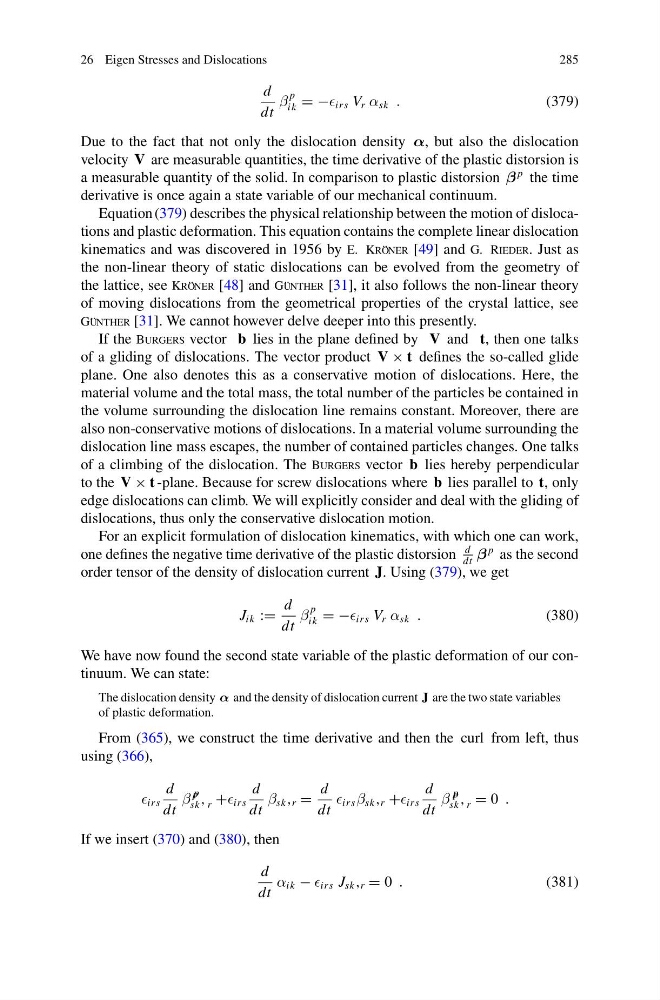
Equation (379) describes the physical relationship between the motion of dislocations and plastic deformation. This equation contains the complete linear dislocation
kinematics and was discovered in 1956 by E. Kröner [49] and G. Rieder. Just as
the non-linear theory of static dislocations can be evolved from the geometry of
the lattice, see Kröner [48] and Günther [31], it also follows the non-linear theory
of moving dislocations from the geometrical properties of the crystal lattice, see
Günther [31]. We cannot however delve deeper into this presently.
If the Burgers vector b lies in the plane defined by V and t, then one talks
of a gliding of dislocations. The vector product V × t defines the so-called glide
plane. One also denotes this as a conservative motion of dislocations. Here, the
material volume and the total mass, the total number of the particles be contained in
the volume surrounding the dislocation line remains constant. Moreover, there are
also non-conservative motions of dislocations. In a material volume surrounding the
dislocation line mass escapes, the number of contained particles changes. One talks
of a climbing of the dislocation. The Burgers vector b lies hereby perpendicular
to the V × t -plane. Because for screw dislocations where b lies parallel to t, only
edge dislocations can climb. We will explicitly consider and deal with the gliding of
dislocations, thus only the conservative dislocation motion.
For an explicit formulation of dislocation kinematics, with which one can work,
one defines the negative time derivative of the plastic distorsion
d
dt
β
p as the second
order tensor of the density of dislocation current J. Using (379), we get
J ik :=
d
dt
β
p
ik = − irs V r α sk .
(380)
We have now found the second state variable of the plastic deformation of our continuum. We can state:
The dislocation density α and the density of dislocation current J are the two state variables
of plastic deformation.
From (365), we construct the time derivative and then the curl from left, thus
using (366),
irs
d
dt
β
p
sk ,
p
r + irs
d
dt
β sk , r =
d
dt
irs β sk , r + irs
d
dt
β
p
sk ,
p
r = 0 .
If we insert (370) and (380), then
d
dt
α ik − irs J sk , r = 0 .
(381)
285
d
dt
β
p
ik = − irs V r α sk .
(379)
Due to the fact that not only the dislocation density α, but also the dislocation
velocity V are measurable quantities, the time derivative of the plastic distorsion is
a measurable quantity of the solid. In comparison to plastic distorsion β
p the time
derivative is once again a state variable of our mechanical continuum.
Equation (379) describes the physical relationship between the motion of dislocations and plastic deformation. This equation contains the complete linear dislocation
kinematics and was discovered in 1956 by E. Kröner [49] and G. Rieder. Just as
the non-linear theory of static dislocations can be evolved from the geometry of
the lattice, see Kröner [48] and Günther [31], it also follows the non-linear theory
of moving dislocations from the geometrical properties of the crystal lattice, see
Günther [31]. We cannot however delve deeper into this presently.
If the Burgers vector b lies in the plane defined by V and t, then one talks
of a gliding of dislocations. The vector product V × t defines the so-called glide
plane. One also denotes this as a conservative motion of dislocations. Here, the
material volume and the total mass, the total number of the particles be contained in
the volume surrounding the dislocation line remains constant. Moreover, there are
also non-conservative motions of dislocations. In a material volume surrounding the
dislocation line mass escapes, the number of contained particles changes. One talks
of a climbing of the dislocation. The Burgers vector b lies hereby perpendicular
to the V × t -plane. Because for screw dislocations where b lies parallel to t, only
edge dislocations can climb. We will explicitly consider and deal with the gliding of
dislocations, thus only the conservative dislocation motion.
For an explicit formulation of dislocation kinematics, with which one can work,
one defines the negative time derivative of the plastic distorsion
d
dt
β
p as the second
order tensor of the density of dislocation current J. Using (379), we get
J ik :=
d
dt
β
p
ik = − irs V r α sk .
(380)
We have now found the second state variable of the plastic deformation of our continuum. We can state:
The dislocation density α and the density of dislocation current J are the two state variables
of plastic deformation.
From (365), we construct the time derivative and then the curl from left, thus
using (366),
irs
d
dt
β
p
sk ,
p
r + irs
d
dt
β sk , r =
d
dt
irs β sk , r + irs
d
dt
β
p
sk ,
p
r = 0 .
If we insert (370) and (380), then
d
dt
α ik − irs J sk , r = 0 .
(381)