

284
26 Eigen Stresses and Dislocations
The single dislocation that moves past the position x produces a plastic displacement
of the vector b in this area F. For each area element A , a dislocation may
be distributed equally. If equidistant dislocations move with the velocity V, then
|V| dt dislocations move past the position x during the time dt, so that the plastic
displacement produced during this procedure can be calculated from δg = −b |V| dt,
in other words,
δg k = −b k |V| dt .
(378)
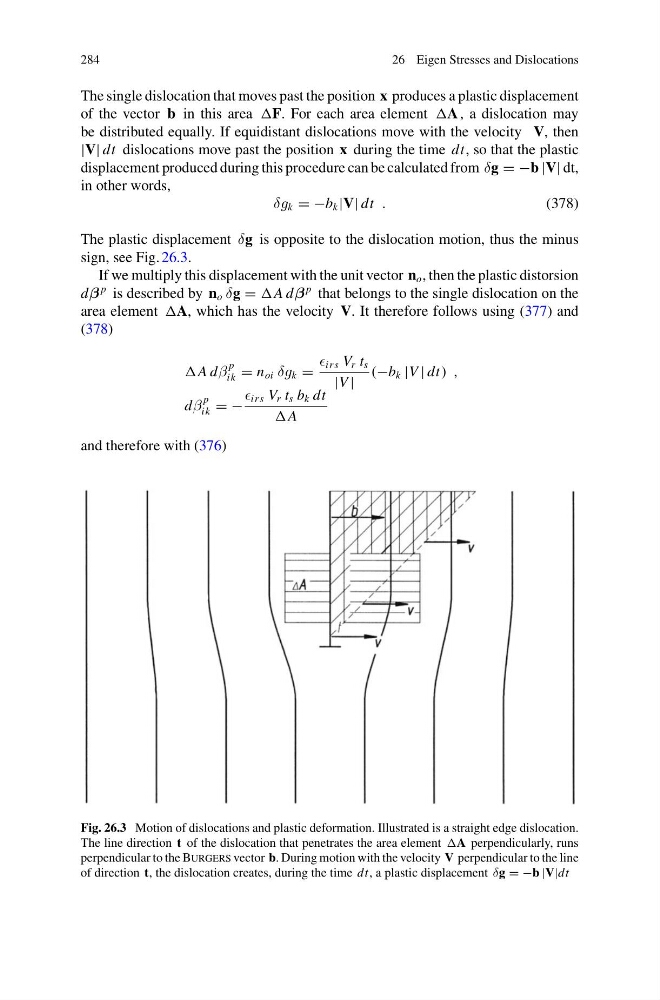
The plastic displacement δg is opposite to the dislocation motion, thus the minus
sign, see Fig. 26.3.
If we multiply this displacement with the unit vector n o , then the plastic distorsion
dβ
p is described by n o δg = A dβ
p that belongs to the single dislocation on the
area element A, which has the velocity V. It therefore follows using (377) and
(378)
A dβ
p
ik = n oi δg k =
irs V r t s
|V |
(−b k |V | dt) ,
dβ
p
ik = −
irs V r t s b k dt
A
and therefore with (376)
Fig. 26.3 Motion of dislocations and plastic deformation. Illustrated is a straight edge dislocation.
The line direction t of the dislocation that penetrates the area element A perpendicularly, runs
perpendicular to the Burgers vector b. During motion with the velocity V perpendicular to the line
of direction t, the dislocation creates, during the time dt, a plastic displacement δg = −b |V|dt
26 Eigen Stresses and Dislocations
The single dislocation that moves past the position x produces a plastic displacement
of the vector b in this area F. For each area element A , a dislocation may
be distributed equally. If equidistant dislocations move with the velocity V, then
|V| dt dislocations move past the position x during the time dt, so that the plastic
displacement produced during this procedure can be calculated from δg = −b |V| dt,
in other words,
δg k = −b k |V| dt .
(378)
The plastic displacement δg is opposite to the dislocation motion, thus the minus
sign, see Fig. 26.3.
If we multiply this displacement with the unit vector n o , then the plastic distorsion
dβ
p is described by n o δg = A dβ
p that belongs to the single dislocation on the
area element A, which has the velocity V. It therefore follows using (377) and
(378)
A dβ
p
ik = n oi δg k =
irs V r t s
|V |
(−b k |V | dt) ,
dβ
p
ik = −
irs V r t s b k dt
A
and therefore with (376)
Fig. 26.3 Motion of dislocations and plastic deformation. Illustrated is a straight edge dislocation.
The line direction t of the dislocation that penetrates the area element A perpendicularly, runs
perpendicular to the Burgers vector b. During motion with the velocity V perpendicular to the line
of direction t, the dislocation creates, during the time dt, a plastic displacement δg = −b |V|dt