

286
26 Eigen Stresses and Dislocations
We now observe that the time derivative of the total displacement vector s
g just about
gives us the velocity v of the mass elements of our continuum,
v =
d
dt
s
g
that is
v i =
d
dt
s i .
(382)
Here, we wish to note that it is this velocity v that stands in Eqs. (337), (341), (343)
and (382), respectively, cannot be constructed from out of an elastic displacement s.
From (365), we construct the sum during the exchange of the indices, in other words
1
2
∂s
g
k
∂x i
+
∂s
g
k
∂x i
=
1
2
(β ik + β ki ) +
1
2
(β
p
ik + β
p
ki ) .
Due to (337), (382) and (373), this equation’s time derivative gives us
d
dt
ε ik −
1
2
(v i , k + v k , i ) =
1
2
(J ik + J ki ) .
(383)
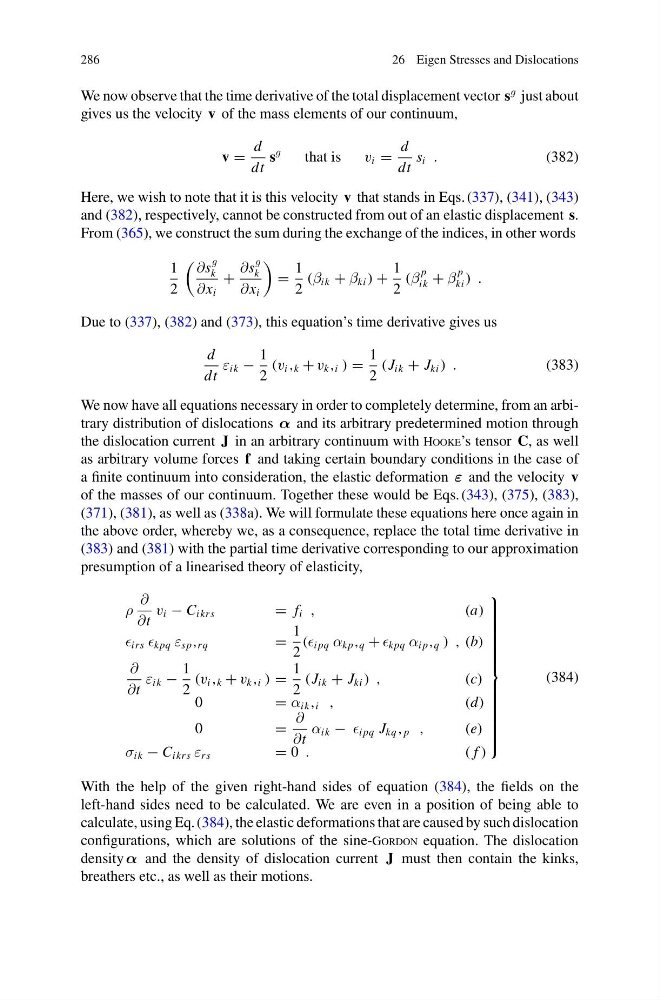
We now have all equations necessary in order to completely determine, from an arbitrary distribution of dislocations α and its arbitrary predetermined motion through
the dislocation current J in an arbitrary continuum with Hooke’s tensor C, as well
as arbitrary volume forces f and taking certain boundary conditions in the case of
a finite continuum into consideration, the elastic deformation ε and the velocity v
of the masses of our continuum. Together these would be Eqs. (343), (375), (383),
(371), (381), as well as (338a). We will formulate these equations here once again in
the above order, whereby we, as a consequence, replace the total time derivative in
(383) and (381) with the partial time derivative corresponding to our approximation
presumption of a linearised theory of elasticity,
ρ
∂
∂t
v i − C ikrs
= f i ,
( a)
irs kpq ε sp , rq
=
1
2
( i pq α kp , q + kpq α i p , q ) , (b)
∂
∂t
ε ik −
1
2
(v i , k + v k , i ) =
1
2
(J ik + J ki ) ,
(c)
0
= α ik , i ,
( d)
0
=
∂
∂t
α ik − i pq J kq , p ,
(e)
σ ik − C ikrs ε rs
= 0 .
( f )
⎫
⎪ ⎪ ⎪ ⎪ ⎪ ⎪ ⎪ ⎪ ⎪ ⎪ ⎪ ⎪ ⎬
⎪ ⎪ ⎪ ⎪ ⎪ ⎪ ⎪ ⎪ ⎪ ⎪ ⎪ ⎪ ⎭
(384)
With the help of the given right-hand sides of equation (384), the fields on the
left-hand sides need to be calculated. We are even in a position of being able to
calculate, using Eq. (384), the elastic deformations that are caused by such dislocation
configurations, which are solutions of the sine-Gordon equation. The dislocation
density α and the density of dislocation current J must then contain the kinks,
breathers etc., as well as their motions.
26 Eigen Stresses and Dislocations
We now observe that the time derivative of the total displacement vector s
g just about
gives us the velocity v of the mass elements of our continuum,
v =
d
dt
s
g
that is
v i =
d
dt
s i .
(382)
Here, we wish to note that it is this velocity v that stands in Eqs. (337), (341), (343)
and (382), respectively, cannot be constructed from out of an elastic displacement s.
From (365), we construct the sum during the exchange of the indices, in other words
1
2
∂s
g
k
∂x i
+
∂s
g
k
∂x i
=
1
2
(β ik + β ki ) +
1
2
(β
p
ik + β
p
ki ) .
Due to (337), (382) and (373), this equation’s time derivative gives us
d
dt
ε ik −
1
2
(v i , k + v k , i ) =
1
2
(J ik + J ki ) .
(383)
We now have all equations necessary in order to completely determine, from an arbitrary distribution of dislocations α and its arbitrary predetermined motion through
the dislocation current J in an arbitrary continuum with Hooke’s tensor C, as well
as arbitrary volume forces f and taking certain boundary conditions in the case of
a finite continuum into consideration, the elastic deformation ε and the velocity v
of the masses of our continuum. Together these would be Eqs. (343), (375), (383),
(371), (381), as well as (338a). We will formulate these equations here once again in
the above order, whereby we, as a consequence, replace the total time derivative in
(383) and (381) with the partial time derivative corresponding to our approximation
presumption of a linearised theory of elasticity,
ρ
∂
∂t
v i − C ikrs
= f i ,
( a)
irs kpq ε sp , rq
=
1
2
( i pq α kp , q + kpq α i p , q ) , (b)
∂
∂t
ε ik −
1
2
(v i , k + v k , i ) =
1
2
(J ik + J ki ) ,
(c)
0
= α ik , i ,
( d)
0
=
∂
∂t
α ik − i pq J kq , p ,
(e)
σ ik − C ikrs ε rs
= 0 .
( f )
⎫
⎪ ⎪ ⎪ ⎪ ⎪ ⎪ ⎪ ⎪ ⎪ ⎪ ⎪ ⎪ ⎬
⎪ ⎪ ⎪ ⎪ ⎪ ⎪ ⎪ ⎪ ⎪ ⎪ ⎪ ⎪ ⎭
(384)
With the help of the given right-hand sides of equation (384), the fields on the
left-hand sides need to be calculated. We are even in a position of being able to
calculate, using Eq. (384), the elastic deformations that are caused by such dislocation
configurations, which are solutions of the sine-Gordon equation. The dislocation
density α and the density of dislocation current J must then contain the kinks,
breathers etc., as well as their motions.