

278
26 Eigen Stresses and Dislocations
We now have to comprehend this statement quantitatively. How can one quantitatively calculate and express the deviation of ink ε= 0 for a given distribution of
dislocations? This question was first answered by Kröner [47, 48]. We will give a
short summary of this answer.
We principally have to differentiate between elastic and plastic displacements δs
and δs
p when dealing with the displacement of atoms of a crystal lattice. Both types
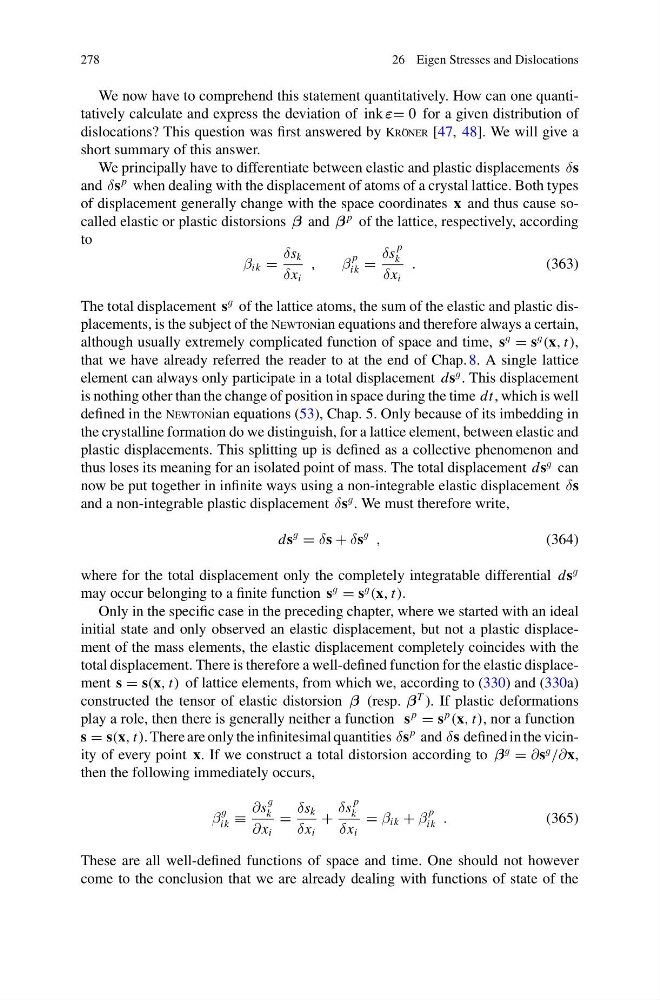
of displacement generally change with the space coordinates x and thus cause socalled elastic or plastic distorsions β and β
p of the lattice, respectively, according
to
β ik =
δs k
δx i
,
β
p
ik =
δs
p
k
δx i
.
(363)
The total displacement s
g of the lattice atoms, the sum of the elastic and plastic displacements, is the subject of the Newtonian equations and therefore always a certain,
although usually extremely complicated function of space and time, s
g
= s
g
(x, t),
that we have already referred the reader to at the end of Chap. 8. A single lattice
element can always only participate in a total displacement ds
g . This displacement
is nothing other than the change of position in space during the time dt, which is well
defined in the Newtonian equations (53), Chap. 5. Only because of its imbedding in
the crystalline formation do we distinguish, for a lattice element, between elastic and
plastic displacements. This splitting up is defined as a collective phenomenon and
thus loses its meaning for an isolated point of mass. The total displacement ds
g can
now be put together in infinite ways using a non-integrable elastic displacement δs
and a non-integrable plastic displacement δs
g . We must therefore write,
ds
g
= δs + δs
g
,
(364)
where for the total displacement only the completely integratable differential ds
g
may occur belonging to a finite function s
g
= s
g
(x, t).
Only in the specific case in the preceding chapter, where we started with an ideal
initial state and only observed an elastic displacement, but not a plastic displacement of the mass elements, the elastic displacement completely coincides with the
total displacement. There is therefore a well-defined function for the elastic displacement s = s(x, t) of lattice elements, from which we, according to (330) and (330a)
constructed the tensor of elastic distorsion β (resp. β
T ). If plastic deformations
play a role, then there is generally neither a function s
p
= s
p
(x, t), nor a function
s = s(x, t). There are only the infinitesimal quantities δs
p and δs defined in the vicinity of every point x. If we construct a total distorsion according to β
g
= ∂s
g
/∂x,
then the following immediately occurs,
β
g
ik ≡
∂s
g
k
∂x i
=
δs k
δx i
+
δs
p
k
δx i
= β ik + β
p
ik .
(365)
These are all well-defined functions of space and time. One should not however
come to the conclusion that we are already dealing with functions of state of the
26 Eigen Stresses and Dislocations
We now have to comprehend this statement quantitatively. How can one quantitatively calculate and express the deviation of ink ε= 0 for a given distribution of
dislocations? This question was first answered by Kröner [47, 48]. We will give a
short summary of this answer.
We principally have to differentiate between elastic and plastic displacements δs
and δs
p when dealing with the displacement of atoms of a crystal lattice. Both types
of displacement generally change with the space coordinates x and thus cause socalled elastic or plastic distorsions β and β
p of the lattice, respectively, according
to
β ik =
δs k
δx i
,
β
p
ik =
δs
p
k
δx i
.
(363)
The total displacement s
g of the lattice atoms, the sum of the elastic and plastic displacements, is the subject of the Newtonian equations and therefore always a certain,
although usually extremely complicated function of space and time, s
g
= s
g
(x, t),
that we have already referred the reader to at the end of Chap. 8. A single lattice
element can always only participate in a total displacement ds
g . This displacement
is nothing other than the change of position in space during the time dt, which is well
defined in the Newtonian equations (53), Chap. 5. Only because of its imbedding in
the crystalline formation do we distinguish, for a lattice element, between elastic and
plastic displacements. This splitting up is defined as a collective phenomenon and
thus loses its meaning for an isolated point of mass. The total displacement ds
g can
now be put together in infinite ways using a non-integrable elastic displacement δs
and a non-integrable plastic displacement δs
g . We must therefore write,
ds
g
= δs + δs
g
,
(364)
where for the total displacement only the completely integratable differential ds
g
may occur belonging to a finite function s
g
= s
g
(x, t).
Only in the specific case in the preceding chapter, where we started with an ideal
initial state and only observed an elastic displacement, but not a plastic displacement of the mass elements, the elastic displacement completely coincides with the
total displacement. There is therefore a well-defined function for the elastic displacement s = s(x, t) of lattice elements, from which we, according to (330) and (330a)
constructed the tensor of elastic distorsion β (resp. β
T ). If plastic deformations
play a role, then there is generally neither a function s
p
= s
p
(x, t), nor a function
s = s(x, t). There are only the infinitesimal quantities δs
p and δs defined in the vicinity of every point x. If we construct a total distorsion according to β
g
= ∂s
g
/∂x,
then the following immediately occurs,
β
g
ik ≡
∂s
g
k
∂x i
=
δs k
δx i
+
δs
p
k
δx i
= β ik + β
p
ik .
(365)
These are all well-defined functions of space and time. One should not however
come to the conclusion that we are already dealing with functions of state of the