

26 Eigen Stresses and Dislocations
279
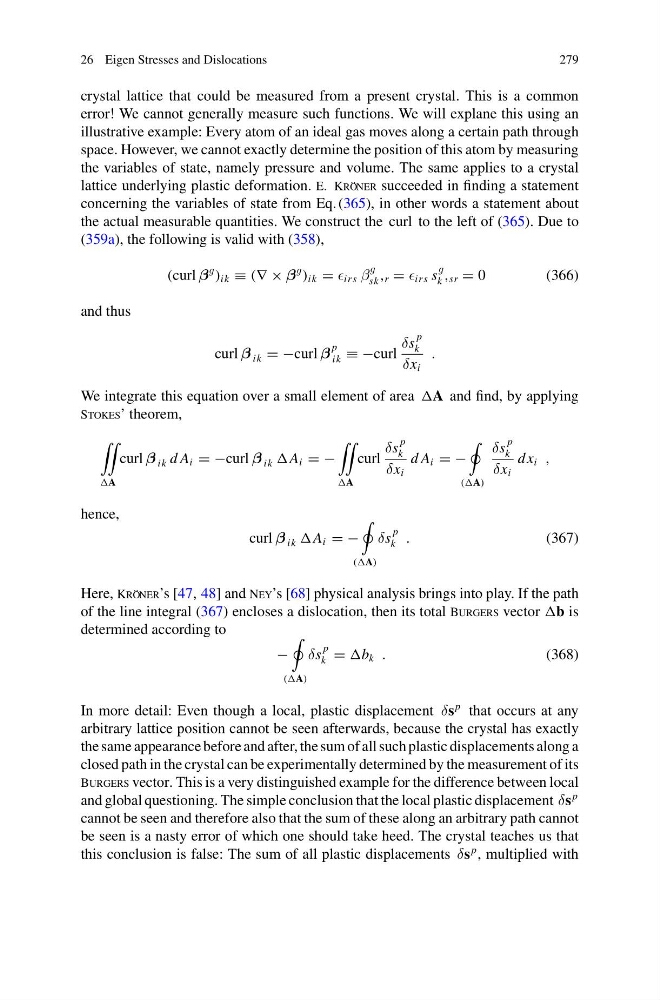
crystal lattice that could be measured from a present crystal. This is a common
error! We cannot generally measure such functions. We will explane this using an
illustrative example: Every atom of an ideal gas moves along a certain path through
space. However, we cannot exactly determine the position of this atom by measuring
the variables of state, namely pressure and volume. The same applies to a crystal
lattice underlying plastic deformation. E. Kröner succeeded in finding a statement
concerning the variables of state from Eq. (365), in other words a statement about
the actual measurable quantities. We construct the curl to the left of (365). Due to
(359a), the following is valid with (358),
(curl β
g
) ik ≡ (∇ × β
g
) ik = irs β
g
sk , r = irs s
g
k , sr = 0
(366)
and thus
curl β ik = −curl β
p
ik ≡ −curl
δs
p
k
δx i
.
We integrate this equation over a small element of area A and find, by applying
Stokes’ theorem,
A
curl β ik d A i = −curl β ik A i = −
A
curl
δs
p
k
δx i
d A i = −
((A)
δs
p
k
δx i
dx i ,
hence,
curl β ik A i = −
((A)
δs
p
k .
(367)
Here, Kröner’s [47, 48] and Ney’s [68] physical analysis brings into play. If the path
of the line integral (367) encloses a dislocation, then its total Burgers vector b is
determined according to
−
((A)
δs
p
k = b k .
(368)
In more detail: Even though a local, plastic displacement δs
p that occurs at any
arbitrary lattice position cannot be seen afterwards, because the crystal has exactly
the same appearance before and after, the sum of all such plastic displacements along a
closed path in the crystal can be experimentally determined by the measurement of its
Burgers vector. This is a very distinguished example for the difference between local
and global questioning. The simple conclusion that the local plastic displacement δs
p
cannot be seen and therefore also that the sum of these along an arbitrary path cannot
be seen is a nasty error of which one should take heed. The crystal teaches us that
this conclusion is false: The sum of all plastic displacements δs
p , multiplied with
279
crystal lattice that could be measured from a present crystal. This is a common
error! We cannot generally measure such functions. We will explane this using an
illustrative example: Every atom of an ideal gas moves along a certain path through
space. However, we cannot exactly determine the position of this atom by measuring
the variables of state, namely pressure and volume. The same applies to a crystal
lattice underlying plastic deformation. E. Kröner succeeded in finding a statement
concerning the variables of state from Eq. (365), in other words a statement about
the actual measurable quantities. We construct the curl to the left of (365). Due to
(359a), the following is valid with (358),
(curl β
g
) ik ≡ (∇ × β
g
) ik = irs β
g
sk , r = irs s
g
k , sr = 0
(366)
and thus
curl β ik = −curl β
p
ik ≡ −curl
δs
p
k
δx i
.
We integrate this equation over a small element of area A and find, by applying
Stokes’ theorem,
A
curl β ik d A i = −curl β ik A i = −
A
curl
δs
p
k
δx i
d A i = −
((A)
δs
p
k
δx i
dx i ,
hence,
curl β ik A i = −
((A)
δs
p
k .
(367)
Here, Kröner’s [47, 48] and Ney’s [68] physical analysis brings into play. If the path
of the line integral (367) encloses a dislocation, then its total Burgers vector b is
determined according to
−
((A)
δs
p
k = b k .
(368)
In more detail: Even though a local, plastic displacement δs
p that occurs at any
arbitrary lattice position cannot be seen afterwards, because the crystal has exactly
the same appearance before and after, the sum of all such plastic displacements along a
closed path in the crystal can be experimentally determined by the measurement of its
Burgers vector. This is a very distinguished example for the difference between local
and global questioning. The simple conclusion that the local plastic displacement δs
p
cannot be seen and therefore also that the sum of these along an arbitrary path cannot
be seen is a nasty error of which one should take heed. The crystal teaches us that
this conclusion is false: The sum of all plastic displacements δs
p , multiplied with