

26 Eigen Stresses and Dislocations
277
(curl β) ik ≡ (∇ × β) ik = irs β sk , r .
(359a)
This one must differentiate from
(β × ∇) ik = kpq β i p , q .
(359b)
If one does not keep the correct order of indices, errors in the mathematical sign may
occur.
The operator ink is now defined as the double application of the operator curl
according to (359a) and (359b),
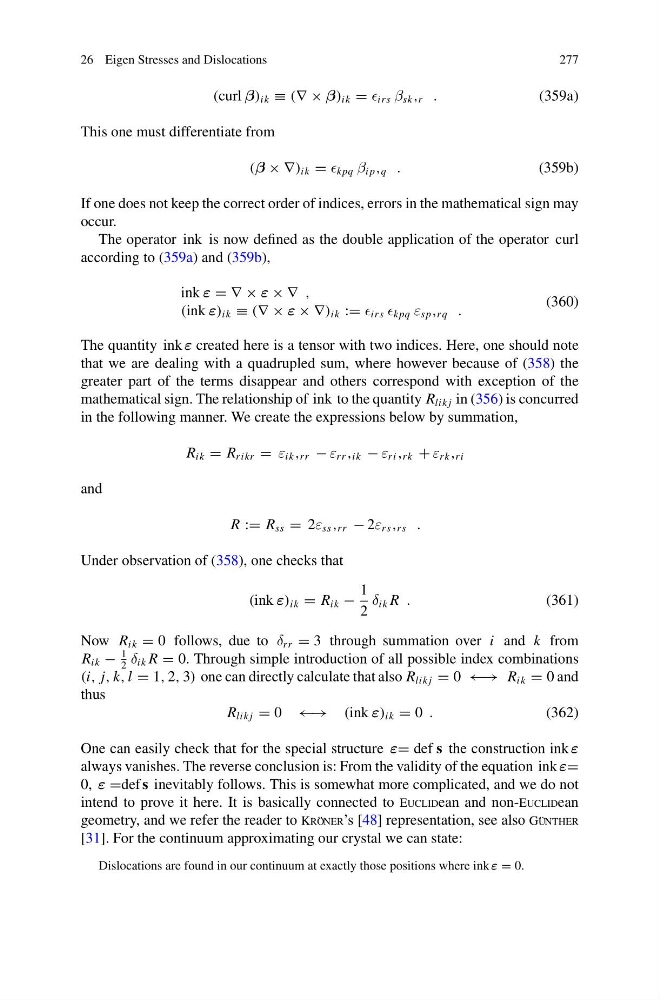
ink ε = ∇ × ε × ∇ ,
(ink ε) ik ≡ (∇ × ε × ∇) ik := irs kpq ε sp , rq .
(360)
The quantity ink ε created here is a tensor with two indices. Here, one should note
that we are dealing with a quadrupled sum, where however because of (358) the
greater part of the terms disappear and others correspond with exception of the
mathematical sign. The relationship of ink to the quantity R lik j in (356) is concurred
in the following manner. We create the expressions below by summation,
R ik = R rikr = ε ik , rr − ε rr , ik − ε ri , rk + ε rk , ri
and
R := R ss = 2ε ss , rr − 2ε rs , rs .
Under observation of (358), one checks that
(ink ε) ik = R ik −
1
2
δ ik R .
(361)
Now R ik = 0 follows, due to δ rr = 3 through summation over i and k from
R ik −
1
2
δ ik R = 0. Through simple introduction of all possible index combinations
(i, j, k, l = 1, 2, 3) one can directly calculate that also R lik j = 0 ←→ R ik = 0 and
thus
R lik j = 0 ←→ (ink ε) ik = 0 .
(362)
One can easily check that for the special structure ε= def s the construction ink ε
always vanishes. The reverse conclusion is: From the validity of the equation ink ε=
0, ε =def s inevitably follows. This is somewhat more complicated, and we do not
intend to prove it here. It is basically connected to Euclidean and non-Euclidean
geometry, and we refer the reader to Kröner’s [48] representation, see also Günther
[31]. For the continuum approximating our crystal we can state:
Dislocations are found in our continuum at exactly those positions where ink ε = 0.
277
(curl β) ik ≡ (∇ × β) ik = irs β sk , r .
(359a)
This one must differentiate from
(β × ∇) ik = kpq β i p , q .
(359b)
If one does not keep the correct order of indices, errors in the mathematical sign may
occur.
The operator ink is now defined as the double application of the operator curl
according to (359a) and (359b),
ink ε = ∇ × ε × ∇ ,
(ink ε) ik ≡ (∇ × ε × ∇) ik := irs kpq ε sp , rq .
(360)
The quantity ink ε created here is a tensor with two indices. Here, one should note
that we are dealing with a quadrupled sum, where however because of (358) the
greater part of the terms disappear and others correspond with exception of the
mathematical sign. The relationship of ink to the quantity R lik j in (356) is concurred
in the following manner. We create the expressions below by summation,
R ik = R rikr = ε ik , rr − ε rr , ik − ε ri , rk + ε rk , ri
and
R := R ss = 2ε ss , rr − 2ε rs , rs .
Under observation of (358), one checks that
(ink ε) ik = R ik −
1
2
δ ik R .
(361)
Now R ik = 0 follows, due to δ rr = 3 through summation over i and k from
R ik −
1
2
δ ik R = 0. Through simple introduction of all possible index combinations
(i, j, k, l = 1, 2, 3) one can directly calculate that also R lik j = 0 ←→ R ik = 0 and
thus
R lik j = 0 ←→ (ink ε) ik = 0 .
(362)
One can easily check that for the special structure ε= def s the construction ink ε
always vanishes. The reverse conclusion is: From the validity of the equation ink ε=
0, ε =def s inevitably follows. This is somewhat more complicated, and we do not
intend to prove it here. It is basically connected to Euclidean and non-Euclidean
geometry, and we refer the reader to Kröner’s [48] representation, see also Günther
[31]. For the continuum approximating our crystal we can state:
Dislocations are found in our continuum at exactly those positions where ink ε = 0.