

276
26 Eigen Stresses and Dislocations
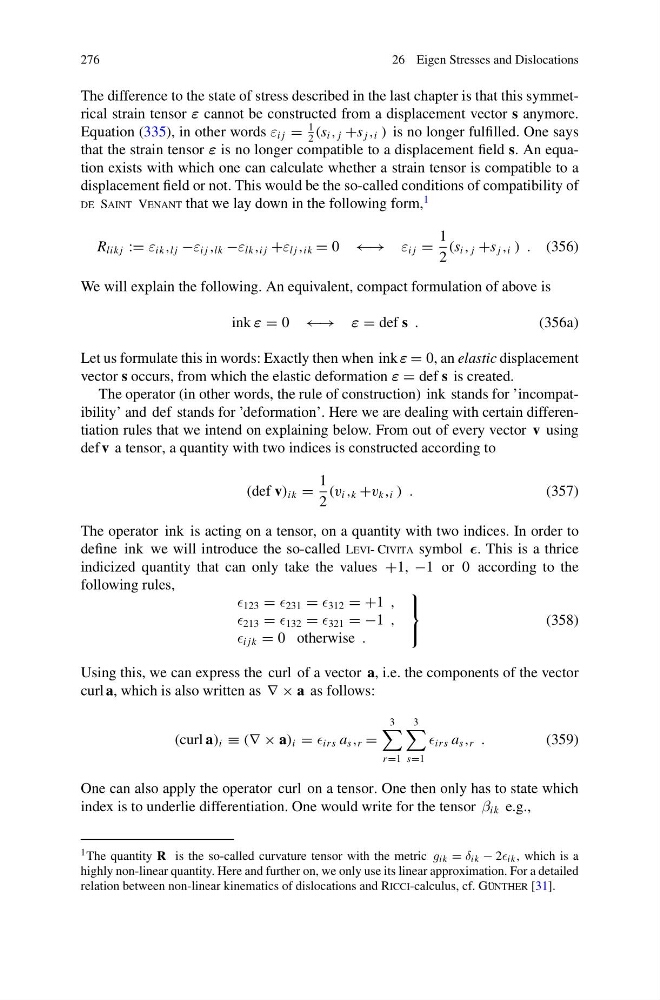
The difference to the state of stress described in the last chapter is that this symmetrical strain tensor ε cannot be constructed from a displacement vector s anymore.
Equation (335), in other words ε i j =
1
2
(s i , j +s j , i ) is no longer fulfilled. One says
that the strain tensor ε is no longer compatible to a displacement field s. An equation exists with which one can calculate whether a strain tensor is compatible to a
displacement field or not. This would be the so-called conditions of compatibility of
de Saint Venant that we lay down in the following form,
1
R lik j := ε ik , l j −ε i j , lk −ε lk , i j +ε l j , ik = 0 ←→ ε i j =
1
2
(s i , j +s j , i ) . (356)
We will explain the following. An equivalent, compact formulation of above is
ink ε = 0 ←→ ε = def s .
(356a)
Let us formulate this in words: Exactly then when ink ε = 0, an elastic displacement
vector s occurs, from which the elastic deformation ε = def s is created.
The operator (in other words, the rule of construction) ink stands for ’incompatibility’ and def stands for ’deformation’. Here we are dealing with certain differentiation rules that we intend on explaining below. From out of every vector v using
def v a tensor, a quantity with two indices is constructed according to
(def v) ik =
1
2
(v i , k +v k , i ) .
(357)
The operator ink is acting on a tensor, on a quantity with two indices. In order to
define ink we will introduce the so-called Levi- Civita symbol . This is a thrice
indicized quantity that can only take the values +1, −1 or 0 according to the
following rules,
123 = 231 = 312 = +1 ,
213 = 132 = 321 = −1 ,
i jk = 0 otherwise .
⎫
⎬
⎭
(358)
Using this, we can express the curl of a vector a, i.e. the components of the vector
curl a, which is also written as ∇ × a as follows:
(curl a) i ≡ (∇ × a) i = irs a s , r =
3
r =1
3
s=1
irs a s , r .
(359)
One can also apply the operator curl on a tensor. One then only has to state which
index is to underlie differentiation. One would write for the tensor β ik e.g.,
1 The quantity R is the so-called curvature tensor with the metric g ik = δ ik − 2 ik , which is a
highly non-linear quantity. Here and further on, we only use its linear approximation. For a detailed
relation between non-linear kinematics of dislocations and Ricci-calculus, cf. Günther [31].
26 Eigen Stresses and Dislocations
The difference to the state of stress described in the last chapter is that this symmetrical strain tensor ε cannot be constructed from a displacement vector s anymore.
Equation (335), in other words ε i j =
1
2
(s i , j +s j , i ) is no longer fulfilled. One says
that the strain tensor ε is no longer compatible to a displacement field s. An equation exists with which one can calculate whether a strain tensor is compatible to a
displacement field or not. This would be the so-called conditions of compatibility of
de Saint Venant that we lay down in the following form,
1
R lik j := ε ik , l j −ε i j , lk −ε lk , i j +ε l j , ik = 0 ←→ ε i j =
1
2
(s i , j +s j , i ) . (356)
We will explain the following. An equivalent, compact formulation of above is
ink ε = 0 ←→ ε = def s .
(356a)
Let us formulate this in words: Exactly then when ink ε = 0, an elastic displacement
vector s occurs, from which the elastic deformation ε = def s is created.
The operator (in other words, the rule of construction) ink stands for ’incompatibility’ and def stands for ’deformation’. Here we are dealing with certain differentiation rules that we intend on explaining below. From out of every vector v using
def v a tensor, a quantity with two indices is constructed according to
(def v) ik =
1
2
(v i , k +v k , i ) .
(357)
The operator ink is acting on a tensor, on a quantity with two indices. In order to
define ink we will introduce the so-called Levi- Civita symbol . This is a thrice
indicized quantity that can only take the values +1, −1 or 0 according to the
following rules,
123 = 231 = 312 = +1 ,
213 = 132 = 321 = −1 ,
i jk = 0 otherwise .
⎫
⎬
⎭
(358)
Using this, we can express the curl of a vector a, i.e. the components of the vector
curl a, which is also written as ∇ × a as follows:
(curl a) i ≡ (∇ × a) i = irs a s , r =
3
r =1
3
s=1
irs a s , r .
(359)
One can also apply the operator curl on a tensor. One then only has to state which
index is to underlie differentiation. One would write for the tensor β ik e.g.,
1 The quantity R is the so-called curvature tensor with the metric g ik = δ ik − 2 ik , which is a
highly non-linear quantity. Here and further on, we only use its linear approximation. For a detailed
relation between non-linear kinematics of dislocations and Ricci-calculus, cf. Günther [31].