

25 Elastic Displacements and Waves
271
In order to comprehend these two statements in an easier manner, we must differentiate between the two different causes for the creation of elastic deformation,
namely internal and external stress sources.
All volume forces f (see (325a)) and those forces that act through the boundary of
a body, surface forces, are typical external stress causes. We can let them influence an
object from the outside, or we can remove their influence from the object whenever
we choose. An object that is exclusively influenced by such external stress sources
completely moves into a stress free condition when these stress sources are removed.
Such a condition was chosen by us as an initial condition.
This is the characteristic of external stress sources: If only these stress causes
are active, then the stress σ caused by them results from a state where all mass
elements of the object are simultaneously in a position of stress free equilibrium.
The change in this state, caused alone by external stress sources, can be described
using a displacement vector s = s(x, t) as we have done here. The calculation of this
displacement vector s is the job of the classical theory of elasticity.
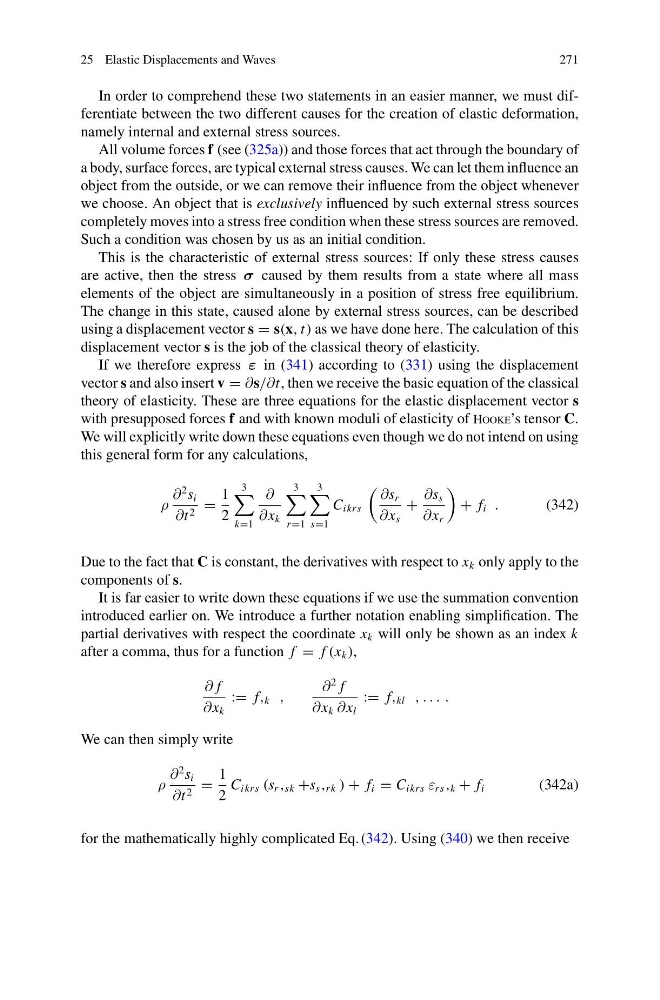
If we therefore express ε in (341) according to (331) using the displacement
vector s and also insert v = ∂s/∂t, then we receive the basic equation of the classical
theory of elasticity. These are three equations for the elastic displacement vector s
with presupposed forces f and with known moduli of elasticity of Hooke’s tensor C.
We will explicitly write down these equations even though we do not intend on using
this general form for any calculations,
ρ
∂
2 s i
∂t 2 =
1
2
3
k=1
∂
∂x k
3
r =1
3
s=1
C ikrs
∂s r
∂x s
+
∂s s
∂x r
+ f i .
(342)
Due to the fact that C is constant, the derivatives with respect to x k only apply to the
components of s.
It is far easier to write down these equations if we use the summation convention
introduced earlier on. We introduce a further notation enabling simplification. The
partial derivatives with respect the coordinate x k will only be shown as an index k
after a comma, thus for a function f = f (x k ),
∂ f
∂x k
:= f, k ,
∂
2 f
∂x k ∂x l
:= f, kl , . . . .
We can then simply write
ρ
∂
2 s i
∂t 2 =
1
2
C ikrs (s r , sk +s s , rk ) + f i = C ikrs ε rs , k + f i
(342a)
for the mathematically highly complicated Eq. (342). Using (340) we then receive
271
In order to comprehend these two statements in an easier manner, we must differentiate between the two different causes for the creation of elastic deformation,
namely internal and external stress sources.
All volume forces f (see (325a)) and those forces that act through the boundary of
a body, surface forces, are typical external stress causes. We can let them influence an
object from the outside, or we can remove their influence from the object whenever
we choose. An object that is exclusively influenced by such external stress sources
completely moves into a stress free condition when these stress sources are removed.
Such a condition was chosen by us as an initial condition.
This is the characteristic of external stress sources: If only these stress causes
are active, then the stress σ caused by them results from a state where all mass
elements of the object are simultaneously in a position of stress free equilibrium.
The change in this state, caused alone by external stress sources, can be described
using a displacement vector s = s(x, t) as we have done here. The calculation of this
displacement vector s is the job of the classical theory of elasticity.
If we therefore express ε in (341) according to (331) using the displacement
vector s and also insert v = ∂s/∂t, then we receive the basic equation of the classical
theory of elasticity. These are three equations for the elastic displacement vector s
with presupposed forces f and with known moduli of elasticity of Hooke’s tensor C.
We will explicitly write down these equations even though we do not intend on using
this general form for any calculations,
ρ
∂
2 s i
∂t 2 =
1
2
3
k=1
∂
∂x k
3
r =1
3
s=1
C ikrs
∂s r
∂x s
+
∂s s
∂x r
+ f i .
(342)
Due to the fact that C is constant, the derivatives with respect to x k only apply to the
components of s.
It is far easier to write down these equations if we use the summation convention
introduced earlier on. We introduce a further notation enabling simplification. The
partial derivatives with respect the coordinate x k will only be shown as an index k
after a comma, thus for a function f = f (x k ),
∂ f
∂x k
:= f, k ,
∂
2 f
∂x k ∂x l
:= f, kl , . . . .
We can then simply write
ρ
∂
2 s i
∂t 2 =
1
2
C ikrs (s r , sk +s s , rk ) + f i = C ikrs ε rs , k + f i
(342a)
for the mathematically highly complicated Eq. (342). Using (340) we then receive