

270
25 Elastic Displacements and Waves
with σ 1 = σ 11 , σ 2 = σ 22 , σ 3 = σ 33 , σ 4 = σ 23 , σ 5 = σ 13 , σ 6 = σ 12 , likewise for ε I ,
hence, e.g., σ 1 = C 11 ε 1 + C 12 ε 2 + C 13 ε 3 + C 14 ε 4 + C 15 ε 5 + C 16 ε 6 . We will here
not use this notation.
Hooke’s tensor C, the tensor of the coefficients of elasticity, possesses some symmetry properties that reduce the maximum number of its independent components,
see also L. D. Landau [54] and E. M. Lifschitz. The following is always valid,
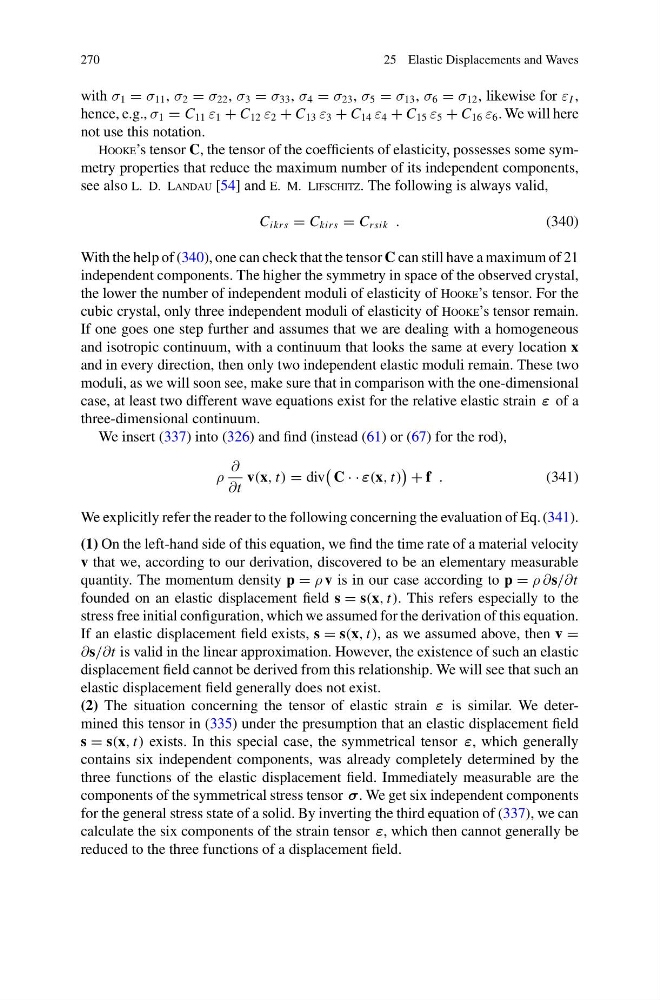
C ikrs = C kirs = C rsik .
(340)
With the help of (340), one can check that the tensor C can still have a maximum of 21
independent components. The higher the symmetry in space of the observed crystal,
the lower the number of independent moduli of elasticity of Hooke’s tensor. For the
cubic crystal, only three independent moduli of elasticity of Hooke’s tensor remain.
If one goes one step further and assumes that we are dealing with a homogeneous
and isotropic continuum, with a continuum that looks the same at every location x
and in every direction, then only two independent elastic moduli remain. These two
moduli, as we will soon see, make sure that in comparison with the one-dimensional
case, at least two different wave equations exist for the relative elastic strain ε of a
three-dimensional continuum.
We insert (337) into (326) and find (instead (61) or (67) for the rod),
ρ
∂
∂t
v(x, t) = div
C · · ε(x, t)
+ f .
(341)
We explicitly refer the reader to the following concerning the evaluation of Eq. (341).
(1) On the left-hand side of this equation, we find the time rate of a material velocity
v that we, according to our derivation, discovered to be an elementary measurable
quantity. The momentum density p = ρ v is in our case according to p = ρ ∂s/∂t
founded on an elastic displacement field s = s(x, t). This refers especially to the
stress free initial configuration, which we assumed for the derivation of this equation.
If an elastic displacement field exists, s = s(x, t), as we assumed above, then v =
∂s/∂t is valid in the linear approximation. However, the existence of such an elastic
displacement field cannot be derived from this relationship. We will see that such an
elastic displacement field generally does not exist.
(2) The situation concerning the tensor of elastic strain ε is similar. We determined this tensor in (335) under the presumption that an elastic displacement field
s = s(x, t) exists. In this special case, the symmetrical tensor ε, which generally
contains six independent components, was already completely determined by the
three functions of the elastic displacement field. Immediately measurable are the
components of the symmetrical stress tensor σ. We get six independent components
for the general stress state of a solid. By inverting the third equation of (337), we can
calculate the six components of the strain tensor ε, which then cannot generally be
reduced to the three functions of a displacement field.
25 Elastic Displacements and Waves
with σ 1 = σ 11 , σ 2 = σ 22 , σ 3 = σ 33 , σ 4 = σ 23 , σ 5 = σ 13 , σ 6 = σ 12 , likewise for ε I ,
hence, e.g., σ 1 = C 11 ε 1 + C 12 ε 2 + C 13 ε 3 + C 14 ε 4 + C 15 ε 5 + C 16 ε 6 . We will here
not use this notation.
Hooke’s tensor C, the tensor of the coefficients of elasticity, possesses some symmetry properties that reduce the maximum number of its independent components,
see also L. D. Landau [54] and E. M. Lifschitz. The following is always valid,
C ikrs = C kirs = C rsik .
(340)
With the help of (340), one can check that the tensor C can still have a maximum of 21
independent components. The higher the symmetry in space of the observed crystal,
the lower the number of independent moduli of elasticity of Hooke’s tensor. For the
cubic crystal, only three independent moduli of elasticity of Hooke’s tensor remain.
If one goes one step further and assumes that we are dealing with a homogeneous
and isotropic continuum, with a continuum that looks the same at every location x
and in every direction, then only two independent elastic moduli remain. These two
moduli, as we will soon see, make sure that in comparison with the one-dimensional
case, at least two different wave equations exist for the relative elastic strain ε of a
three-dimensional continuum.
We insert (337) into (326) and find (instead (61) or (67) for the rod),
ρ
∂
∂t
v(x, t) = div
C · · ε(x, t)
+ f .
(341)
We explicitly refer the reader to the following concerning the evaluation of Eq. (341).
(1) On the left-hand side of this equation, we find the time rate of a material velocity
v that we, according to our derivation, discovered to be an elementary measurable
quantity. The momentum density p = ρ v is in our case according to p = ρ ∂s/∂t
founded on an elastic displacement field s = s(x, t). This refers especially to the
stress free initial configuration, which we assumed for the derivation of this equation.
If an elastic displacement field exists, s = s(x, t), as we assumed above, then v =
∂s/∂t is valid in the linear approximation. However, the existence of such an elastic
displacement field cannot be derived from this relationship. We will see that such an
elastic displacement field generally does not exist.
(2) The situation concerning the tensor of elastic strain ε is similar. We determined this tensor in (335) under the presumption that an elastic displacement field
s = s(x, t) exists. In this special case, the symmetrical tensor ε, which generally
contains six independent components, was already completely determined by the
three functions of the elastic displacement field. Immediately measurable are the
components of the symmetrical stress tensor σ. We get six independent components
for the general stress state of a solid. By inverting the third equation of (337), we can
calculate the six components of the strain tensor ε, which then cannot generally be
reduced to the three functions of a displacement field.