

24 The Michelson Experiment
257
according to
t 1 =
l 1
c L − v
+
l 1
c L + v
=
l 1
c L
1
1 − v/c L
+
1
1 + v/c L
,
t 1 =
2l 1
c L
1
1 − v 2 /c
2
L
.
(305)
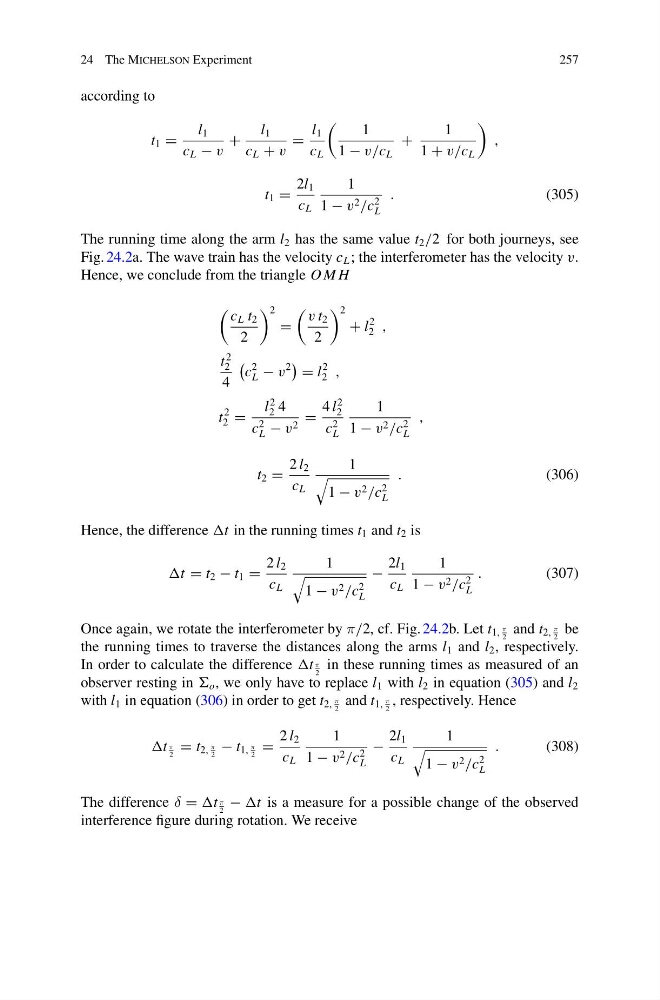
The running time along the arm l 2 has the same value t 2 /2 for both journeys, see
Fig. 24.2a. The wave train has the velocity c L ; the interferometer has the velocity v.
Hence, we conclude from the triangle O M H
c L t 2
2
2
=
v t 2
2
2
+ l
2
2 ,
t
2
2
4
c
2
L − v
2
= l
2
2 ,
t
2
2 =
l
2
2 4
c
2
L − v 2 =
4 l
2
2
c
2
L
1
1 − v 2 /c
2
L
,
t 2 =
2 l 2
c L
1
1 − v 2 /c
2
L
.
(306)
Hence, the difference t in the running times t 1 and t 2 is
t = t 2 − t 1 =
2 l 2
c L
1
1 − v 2 /c
2
L
−
2l 1
c L
1
1 − v 2 /c
2
L
.
(307)
Once again, we rotate the interferometer by π/2, cf. Fig. 24.2b. Let t 1,
π
2
and t 2,
π
2
be
the running times to traverse the distances along the arms l 1 and l 2 , respectively.
In order to calculate the difference t π
2
in these running times as measured of an
observer resting in o , we only have to replace l 1 with l 2 in equation (305) and l 2
with l 1 in equation (306) in order to get t 2,
π
2
and t 1,
π
2
, respectively. Hence
t π
2
= t 2,
π
2
− t 1,
π
2
=
2 l 2
c L
1
1 − v 2 /c
2
L
−
2l 1
c L
1
1 − v 2 /c
2
L
.
(308)
The difference δ = t π
2
− t is a measure for a possible change of the observed
interference figure during rotation. We receive
257
according to
t 1 =
l 1
c L − v
+
l 1
c L + v
=
l 1
c L
1
1 − v/c L
+
1
1 + v/c L
,
t 1 =
2l 1
c L
1
1 − v 2 /c
2
L
.
(305)
The running time along the arm l 2 has the same value t 2 /2 for both journeys, see
Fig. 24.2a. The wave train has the velocity c L ; the interferometer has the velocity v.
Hence, we conclude from the triangle O M H
c L t 2
2
2
=
v t 2
2
2
+ l
2
2 ,
t
2
2
4
c
2
L − v
2
= l
2
2 ,
t
2
2 =
l
2
2 4
c
2
L − v 2 =
4 l
2
2
c
2
L
1
1 − v 2 /c
2
L
,
t 2 =
2 l 2
c L
1
1 − v 2 /c
2
L
.
(306)
Hence, the difference t in the running times t 1 and t 2 is
t = t 2 − t 1 =
2 l 2
c L
1
1 − v 2 /c
2
L
−
2l 1
c L
1
1 − v 2 /c
2
L
.
(307)
Once again, we rotate the interferometer by π/2, cf. Fig. 24.2b. Let t 1,
π
2
and t 2,
π
2
be
the running times to traverse the distances along the arms l 1 and l 2 , respectively.
In order to calculate the difference t π
2
in these running times as measured of an
observer resting in o , we only have to replace l 1 with l 2 in equation (305) and l 2
with l 1 in equation (306) in order to get t 2,
π
2
and t 1,
π
2
, respectively. Hence
t π
2
= t 2,
π
2
− t 1,
π
2
=
2 l 2
c L
1
1 − v 2 /c
2
L
−
2l 1
c L
1
1 − v 2 /c
2
L
.
(308)
The difference δ = t π
2
− t is a measure for a possible change of the observed
interference figure during rotation. We receive