

258
24 The Michelson Experiment
δ = t π
2
− t =
=
2 l 2
c L
1
1 − v 2 /c
2
L
−
2l 1
c L
1
1 − v 2 /c
2
L
−
2 l 2
c L
1
1 − v 2 /c
2
L
−
2l 1
c L
1
1 − v 2 /c
2
L
=
2 l 2
c L
1
1 − v 2 /c
2
L
−
1
1 − v 2 /c
2
L
+
2 l 1
c L
1
1 − v 2 /c
2
L
−
1
1 − v 2 /c
2
L
,
hence
δ =
2 l 1
c L
+
2 l 2
c L
1
1 − v 2 /c
2
L
−
1
1 − v 2 /c
2
L
.
Moving
interferometer
(309)
With the Taylor series expansions 1/(1−x
2
) ≈ 1 + x
2 and 1/
√
1−x 2 ≈ 1 +
(1/2)x
2 we get with x = v/c L
δ =
2
c L
(l 1 + l 2 )
1 +
v
2
c
2
L
− 1 −
1
2
v
2
c
2
L
=
2
c L
(l 1 + l 2 )
1
2
v
2
c
2
L
,
hence
δ =
l 1 + l 2
c L
v
2
c
2
L
.
(310)
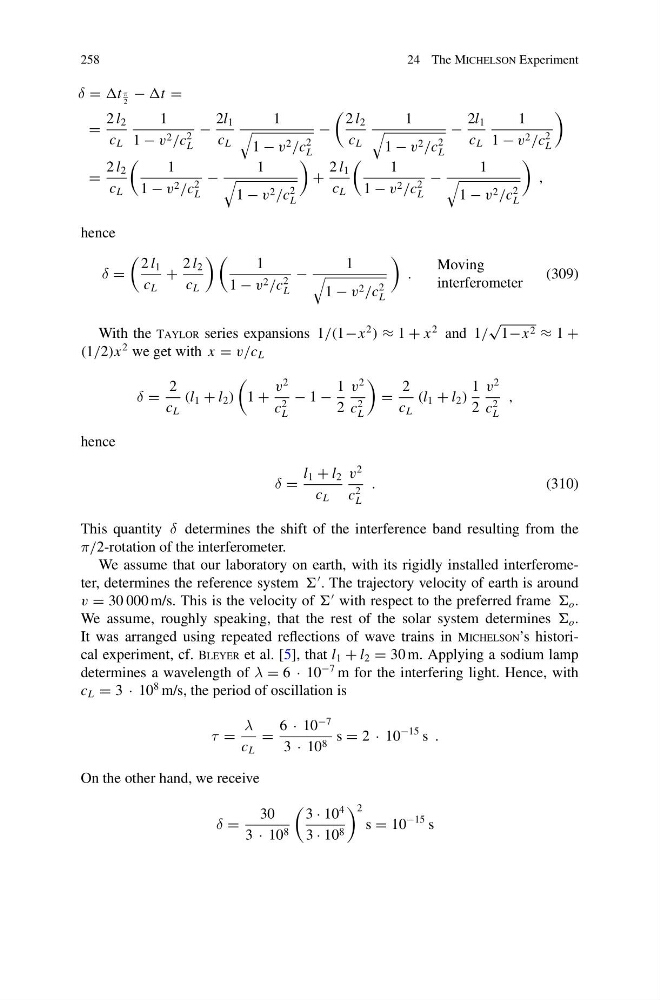
This quantity δ determines the shift of the interference band resulting from the
π/2-rotation of the interferometer.
We assume that our laboratory on earth, with its rigidly installed interferometer, determines the reference system
. The trajectory velocity of earth is around
v = 30 000 m/s. This is the velocity of
with respect to the preferred frame o .
We assume, roughly speaking, that the rest of the solar system determines o .
It was arranged using repeated reflections of wave trains in Michelson’s historical experiment, cf. Bleyer et al. [5], that l 1 + l 2 = 30 m. Applying a sodium lamp
determines a wavelength of λ = 6 · 10
−7 m for the interfering light. Hence, with
c L = 3 · 10
8 m/s, the period of oscillation is
τ =
λ
c L
=
6 · 10
−7
3 · 10 8 s = 2 · 10
−15 s .
On the other hand, we receive
δ =
30
3 · 10 8
3 · 10
4
3 · 10 8
2
s = 10
−15 s
24 The Michelson Experiment
δ = t π
2
− t =
=
2 l 2
c L
1
1 − v 2 /c
2
L
−
2l 1
c L
1
1 − v 2 /c
2
L
−
2 l 2
c L
1
1 − v 2 /c
2
L
−
2l 1
c L
1
1 − v 2 /c
2
L
=
2 l 2
c L
1
1 − v 2 /c
2
L
−
1
1 − v 2 /c
2
L
+
2 l 1
c L
1
1 − v 2 /c
2
L
−
1
1 − v 2 /c
2
L
,
hence
δ =
2 l 1
c L
+
2 l 2
c L
1
1 − v 2 /c
2
L
−
1
1 − v 2 /c
2
L
.
Moving
interferometer
(309)
With the Taylor series expansions 1/(1−x
2
) ≈ 1 + x
2 and 1/
√
1−x 2 ≈ 1 +
(1/2)x
2 we get with x = v/c L
δ =
2
c L
(l 1 + l 2 )
1 +
v
2
c
2
L
− 1 −
1
2
v
2
c
2
L
=
2
c L
(l 1 + l 2 )
1
2
v
2
c
2
L
,
hence
δ =
l 1 + l 2
c L
v
2
c
2
L
.
(310)
This quantity δ determines the shift of the interference band resulting from the
π/2-rotation of the interferometer.
We assume that our laboratory on earth, with its rigidly installed interferometer, determines the reference system
. The trajectory velocity of earth is around
v = 30 000 m/s. This is the velocity of
with respect to the preferred frame o .
We assume, roughly speaking, that the rest of the solar system determines o .
It was arranged using repeated reflections of wave trains in Michelson’s historical experiment, cf. Bleyer et al. [5], that l 1 + l 2 = 30 m. Applying a sodium lamp
determines a wavelength of λ = 6 · 10
−7 m for the interfering light. Hence, with
c L = 3 · 10
8 m/s, the period of oscillation is
τ =
λ
c L
=
6 · 10
−7
3 · 10 8 s = 2 · 10
−15 s .
On the other hand, we receive
δ =
30
3 · 10 8
3 · 10
4
3 · 10 8
2
s = 10
−15 s