

23 A Particle Solution—The Inertia of Energy
251
m =
m o
1 − v 2 /c 2
o
,
m o = f m a , f =
2
π
a
L o
, m a =
aσ
c 2
o
.
⎫
⎪ ⎪ ⎪ ⎬
⎪ ⎪ ⎪ ⎭
(296)
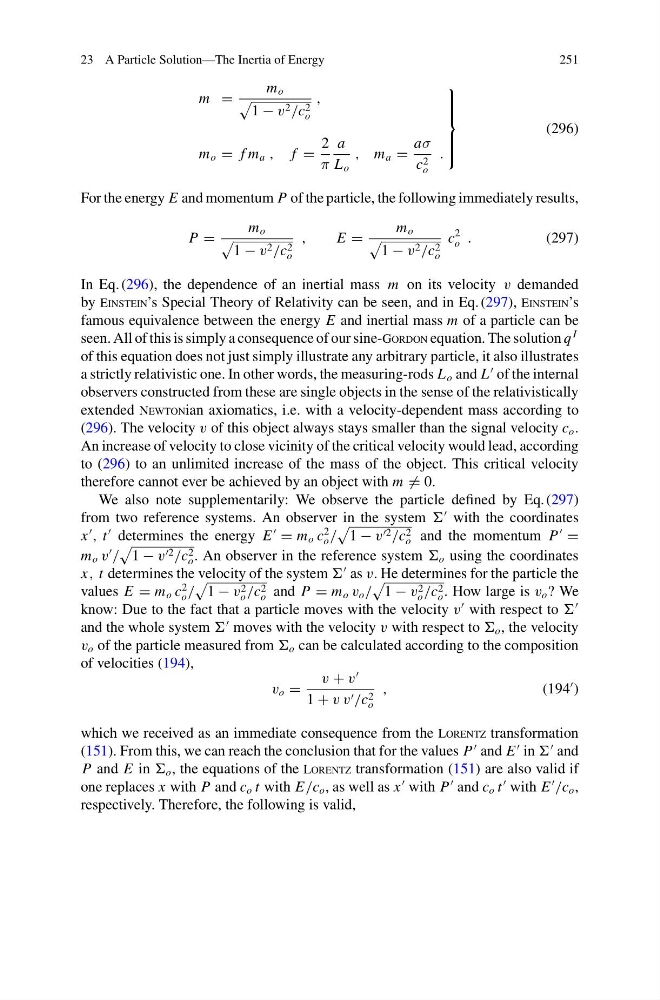
For the energy E and momentum P of the particle, the following immediately results,
P =
m o
1 − v 2 /c 2
o
,
E =
m o
1 − v 2 /c 2
o
c
2
o .
(297)
In Eq. (296), the dependence of an inertial mass m on its velocity v demanded
by Einstein’s Special Theory of Relativity can be seen, and in Eq. (297), Einstein’s
famous equivalence between the energy E and inertial mass m of a particle can be
seen. All of this is simply a consequence of our sine-Gordon equation. The solution q
I
of this equation does not just simply illustrate any arbitrary particle, it also illustrates
a strictly relativistic one. In other words, the measuring-rods L o and L
of the internal
observers constructed from these are single objects in the sense of the relativistically
extended Newtonian axiomatics, i.e. with a velocity-dependent mass according to
(296). The velocity v of this object always stays smaller than the signal velocity c o .
An increase of velocity to close vicinity of the critical velocity would lead, according
to (296) to an unlimited increase of the mass of the object. This critical velocity
therefore cannot ever be achieved by an object with m = 0.
We also note supplementarily: We observe the particle defined by Eq. (297)
from two reference systems. An observer in the system
with the coordinates
x
, t
determines the energy E
= m o c
2
o /
1 − v 2 /c 2
o and the momentum P
=
m o v
/
1 − v 2 /c 2
o . An observer in the reference system o using the coordinates
x, t determines the velocity of the system
as v. He determines for the particle the
values E = m o c
2
o /
1 − v 2
o /c 2
o and P = m o v o /
1 − v 2
o /c 2
o . How large is v o ? We
know: Due to the fact that a particle moves with the velocity v
with respect to
and the whole system
moves with the velocity v with respect to o , the velocity
v o of the particle measured from o can be calculated according to the composition
of velocities (194),
v o =
v + v
1 + v v /c 2
o
,
(194
)
which we received as an immediate consequence from the Lorentz transformation
(151). From this, we can reach the conclusion that for the values P
and E
in
and
P and E in o , the equations of the Lorentz transformation (151) are also valid if
one replaces x with P and c o t with E/c o , as well as x
with P
and c o t
with E
/c o ,
respectively. Therefore, the following is valid,
251
m =
m o
1 − v 2 /c 2
o
,
m o = f m a , f =
2
π
a
L o
, m a =
aσ
c 2
o
.
⎫
⎪ ⎪ ⎪ ⎬
⎪ ⎪ ⎪ ⎭
(296)
For the energy E and momentum P of the particle, the following immediately results,
P =
m o
1 − v 2 /c 2
o
,
E =
m o
1 − v 2 /c 2
o
c
2
o .
(297)
In Eq. (296), the dependence of an inertial mass m on its velocity v demanded
by Einstein’s Special Theory of Relativity can be seen, and in Eq. (297), Einstein’s
famous equivalence between the energy E and inertial mass m of a particle can be
seen. All of this is simply a consequence of our sine-Gordon equation. The solution q
I
of this equation does not just simply illustrate any arbitrary particle, it also illustrates
a strictly relativistic one. In other words, the measuring-rods L o and L
of the internal
observers constructed from these are single objects in the sense of the relativistically
extended Newtonian axiomatics, i.e. with a velocity-dependent mass according to
(296). The velocity v of this object always stays smaller than the signal velocity c o .
An increase of velocity to close vicinity of the critical velocity would lead, according
to (296) to an unlimited increase of the mass of the object. This critical velocity
therefore cannot ever be achieved by an object with m = 0.
We also note supplementarily: We observe the particle defined by Eq. (297)
from two reference systems. An observer in the system
with the coordinates
x
, t
determines the energy E
= m o c
2
o /
1 − v 2 /c 2
o and the momentum P
=
m o v
/
1 − v 2 /c 2
o . An observer in the reference system o using the coordinates
x, t determines the velocity of the system
as v. He determines for the particle the
values E = m o c
2
o /
1 − v 2
o /c 2
o and P = m o v o /
1 − v 2
o /c 2
o . How large is v o ? We
know: Due to the fact that a particle moves with the velocity v
with respect to
and the whole system
moves with the velocity v with respect to o , the velocity
v o of the particle measured from o can be calculated according to the composition
of velocities (194),
v o =
v + v
1 + v v /c 2
o
,
(194
)
which we received as an immediate consequence from the Lorentz transformation
(151). From this, we can reach the conclusion that for the values P
and E
in
and
P and E in o , the equations of the Lorentz transformation (151) are also valid if
one replaces x with P and c o t with E/c o , as well as x
with P
and c o t
with E
/c o ,
respectively. Therefore, the following is valid,