

250
23 A Particle Solution—The Inertia of Energy
and thus once again with the function ρ = ρ(x − v t) according to (292)
− e = −c
2
o ρ .
(293c)
From (293)–(293c), we can determine the energy–momentum tensor T
I of the sineGordon field q
I with ρ = ρ(x − v t) according to (254), in other words of the field
defined by our natural measuring-rods L o and L
, respectively,
T
I
=
v
2
ρ
vρ
−v c
2
o ρ −c
2
o ρ
.
Energy-momentum tensor
of the field q
I
(x, t)
(294)
We register: The tensor T
I is the energy–momentum tensor of a particle according to
(279). In order to prepare the discussion of this remarkable result, we firstly calculate
the inertial mass m a that a dislocation portion possesses along the length a of a lattice
parameter. m a is therefore the inertial mass m α on the length a in Eq. (79).
According to the second Eq. (88) where we use σ for the modulus of elasticity,
c o =
√ σ/ρ o and
corresponding to our expression (284b) for the kinetic energy
density T =
ρ o
2
(
∂q
∂t
)
2
the formula ρ o = σ/c
2
o applies for the mass density ρ o of the
dislocation and therefore after multiplication with the lattice parameter a,
m a =
a σ
c 2
o
(295)
is valid for the mass m a on the length a.
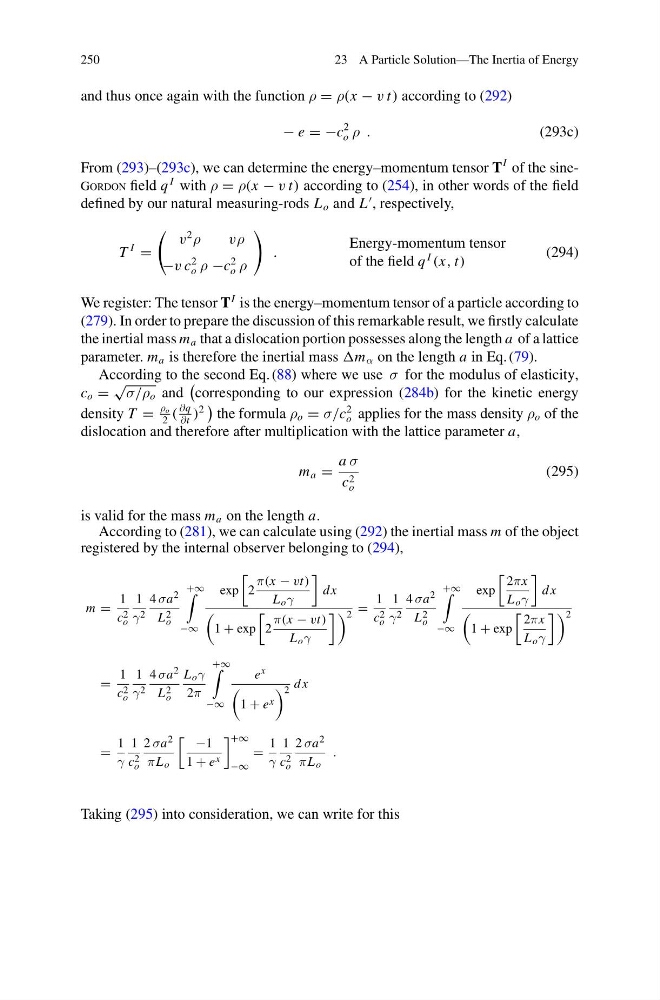
According to (281), we can calculate using (292) the inertial mass m of the object
registered by the internal observer belonging to (294),
m =
1
c 2
o
1
γ 2
4 σa 2
L 2
o
+∞
−∞
exp
2
π(x − vt)
L o γ
dx
1 + exp
2
π(x − vt)
L o γ
2 =
1
c 2
o
1
γ 2
4 σa 2
L 2
o
+∞
−∞
exp
2πx
L o γ
dx
1 + exp
2πx
L o γ
2
=
1
c 2
o
1
γ 2
4 σa 2
L 2
o
L o γ
2π
+∞
−∞
e x
1 + e x
2 dx
=
1
γ
1
c 2
o
2 σa 2
πL o
−1
1 + e x
+∞
−∞
=
1
γ
1
c 2
o
2 σa 2
πL o
.
Taking (295) into consideration, we can write for this
23 A Particle Solution—The Inertia of Energy
and thus once again with the function ρ = ρ(x − v t) according to (292)
− e = −c
2
o ρ .
(293c)
From (293)–(293c), we can determine the energy–momentum tensor T
I of the sineGordon field q
I with ρ = ρ(x − v t) according to (254), in other words of the field
defined by our natural measuring-rods L o and L
, respectively,
T
I
=
v
2
ρ
vρ
−v c
2
o ρ −c
2
o ρ
.
Energy-momentum tensor
of the field q
I
(x, t)
(294)
We register: The tensor T
I is the energy–momentum tensor of a particle according to
(279). In order to prepare the discussion of this remarkable result, we firstly calculate
the inertial mass m a that a dislocation portion possesses along the length a of a lattice
parameter. m a is therefore the inertial mass m α on the length a in Eq. (79).
According to the second Eq. (88) where we use σ for the modulus of elasticity,
c o =
√ σ/ρ o and
corresponding to our expression (284b) for the kinetic energy
density T =
ρ o
2
(
∂q
∂t
)
2
the formula ρ o = σ/c
2
o applies for the mass density ρ o of the
dislocation and therefore after multiplication with the lattice parameter a,
m a =
a σ
c 2
o
(295)
is valid for the mass m a on the length a.
According to (281), we can calculate using (292) the inertial mass m of the object
registered by the internal observer belonging to (294),
m =
1
c 2
o
1
γ 2
4 σa 2
L 2
o
+∞
−∞
exp
2
π(x − vt)
L o γ
dx
1 + exp
2
π(x − vt)
L o γ
2 =
1
c 2
o
1
γ 2
4 σa 2
L 2
o
+∞
−∞
exp
2πx
L o γ
dx
1 + exp
2πx
L o γ
2
=
1
c 2
o
1
γ 2
4 σa 2
L 2
o
L o γ
2π
+∞
−∞
e x
1 + e x
2 dx
=
1
γ
1
c 2
o
2 σa 2
πL o
−1
1 + e x
+∞
−∞
=
1
γ
1
c 2
o
2 σa 2
πL o
.
Taking (295) into consideration, we can write for this